There are many types of professions but trading Hits different let’s explore How is trading better than other professions.
Welcome to JD Trading Zone.
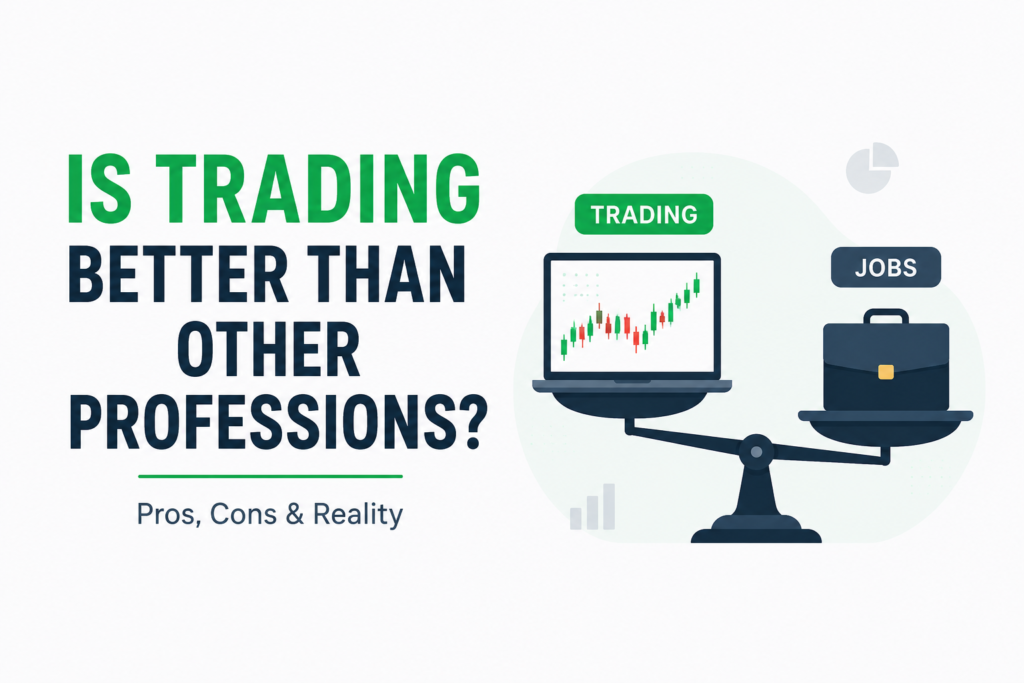
Is Trading Better Than Other careers?
Many people dream of becoming a full-time trader because they see stories of financial freedom, flexible working hours, and the possibility of earning unlimited income. At the same time, traditional professions such as engineering, teaching, medicine, software development, or government jobs provide stability and predictable earnings.
So, is trading really better than other professions?
The answer is not the same for everyone. Trading can be an excellent career for the right person, but it is not a shortcut to becoming rich. Success requires education, discipline, patience, and proper risk management.
Also check:- (Why Do Most Traders Lose Money?) (The Secret to Consistency in Trading) (Can Trading Really Change Your Life?) (7 Habits That Help Traders Reach the Top 2%) (How to Recover Share Market Losses)
What Is Trading?
Trading is the process of buying and selling financial assets such as stocks, ETFs, futures, commodities, or currencies with the goal of making a profit from price movements.
Unlike salaried jobs, traders earn money only when their trades are profitable. There is no fixed monthly income or guaranteed paycheck.
How Trading Is Different from Traditional Professions
How Trading Is Different from Traditional Professions
Traditional careers usually involve:
• Fixed working hours
• Monthly salary
• Employee benefits
• Promotions based on experience
• Job security (depending on the industry)
Trading works differently:
• No fixed salary
• Flexible working hours
• Performance-based income
• Complete financial responsibility
• Continuous learning and adaptation
This difference makes trading attractive to some people while making it unsuitable for others.
→ Advantages of Trading Compared to Other Professions
1. Freedom of Time
One of the biggest attractions of trading is flexibility.
Many traders only spend a few hours each day analyzing charts and placing trades. This leaves additional time for learning, family, business, or hobbies.
However, beginners often spend more time studying and practicing before becoming consistently profitable.
2. Unlimited Income Potential
In most jobs, salary increases gradually through promotions or experience.
Trading has no income ceiling. As your knowledge, capital, and consistency improve, your potential profits may also grow.
Keep in mind that higher returns usually come with higher risks.
3. You Are Your Own Boss
Professional traders don’t need a manager or supervisor.
They make their own decisions, create their own strategies, and manage their own schedules.
This independence is one of the biggest reasons many people choose trading.
4. Work from Almost Anywhere
Modern trading platforms allow traders to work from home or while traveling, provided they have:
• A reliable internet connection
• A computer or smartphone
• A trusted broker
• A disciplined trading plan
5. Continuous Personal Growth
Trading teaches valuable life skills such as:
• Patience
• Discipline
• Emotional control
• Decision-making
• Risk management
• Self-analysis
These skills are useful in many other areas of life as well.
6. Low Business Setup Cost
Compared to starting many businesses, trading usually requires relatively little equipment.
Most beginners only need:
• A computer or smartphone
• Internet connection
• Trading account
• Learning resources
Remember that your trading capital should be money you can afford to risk.
→ Where Traditional Professions Are Better
Trading also has several disadvantages that many people overlook.
1. No Guaranteed Income
Employees receive salaries every month.
Traders may experience losing months even after years of experience.
Income depends entirely on performance.
2. Emotional Pressure
Trading can be mentally demanding.
Fear, greed, overconfidence, and frustration often influence trading decisions.
Learning emotional discipline is just as important as learning technical analysis
3. Financial Risk
Every trade carries risk.
Without proper risk management, traders can lose a significant portion of their capital.
This is why beginners should focus on protecting capital rather than chasing quick profits.
4. Long Learning Curve
Many beginners expect fast success.
In reality, becoming consistently profitable often takes months or even years of practice, journaling, and continuous improvement.
5. No Employee Benefits
Unlike traditional jobs, traders generally do not receive:
• Paid leave
• Health insurance
• Retirement benefits
• Employer-sponsored pensions
• Annual bonuses
These responsibilities become your own.
Who Should Choose Trading?
Trading may be suitable for people who:
• Enjoy learning financial markets
• Can control emotions
• Accept calculated risks
• Are patient and disciplined
• Think logically instead of emotionally
• Are willing to improve continuously
Who Should Avoid Full-Time Trading?
Trading may not be the best choice for people who:
• Need guaranteed monthly income
• Expect quick wealth
• Cannot tolerate financial losses
• Trade based on emotions
• Ignore risk management
• Prefer stable career paths
Can You Combine Trading with a Job?
Yes.
Many successful traders begin while working full-time.
This approach offers several advantages:
• Stable monthly income
• Less financial pressure
• More time to learn
• Better emotional control
• Opportunity to gain experience before trading full-time
Many professionals trade part-time until they develop consistent profitability.
Common Misconceptions About Trading
→ Myth: Trading is easy money.
→ Reality: Consistent trading requires education, practice, discipline, and patience.
→ Myth: Professional traders never lose.
→ Reality: Every successful trader experiences losing trades. The difference is that they manage losses effectively.
→ Myth: Bigger investments guarantee bigger profits.
→ Reality: Without proper risk management, larger investments can also lead to larger losses.
Tips for Beginners
If you’re considering trading as a career:
• Learn market basics before risking real money.
• Practice with a demo account.
• Create a written trading plan.
• Never risk money you cannot afford to lose.
• Keep a trading journal.
• Focus on consistency instead of quick profits.
• Continue learning from books, courses, and market experience.
Frequently Asked Questions
Is trading better than a job?
→ Trading offers flexibility and income potential, while jobs provide stability and predictable earnings. Which is better depends on your goals, personality, and financial situation.
Can beginners become successful traders?
→ Yes. Beginners can become successful by learning gradually, practicing consistently, and following disciplined risk management.
Is trading suitable as a full-time career?
→ It can be, but only after achieving consistent profitability and building adequate financial reserves. Many traders start part-time before making it their primary profession.
Is trading risk-free?
→ No. All forms of trading involve risk. Proper education and risk management are essential.
Final takeaway
Trading can offer freedom, flexibility, and significant growth opportunities, but it also demands responsibility, discipline, and continuous learning. Unlike many traditional professions, there is no guaranteed paycheck, and success depends on skill rather than luck.
For beginners, the smartest approach is to treat trading as a skill to develop—not a quick path to wealth. Learn the basics, manage your risk carefully, and gain experience over time. Whether you eventually choose trading full-time or alongside another profession, building knowledge and consistency will always be more valuable than chasing fast profits.
Pingback: What Is VWAP in Share Market? - jdtradingzone.com
Reading this on a difficult day was a small bright spot, and a stop at trustedshoppingzone extended that brightness, content that improves a hard day is content that has earned a particular kind of place in my reading habits and this site is occupying that uplifting role for me today which I appreciate clearly.
A small thing but the line spacing and font choices made reading this physically pleasant, and a look at shopward maintained the same careful design, technical choices about typography are part of what makes online reading actually comfortable and this site has clearly invested in the design layer alongside the content layer carefully.
Most attempts at writing on this topic feel like they are missing something and this post finally identified what was missing, and a look at buildforwardsteps extended that diagnostic clarity, content that names what is wrong with adjacent treatments while doing better itself is content with both critical and constructive value and this site has both.
Appreciate the thoughtful approach, the writer clearly took time to make this readable for someone who is not already an expert, and a look at bondprimex kept that going nicely, easy on the eyes and easy on the brain which is always a winning combination when reading on a busy day.
Pingback: 10 Risk Management Rules Every Trader Must Know - jdtradingzone.com
Pingback: How to Use Pre-Market Data for Better Intraday Trades - jdtradingzone.com
Pingback: VWAP with RSI Strategy for More Accurate Trades - jdtradingzone