
Vwap with rsi strategy, not every strategy is 100% accurate but this strategy makes sense. If you use this strategy properly at least it will give good traders so let’s explore it.
Welcome to JD Trading Zone
Many beginner traders rely on a single indicator and wonder why their trades fail. The truth is that no indicator can predict the market with complete accuracy. However, combining two indicators that measure different aspects of price action can significantly improve your trading decisions.
One of the most effective combinations for intraday trading is VWAP (Volume Weighted Average Price) and RSI (Relative Strength Index).
VWAP helps traders identify the market’s fair value based on price and volume, while RSI measures momentum and indicates whether buying or selling pressure is becoming stronger.
Also check:- (10 Risk Management Rules Every Trader Must Know) (What Is VWAP in Share Market?) (How is trading better than other professions) (Why Is It So Difficult to Learn Trading?) (How Much Money Can You Earn with Trading?)
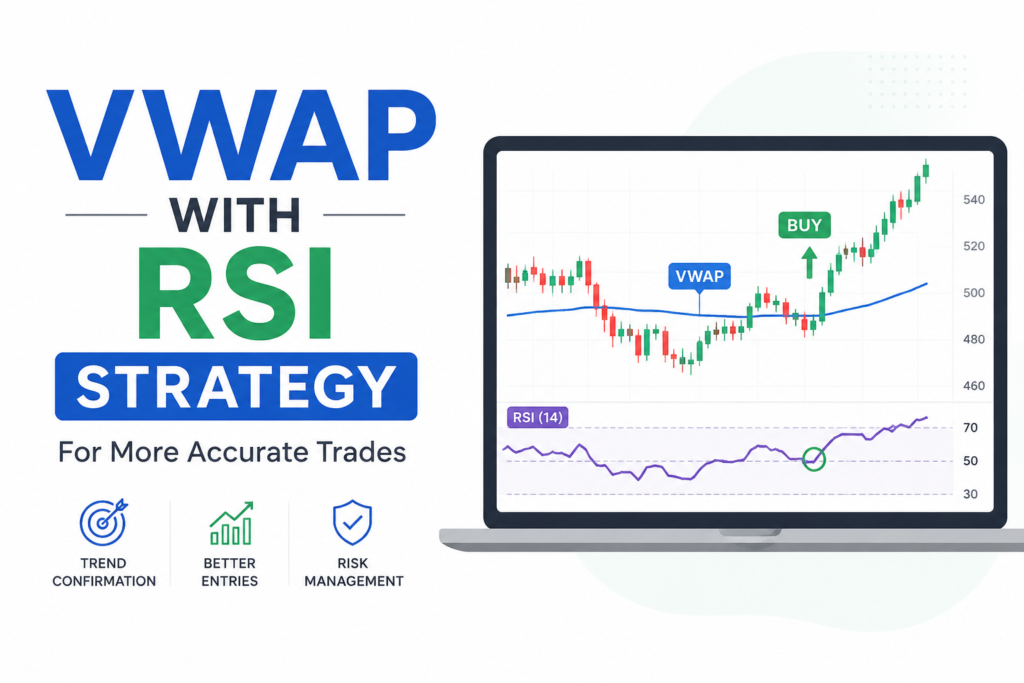
How to use the VWAP with RSI strategy
VWAP with RSI Strategy for More Accurate Trades
What Is VWAP?
VWAP stands for Volume Weighted Average Price.
Unlike a simple moving average, VWAP considers both price and trading volume. This makes it one of the most trusted indicators among professional intraday traders.
Why VWAP is Important
• Shows the average price based on volume
• Helps identify the current trend
• Acts as dynamic support and resistance
• Filters low-quality trades
• Widely used by institutional traders
Basic Rule
• Price above VWAP = Buyers are stronger.
• Price below VWAP = Sellers are stronger.
What Is RSI?
RSI stands for Relative Strength Index.
It is a momentum oscillator that moves between 0 and 100.
The default setting is 14 periods.
→ Standard RSI Levels
• Above 70 = Overbought
• Below 30 = Oversold
• Around 50 = Neutral momentum
Instead of blindly buying at RSI 30 or selling at RSI 70, professional traders use RSI to confirm the strength of the trend.
Why Combine VWAP with RSI?
VWAP with RSI Strategy for More Accurate Trades
Each indicator solves a different problem.
→ VWAP
• Shows trend direction
• Uses volume
• Filters bad trades
• Dynamic support/resistance
→ Rsi
• Shows momentum
• Measures buying/selling pressure
• Confirms entries
• Identifies momentum shifts
Together, they create higher-quality trade setups.
Best Time Frame for VWAP with RSI
This strategy works best for intraday trading.
Recommended timeframes:
• 5-Minute Chart
• 10-Minute Chart
• 15-Minute Chart
Beginners should start with the 5-minute chart because it provides a good balance between trading opportunities and reduced market noise.
Indicator Settings
VWAP
• Default settings
• No modifications required
RSI
• Period: 14
• Overbought: 70
• Oversold: 30
Many experienced traders also watch the 50 level because it often acts as a trend confirmation line.
Take a buy trade only when all conditions are satisfied.
→ Entry Rules
Step 1
→ Price should be trading above VWAP.
Step 2
→ RSI should move above 50.
Step 3
→ Wait for a bullish candle after a small pullback.
Step 4
→ Enter after the confirmation candle closes.
→ Stop Loss
Place your stop loss:
• Below the recent swing low
• Or slightly below VWAP
Never risk more than 1–2% of your trading capital on a single trade.
→ Target
You can use:
• 1:2 Risk-Reward Ratio
• Previous resistance
• Trail the stop loss as the trend continues
VWAP with RSI Sell Strategy
Take a sell trade only when these conditions match.
→ Entry Rules
• Price is below VWAP
• RSI falls below 50
• Bearish confirmation candle appears
• Enter after candle close
→ Stop Loss
Place stop loss:
• Above recent swing high
• Or above VWAP
→ Profit Target
Choose one of these methods:
• 1:2 Risk-Reward
• Previous support level
• Trailing stop
Example of a Buy Trade
Imagine a stock opens strong and stays above VWAP.
After a brief pullback:
• Price bounces from VWAP.
• RSI rises from 48 to 56.
• A bullish engulfing candle forms.
This combination provides stronger confirmation than relying on either VWAP or RSI alone.
Example of a Sell Trade
A stock opens weak and remains below VWAP.
During a pullback:
• Price fails to move above VWAP.
• RSI drops below 50.
• A bearish candle confirms selling pressure.
This setup offers a potential short-selling opportunity.
Risk Management Rules
Even the best strategy cannot win every trade.
Follow these rules:
• Risk only 1–2% per trade.
• Avoid revenge trading.
• Wait for confirmation.
• Never chase fast-moving candles.
• Trade only during liquid market hours.
• Maintain a trading journal.
• Stick to your trading plan.
Consistency matters more than trying to win every trade.
Common Mistakes Beginners Make
Trading Against VWAP
→ Buying below VWAP or selling above VWAP often leads to poor trades.
Ignoring RSI Confirmation
→ Entering before RSI confirms momentum increases false signals.
Trading During Sideways Markets
→ When price repeatedly crosses VWAP, avoid trading because there is no clear trend.
Overtrading
→ Not every candle offers a valid setup. Wait patiently for high-quality opportunities.
Ignoring Risk Management
→ A good strategy without proper risk management can still lead to significant losses.
Advantages of the VWAP with RSI Strategy
• Easy to learn
• Beginner-friendly
• Filters weak trades
• Combines trend and momentum
• Suitable for stocks, ETFs, and many liquid markets
• Works well on major indices like Nifty and Bank Nifty
Limitations
No strategy is perfect.
The VWAP with RSI strategy may produce false signals during:
• Low-volume sessions
• Highly volatile news events
• Sideways markets
• Gap-up or gap-down openings
Always use proper position sizing and stop losses.
Tips to Improve Accuracy
• Trade in the direction of the overall market trend.
• Avoid taking trades during major economic announcements.
• Wait for candle confirmation before entering.
• Focus on high-volume stocks.
• Aim for a minimum 1:2 risk-reward ratio.
• Review your trades regularly to identify patterns and improve discipline.
Frequently Asked Questions
Is VWAP with RSI good for beginners?
→ Yes. It is easy to understand and combines trend with momentum, making it a practical strategy for new traders.
Which RSI setting is best?
→ The default 14-period RSI works well for most intraday traders.
Can I use this strategy in options trading?
→ Yes. Many traders use it for index options, but remember that options involve additional factors such as time decay and implied volatility. Practice on a demo account before trading with real money.
Does this strategy guarantee profits?
→ No. No trading strategy guarantees profits. Success depends on disciplined execution, proper risk management, and continuous learning.
Final takeaway
The VWAP with RSI strategy is a simple yet effective approach for improving trade quality. VWAP helps you identify the market’s primary direction, while RSI confirms whether momentum supports that direction. When used together with patience and sound risk management, they can help you avoid many low-probability trades.
Remember that successful trading is built on consistency, not certainty. Test this strategy on historical charts or in a paper trading account before using real money. Over time, disciplined practice and careful trade review can help you build confidence and improve your decision-making.
→ Disclaimer: This article is for educational purposes only and should not be considered financial or investment advice. Trading in financial markets involves risk, and you should conduct your own research or consult a qualified financial advisor before making investment decisions.
Pingback: How to Use Pre-Market Data for Better Intraday Trades - jdtradingzone.com