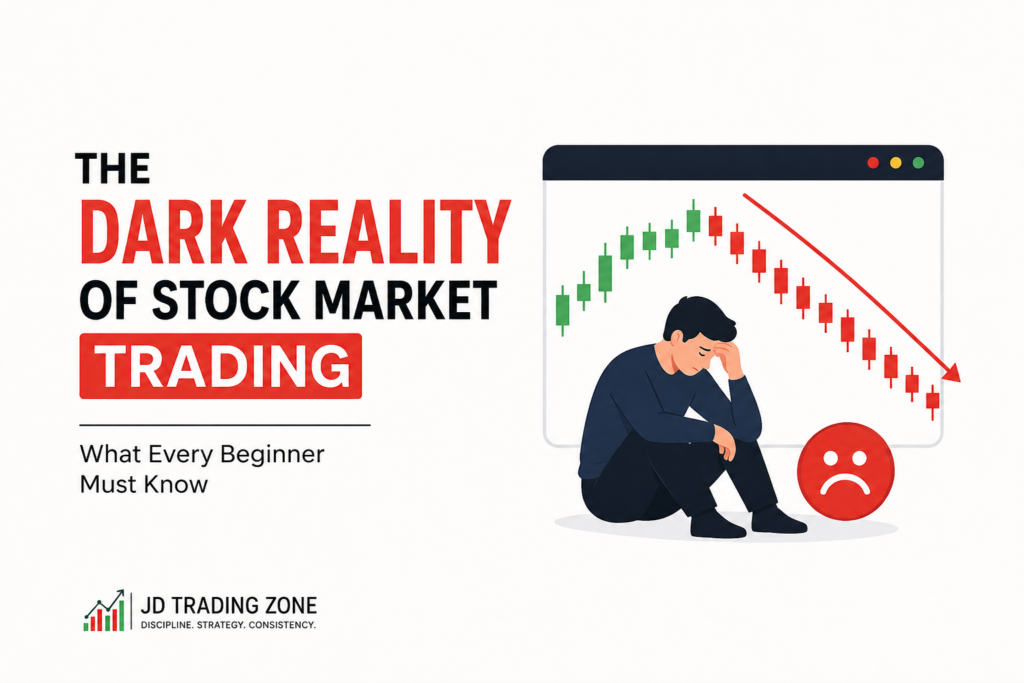
This guide explains the dark reality of stock market trading ,so that beginners can start with realistic expectations instead of false promises.
Many people enter the stock market after watching social media videos showing traders making thousands of rupees within minutes. Luxury cars, expensive lifestyles, and screenshots of huge profits create the impression that trading is an easy way to become rich.
The truth is very different.
Stock market trading can create wealth, but it can also destroy savings if you don’t understand the risks. Thousands of beginners lose money every year because they focus only on profits and ignore the realities of trading.
Also check:- (How to become profitable in 365 trades.) (Can Trading Really Change Your Life?) (How to recover share market losses?) (Daily routine of successful traders|JD Trading Zone) (Can you really earn money from trading)
Why Does Trading Look So Easy?
Why Does Trading Look So Easy?
Social media usually highlights success stories while hiding failures.
You often see:
• Massive profit screenshots
• Winning trades only
• Luxury lifestyle content
• “Secret strategy” advertisements
• Claims of 90% or 95% accuracy
What you rarely see:
• Losing trades
• Months of poor performance
• Emotional stress
• Capital losses
• Years spent learning
This creates unrealistic expectations for new traders.
The Biggest Reality: Most Beginners Lose Money
The stock market rewards discipline—not excitement.
Many beginners lose money because they:
• Trade without learning
• Risk too much capital
• Follow random tips
• Copy influencers
• Ignore risk management
• Expect quick profits
Successful trading is a skill developed over years, not days.
Trading Is a Business, Not a Lottery
Professional traders think differently.
→ Instead of asking:
“How much money can I make today?”
→ They ask:
“How much can I afford to lose if this trade fails?”
This mindset helps them survive during difficult market conditions.
Emotional Trading Is the Biggest Enemy
Most losses are caused by emotions rather than strategy.
Common emotional mistakes include:
→ Fear
• Exiting winning trades too early
• Avoiding good setups
→ Greed
• Holding trades for unrealistic targets
• Taking oversized positions
→Revenge Trading
• After a loss, many traders immediately open another trade hoping to recover quickly.
This often leads to even larger losses.
The Hidden Cost of Overtrading
Many beginners believe more trades mean more profits.
In reality:
• More trades increase brokerage costs.
• More trades increase emotional pressure.
• More trades often reduce trading quality.
Professional traders sometimes take only one or two high-quality trades in an entire day.
→ Quality always beats quantity.
There Is No Perfect Trading Strategy
Many people spend months searching for the “holy grail” strategy.
The reality is:
→ Every trading strategy experiences losing trades.
→ Even strategies with a high success rate can go through losing streaks.
→ Successful traders don’t avoid losses—they manage them effectively.
Risk Management Matters More Than Accuracy
A trader with a 45% win rate can still be consistently profitable.
How?
→ Because profits on winning trades are larger than losses on losing trades.
For example:
• Average loss: ₹500
• Average profit: ₹1,500
Even with fewer winning trades, the trader can remain profitable over time.
The Market Doesn’t Care About Your Opinion
→ Many beginners become emotionally attached to their predictions.
→ The market moves according to supply and demand—not personal opinions.
→ Successful traders accept being wrong quickly and exit losing positions without hesitation.
Trading Can Affect Mental Health
Few people talk about this.
Trading can create:
• Stress
• Anxiety
• Sleep problems
• Fear of missing out (FOMO)
• Loss of confidence
If trading starts affecting your daily life, it’s important to reduce position sizes or take a break and review your trading process.
Borrowing Money for Trading Is Dangerous
One of the biggest mistakes beginners make is trading with:
• Personal loans
• Credit cards
• Borrowed money
• Emergency savings
The stock market offers no guarantee of profit.
Only trade with money you can afford to lose without affecting your essential expenses.
Social Media Is Not Always Reality
Many influencers earn more from:
• Selling courses
• Affiliate marketing
• Paid communities
• Sponsorships
than from actual trading.
This doesn’t mean all educators are dishonest, but always verify claims and avoid trusting screenshots alone.
Focus on learning, not on promises of guaranteed income.
The Truth About Becoming Profitable
Consistency comes from following a structured process.
Successful traders usually:
• Learn price action and market structure.
• Practice before risking significant money.
• Use stop-loss orders.
• Maintain a trading journal.
• Review mistakes regularly.
• Protect capital above everything else.
There are no shortcuts.
How Beginners Can Reduce Their Risk
If you’re new to trading, follow these practical steps:
1. Learn Before You Trade
→ Understand chart patterns, risk management, and order types before using real money.
2. Start Small
→ Use a small trading account while building experience.
3. Always Use a Stop-Loss
→ A stop-loss limits losses and protects your capital from unexpected market moves.
4. Avoid Tips
→ Build your own trading plan instead of following random recommendations.
5. Keep a Trading Journal
→ Record every trade, including the reason for entering and exiting. Reviewing your journal helps identify recurring mistakes.
6. Be Patient
→ Trading is a long-term skill. Consistency develops through practice and disciplined execution.
Common Myths About Stock Market Trading
1. Myth:- trading is easy money
Reality – Trading requires skill, discipline, and experience.
2. Myth:- More trades mean more profit
Reality – Better trade selection is usually more important than frequency.
3. Myth:- High accuracy guarantees success
Reality – Risk management often matters more than win rate.
4. Myth:- You need a secret indicator
Reality- No indicator can predict the market with certainty
5. Myth:- Professionals never lose
Reality – Even experienced traders have losing trades.
Final Thoughts
The stock market is neither a shortcut to wealth nor a guaranteed path to financial loss. It is a competitive environment where preparation, discipline, and patience make a significant difference.
The dark reality of trading is that many beginners underestimate the importance of education and risk management. Those who survive and grow are usually the ones who focus on protecting their capital, learning from mistakes, and improving steadily over time.
If you approach trading as a skill to master rather than a quick-money opportunity, you’ll be in a much stronger position to succeed in the long run.
This is the dark reality of stock market trading
Frequently Asked Questions (FAQs)
Is stock market trading risky?
→ Yes. Trading always involves risk, and prices can move against your expectations. Proper risk management is essential.
Why do most beginner traders lose money?
→ Common reasons include lack of knowledge, emotional decision-making, poor risk management, and unrealistic expectations.
Can I become profitable in stock trading?
→ Yes, but profitability typically requires continuous learning, disciplined execution, and consistent risk management over time.
Should I quit after losing money?
→ Not necessarily. Review your mistakes, improve your trading plan, and avoid trying to recover losses through impulsive trades.
Is trading a reliable full-time income?
→ For most people, it takes years of experience before trading can become a stable source of income. Beginners should avoid relying on trading to cover essential living expenses.
If this blog makes sense to you give your feedback in comments and stay tuned for more information about JD Trading Zone.
Pingback: The Real Reasons Most Traders Quit - jdtradingzone.com
Pingback: 7 Habits That Help Traders Reach the Top 2% - jdtradingzone.com