For beginners which is good for trading nifty or nifty bank, today we will compare Nifty vs Bank Nifty: Which Is Better for Beginners?, discuss their advantages and disadvantages, and help beginners decide where to start.
Welcome to JD Trading Zone blog
If you are new to the Indian stock market, one of the first decisions you may face is choosing between Nifty 50 and Bank Nifty for trading.
Both are popular indices, but they behave differently. Nifty 50 represents major companies from several sectors, while
Bank Nifty focuses on the banking sector. This difference can affect volatility, price movement, risk, and the type of trading opportunities available.
For beginners, choosing the right index is not simply about asking, “Which one gives more profit?” A better question is:
Which index is easier to understand, manage, and trade according to my risk tolerance and experience?
Also check:- (Best Chart Patterns for Trading) (How to Build Consistency in Trading) (Best Risk Management Strategy for a Small Trading Account) (How to Avoid Overtrading) (Gap-Up and Gap-Down Trading Guide)
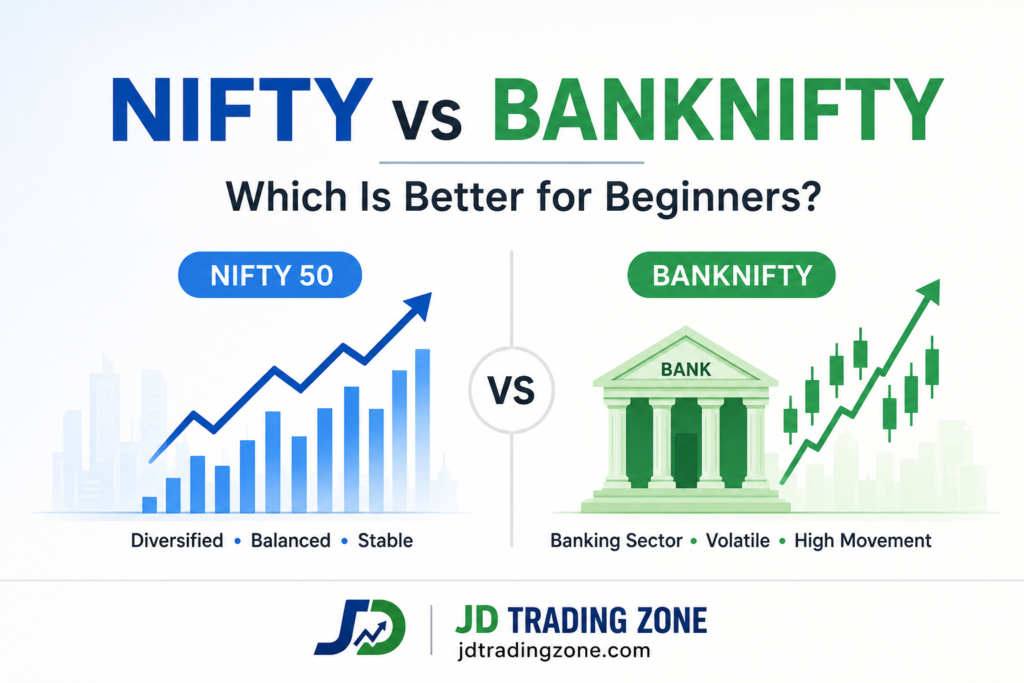
Nifty vs Bank Nifty: Which Is Better for Beginners?
What Is Nifty 50?
Nifty 50 is a major benchmark stock-market index in India. It tracks 50 large companies listed on the National Stock Exchange (NSE) across different sectors.
Because it contains companies from multiple industries, Nifty is more diversified than a sector-specific index.
Its movement can be influenced by sectors such as:
• Financial services
• Information technology
• Energy
• Consumer goods
• Automobiles
• Pharmaceuticals
• Telecommunications
• Industrials
This diversification can make Nifty’s movement relatively balanced compared with a sector-focused index.
Why Do Traders Trade Nifty?
→ Nifty is popular among traders because it generally offers:
• High market participation
• Strong liquidity
• Plenty of technical-analysis opportunities
• Regular intraday movement
• Futures and options markets
• A large amount of publicly available market information
However, liquidity does not mean low risk. Nifty options can still experience significant price fluctuations, particularly around major economic events.
What Is Bank Nifty?
Bank Nifty, commonly known as the Nifty Bank index, represents major banking stocks listed on the NSE.
Its performance is therefore strongly connected to India’s banking and financial sector.
Factors that can influence Bank Nifty include:
• Interest-rate expectations
• RBI decisions
• Banking-sector news
• Credit growth
• Bank earnings
• Economic conditions
• Financial-sector sentiment
Large movements in major banking stocks
Because the index is concentrated in one sector, it can sometimes react more strongly to banking-related developments.
Nifty vs Bank Nifty: Quick Comparison
Feature
• Sector exposure
• Volatility
• Beginner friendliness
• Price movement
• Sector concentration
• Risk management
• Reaction to banking news
• Suitable for learning
• Intraday opportunities
• Options trading risk
Nifty 50
• Diversified
• Generally moderate
• Higher
• Usually more balanced
• Lower
• Comparatively easier
• Moderate
• Yes
• Plenty
• High
Bank Nifty
• Banking-focused
• Can be higher
• Lower for many beginners
• Can be sharp
• High
• Requires stricter discipline
• Often stronger
• Better after gaining experience
• Plenty
• High to very high
These are general characteristics, not guarantees. Market behavior changes depending on volatility, news, expiry, liquidity, and broader market conditions.
Nifty vs Bank Nifty: Which Is More Volatile?
Volatility is one of the biggest differences beginners should understand.
Bank Nifty can experience sharp movements when banking stocks move strongly together. A major announcement related to interest rates, banking regulations, or financial results can affect the index quickly.
Nifty, on the other hand, represents multiple sectors. A large move in one sector may sometimes be partially offset by another sector.
Simple Example
Suppose banking stocks suddenly fall because of negative banking-sector news.
Bank Nifty could react strongly because banking stocks make up its core composition.
Nifty may also fall, but the effect can be moderated if other sectors remain stable.
This does not mean Nifty cannot make large moves. It simply means the two indices have different sources of market movement.
Which Is Better for Beginners?
For most beginners, Nifty 50 is generally the better starting point.
The reason is not that Nifty is automatically safer or more profitable.
The main advantage is that Nifty can provide a relatively easier environment for learning:
1. Understanding market structure
2. Practicing support and resistance
3. Learning trend identification
4. Studying price action
5. Testing indicators
6. Practicing stop-loss management
7. Developing trading discipline
Bank Nifty can also be traded by beginners, but its faster movements can make mistakes more expensive.
A beginner who enters a trade without a clear stop-loss may find a rapidly moving market difficult to manage.
Why Nifty May Be Better for New Traders
1. More Diversified Exposure
Nifty includes companies from different sectors.
This means its movement is not dependent on only one industry.
For beginners learning how the broader market behaves, this diversification can make Nifty easier to study.
2. Easier Risk Management
Risk management is more important than finding the perfect entry.
A beginner should first learn:
• How much capital to risk
• Where to place a stop-loss
• How to calculate position size
• When to avoid a trade
• How to handle losing trades
Nifty can provide a useful environment for developing these habits.
3. Suitable for Learning Technical Analysis
Beginners can use Nifty to practice common technical concepts such as:
• Support and resistance
• Trendlines
• Breakouts
• Pullbacks
• Moving averages
• VWAP
• RSI
• MACD
• Candlestick patterns
• Chart patterns
The goal should not be to use every indicator.
Instead, beginners should learn how price behaves and then use a small number of tools to support their analysis.
Why Some Traders Prefer Bank Nifty
Bank Nifty also has several characteristics that attract active traders.
Why Some Traders Prefer Bank Nifty
Bank Nifty also has several characteristics that attract active traders.
1. Strong Intraday Movement
Bank Nifty can produce large intraday moves.
For experienced traders, this can create opportunities when a clear trend develops.
But the same characteristic can increase losses when a trader enters without proper risk management.
2. Banking Sector Momentum
When major banking stocks move strongly in the same direction, Bank Nifty can respond quickly.
For example:
Positive banking sentiment → banking stocks rise → Bank Nifty may rise
Or:
Negative banking sentiment → banking stocks fall → Bank Nifty may decline
The relationship is not always this simple, but it illustrates why sector-specific news can matter.
3. Suitable for Experienced Intraday Traders
Once a trader understands:
• Market structure
• Volatility
• Position sizing
• Stop-loss placement
• Trading psychology
• Options risks
Bank Nifty can become another index to study.
However, experience does not guarantee profitability.
Nifty vs Bank Nifty for Options Trading
This is where beginners need to be especially careful.
Buying options can look attractive because the required premium may appear smaller than buying a large position in the underlying market.
But options have additional risks.
An option’s value can be affected by:
• Underlying price movement
• Time to expiry
• Implied volatility
• Strike price
• Market expectations
• Option Greeks
• Important Point
A trader can correctly predict the market direction and still lose money on an option trade.
For example, suppose you buy a call option expecting the index to rise.
If the index rises too slowly, the option may lose value because of time decay and other factors.
Therefore:
Correct direction does not always mean a profitable options trade.
Beginners should understand this before trading index options.
Which Is Better for Intraday Trading?
There is no universal answer.
The better index depends on your strategy, experience, capital, risk tolerance, and ability to follow your trading plan.
Nifty may be preferable if you:
• Are new to intraday trading
• Want to learn technical analysis
• Prefer comparatively smoother movements
• Are still developing discipline
• Want to focus on risk management
Bank Nifty may be preferable if you:
• Already understand market structure
• Can handle faster price movements
• Have a tested trading strategy
• Understand volatility
• Follow strict position sizing
• Can accept losing trades without revenge trading
Nifty vs Bank Nifty: Example of Risk Management
Imagine a trader has a trading account of ₹50,000.
Instead of deciding:
“How much can I make today?”
A disciplined trader might first ask:
“How much am I willing to lose if my setup fails?”
Suppose the trader decides that the maximum acceptable loss on one trade is 1% of the account.
₹50,000 × 1% = ₹500
The trader should then determine the appropriate position size based on the stop-loss distance.
This approach is better than choosing a trade size first and then trying to find a stop-loss that fits.
Remember
The example is only for explaining risk management. It is not a recommendation to risk exactly 1% on every trade.
A Simple Beginner Framework
If you are completely new to index trading, consider following a learning sequence rather than immediately trading real money.
Step 1: Learn the Index
Understand:
• What Nifty is
• What Bank Nifty is
• How indices move
• What affects their prices
Step 2: Learn Price Action
Start with:
• Higher highs
• Higher lows
• Lower highs
• Lower lows
• Support
• Resistance
• Breakouts
• Pullbacks
Step 3: Choose One Strategy
Don’t jump between ten strategies.
Choose one simple setup and study it thoroughly.
For example:
Trend + VWAP + price action confirmation
The exact strategy is less important than understanding its rules and testing it properly.
Step 4: Backtest
Study historical charts and record:
• Entry
• Stop-loss
• Target
• Setup type
• Market condition
• Result
Don’t Choose an Index Based Only on Profit Potential
One of the biggest mistakes beginners make is choosing an index because they believe it can produce bigger profits.
Higher potential movement also means higher potential losses.
For example:
More volatility → potentially larger opportunity + potentially larger loss
This is why experienced traders often focus on risk-adjusted returns, not simply the size of individual winning trades.
Your first objective should be survival and skill development.
Common Mistakes Beginners Make
1. Trading Without a Stop-Loss
A trade can move against you much farther than expected.
A predefined exit can help control the damage.
2. Overtrading
After one losing trade, some traders immediately look for another setup.
This can create a cycle:
Loss → frustration → impulsive trade → another loss → revenge trading
Instead, follow your daily trading rules.
3. Using Too Much Leverage
Leverage can magnify both profits and losses.
A small adverse movement can become a large percentage loss when position size is excessive.
4. Changing Strategies Constantly
One losing trade does not prove that a strategy is useless.
Evaluate a strategy over a meaningful sample of trades.
5. Trading Every Market Move
There is no requirement to trade every candle.
Sometimes the best decision is:
No trade.
If your setup is absent, staying out is a valid trading decision.
Can You Trade Both Nifty and Bank Nifty?
Yes, but beginners should avoid monitoring too many instruments at once.
A better approach is:
Start with one index → develop a strategy → collect data → improve execution → then consider adding another index.
Once you become comfortable with Nifty, you can study Bank Nifty separately.
This allows you to compare their behavior without confusing your trading process.
Nifty vs Bank Nifty: Final Verdict
For most beginners, Nifty 50 is the better place to start learning index trading.
It offers exposure to a diversified group of major companies and can provide a useful environment for learning technical analysis and risk management.
Bank Nifty can be attractive for experienced traders because its banking-sector concentration can lead to strong movements. However, those movements can also increase risk.
The most important lesson is this:
→ The best index is not the one that moves the most. It is the one you can trade with a tested strategy and controlled risk.
If you cannot follow your stop-loss, control position size, and avoid emotional decisions, switching between Nifty and
Bank Nifty will not make you a profitable trader.
Focus first on process, risk management, consistency, and education. Profitability should come after those foundations.
Nifty vs Bank Nifty: Which Is Better for Beginners?
Frequently Asked Questions
Is Nifty better than Bank Nifty for beginners?
→ For many beginners, yes. Nifty can be a more comfortable starting point because it is diversified and may be easier to study while developing basic trading skills.
However, neither index is inherently safe.
Is Bank Nifty more risky than Nifty?
→ Bank Nifty can experience sharper movements because it is concentrated in the banking sector. That can create larger opportunities but also larger risks.
Which is better for intraday trading?
→ Both can be used for intraday trading. The better choice depends on your strategy, experience, risk tolerance, and ability to manage volatility.
Which is better for options trading?
→ Neither should be considered automatically better. Index options carry substantial risk, and beginners should understand option pricing, time decay, volatility, and position sizing before trading them.
Can beginners trade Bank Nifty?
→ Beginners can study Bank Nifty, but they should first develop basic skills in technical analysis and risk management. Paper trading or simulated practice can be useful before risking real capital.
Can I trade Nifty and Bank Nifty together?
→ You can, but beginners may benefit from focusing on one index first. Monitoring multiple instruments can lead to more trades and weaker decision-making.
Is Nifty safer than Bank Nifty?
→ Not necessarily. Nifty may have more diversified exposure, but trading Nifty—especially its derivatives—still involves substantial risk.
How much money do I need to start trading?
→ There is no universal amount that guarantees successful trading. The appropriate amount depends on the instrument, position size, risk per trade, brokerage and other costs. Never trade money you cannot afford to lose.
Nifty vs Bank Nifty: Which Is Better for Beginners?
Pingback: Common Trading Myths That Cost Traders Money - jdtradingzone.com
Pingback: Daily Routine of Successful Traders - jdtradingzone.com
Pingback: How to Backtest a Trading Strategy - jdtradingzone.com
Pingback: Trading Journal: Why Every Trader Needs One - jdtradingzone.com
Hi there very nice blog!! Man .. Excellent .. Amazing .. I’ll bookmark your website and take the feeds alsoKI’m happy to seek out so many useful info here in the post, we want work out more strategies on this regard, thank you for sharing. . . . . .
It’s an amazing post designed for all the online visitors; they will get
benefit from it I am sure.