In trading journel writing is the most important thing to become profitable so learn about the ,trading journel: why every trader needs one, for beginners in simple words.
Welcome to JD Trading Zone
Introduction
Many beginners spend a lot of time searching for the perfect trading strategy. They study indicators, chart patterns, entry techniques, risk management, and market news.
But there is another important tool that is often ignored: a trading journal.
A trading journal is a record of your trades, decisions, emotions, mistakes, and results. It helps you understand not only what happened in a trade, but also why you took the trade in the first place.
Without a journal, traders often repeat the
same mistakes without realizing it. They may remember their biggest winning trades but forget the losing trades that taught them important lessons.
A good trading journal turns your past trades into useful information.
Important: A trading journal cannot guarantee profits or make a losing strategy profitable. Its purpose is to help you evaluate your decisions, identify patterns in your behavior, and improve your trading process.
Also check:- (How to Backtest a Trading Strategy) (Daily Routine of Successful Traders) (Common Trading Myths That Cost Traders Money) (Nifty vs Bank Nifty: Which Is Better for Beginners?) (Best Chart Patterns for Trading)
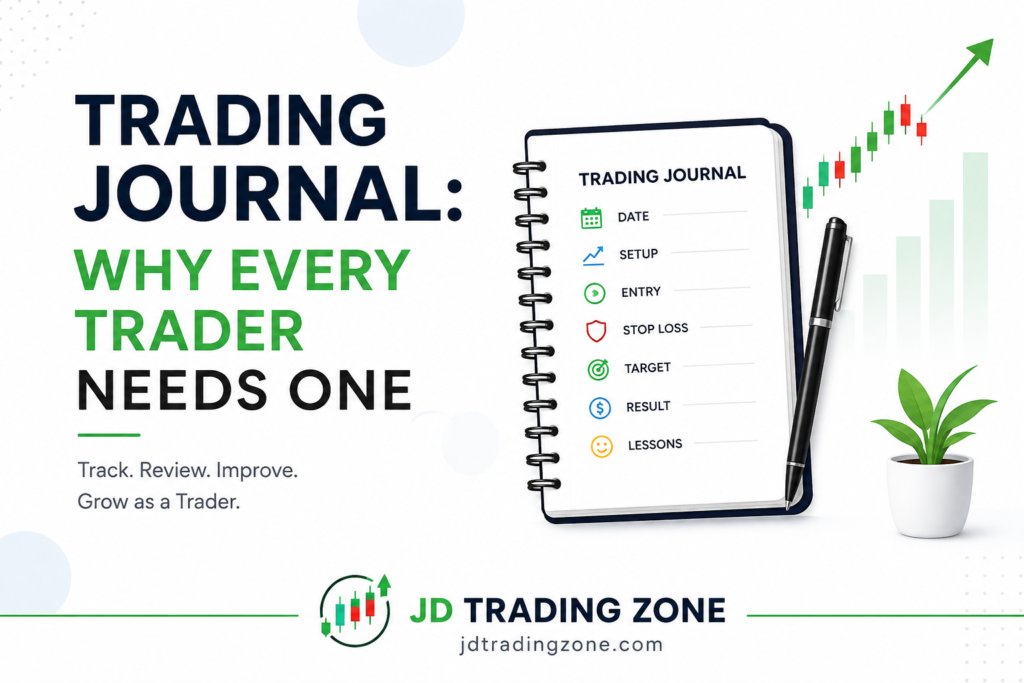
Trading Journal: Why Every Trader Needs One
What Is a Trading Journal?
A trading journal is a structured record of your trading activity.
It can be a notebook, spreadsheet, trading journal application, or any other system that allows you to record and review your trades.
A basic journal may include:
• Date and time of the trade
• Trading instrument
• Buy or sell direction
• Entry price
• Stop-loss
• Target
• Exit price
• Position size
• Risk-to-reward ratio
• Profit or loss
• Trading setup
• Reason for entering
• Reason for exiting
• Market conditions
• Emotional state
• Mistakes made
• Lessons learned
The goal isn’t simply to record whether you made money.
The bigger goal is to understand whether you followed your trading plan.
For example, a losing trade can still be a good trade if you followed your strategy and managed risk correctly.
On the other hand, a profitable trade can still be a bad trade if you entered without a setup, ignored your stop-loss, or took excessive risk.
Why Every Trader Needs a Trading Journal
1. It Helps You Identify Your Trading Mistakes
Every trader makes mistakes.
The problem is not making a mistake. The problem is repeatedly making the same mistake without recognizing it.
Suppose you record 50 trades and discover that many losing trades happened because you:
• Entered too early
• Chased price after a large move
• Ignored your stop-loss
• Traded without confirmation
• Took trades outside your strategy
• Increased position size after a loss
• Entered because of fear of missing out
Without a journal, these patterns can be difficult to notice.
With a journal, your mistakes become visible.
Once you know what is going wrong, you can work on changing it.
2. It Shows Whether Your Strategy Actually Works
A strategy may look excellent when you see a few successful trades.
But a small sample of trades doesn’t tell you much.
A trading journal allows you to collect enough data to evaluate your strategy more objectively.
For example, after recording 100 trades, you might discover:
• Winning trades: 42
• Losing trades: 58
• Average winning trade: ₹1,500
• Average losing trade: ₹800
Although the win rate is below 50%, the strategy may still have positive expectancy because the average winning trade is larger than the average losing trade.
This is why traders should look beyond individual wins and losses.
Your journal can help you evaluate metrics such as:
• Win rate
• Average profit
• Average loss
• Risk-to-reward ratio
• Maximum losing streak
• Maximum drawdown
• Profit factor
• Average R per trade
• Performance by setup
• Performance by trading session
The more organized your data, the easier it becomes to evaluate your trading process.
3. It Improves Trading Discipline
Trading discipline means following your rules even when emotions are strong.
For example, your trading plan may say:
Risk only 1% of your trading capital on a trade.
But after two consecutive losses, you may feel tempted to increase your position size to recover the money.
A journal can help expose this behavior.
You can record:
Trade: Nifty options
Result: Loss
Mistake: Increased position size after previous loss
Emotion: Frustration
Lesson: Do not change risk because of previous results
Over time, these records can make you more aware of your behavior.
4. It Helps Control Emotional Trading
Trading decisions are often affected by emotions.
Common emotions include:
• Fear
• Greed
• FOMO
• Frustration
• Overconfidence
• Revenge trading
• Anxiety
• Excitement
Imagine you take three trades in one morning.
The first trade is a loss.
You become frustrated and enter another trade that doesn’t meet your setup rules.
That trade also loses.
You then take a third trade because you want to recover the previous losses.
This is a common example of revenge trading.
If you record your emotional state after every trade, you may eventually discover that your worst trades happen when you are frustrated or trying to recover a loss.
That information can be extremely valuable.
5. It Separates a Good Trade From a Profitable Trade
One of the most important lessons for beginners is this:
A profitable trade is not necessarily a good trade.
Consider two examples.
→ Trade A
You followed your strategy, used the correct position size, placed your stop-loss, and accepted the planned risk.
The trade eventually hit your stop-loss.
Result: Loss
→ Trade B
You ignored your setup, entered because of FOMO, used excessive position size, and didn’t place a proper stop-loss.
The market unexpectedly moved in your direction.
Result: Profit
Trade A was better from a process perspective, even though it lost money.
Trade B produced money but involved poor decision-making.
Your journal helps you evaluate process instead of judging yourself only by the result.
6. It Helps You Discover Your Best Trading Conditions
Not every setup performs equally well.
You may discover that your strategy works better:
• During a particular market session
• In trending markets
• During specific setups
• On certain instruments
• When volume is strong
When multiple confirmations are present
For example, after reviewing your trades, you might find that your VWAP-based setup performs better during strong trending sessions than during sideways markets.
That doesn’t automatically mean you should eliminate every other market condition.
Instead, it gives you data to investigate further.
Your journal becomes a source of personal trading research.
7. It Prevents You From Relying on Memory
Human memory is not a perfect trading database.
After a profitable trade, you may remember how confident you felt.
After a large loss, you may remember the pain.
But you may forget important details such as:
• Why you entered
• What the market looked like
• Whether your setup was valid
• How much you risked
• Whether you followed your rules
• Why you exited
Writing down these details immediately after a trade creates a more reliable record.
What Should You Record in a Trading Journal?
You don’t need a complicated system when starting.
A beginner can start with the following information.
Trade Information
Record:
• Date
• Time
• Instrument
• Buy/Sell
• Entry price
• Exit price
• Stop-loss
• Target
• Position size
• Profit/loss
Strategy Information
Record:
• Trading setup
• Indicators used
• Entry reason
• Confirmation
• Market trend
• Timeframe
Psychological Information
Record:
• Mood before entering
• Confidence level
• Fear or hesitation
• FOMO
• Frustration
• Greed
• Emotional state after exiting
Review Information
Record:
• Did I follow my rules?
• What went well?
• What went wrong?
• Was the trade avoidable?
• What should I do differently next time?
How to Create a Trading Journal Step by Step
Step 1: Choose Your Format
You can use:
• Excel
• Google Sheets
• A notebook
• A dedicated trading journal application
Beginners can start with a simple spreadsheet.
You don’t need expensive software to begin.
Step 2: Define Your Trading Rules
Before recording trades, write down your basic trading plan.
For example:
• Maximum risk per trade
• Trading timeframe
• Entry conditions
• Stop-loss rules
• Exit rules
• Maximum number of trades per day
• Conditions when you will not trade
This gives you something to compare your actual behavior against.
Step 3: Record Every Trade
Don’t record only winning trades.
Record every trade.
If you skip losing trades because you don’t want to look at them, your journal becomes incomplete and less useful.
Step 4: Add a Chart Screenshot
A screenshot can make your journal much more useful.
Take a screenshot showing:
• Entry
• Stop-loss
• Target
• Important support/resistance
• Indicators
• Exit
Later, you can visually review what happened.
This can help you identify chart-reading mistakes that numbers alone may not show.
Step 5: Write a Short Explanation
After each trade, answer three questions:
→ Why did I enter?
→ Why did I exit?
→ Did I follow my rules?
Keep your answers honest.
The journal is for learning, not for impressing anyone.
How Often Should You Review Your Trading Journal?
Recording trades is only half the process.
You also need to review them.
→ Daily Review
At the end of the trading day, ask:
• Did I follow my plan?
• Did I overtrade?
• Did I take unnecessary risks?
• Did emotions influence my decisions?
• What was my best decision today?
→ Weekly Review
At the end of the week, look for patterns.
For example:
• Which setups performed best?
• Which setups performed poorly?
• How many trades violated your rules?
• What was your average risk?
• Did you trade more after losses?
• Which emotional mistakes appeared repeatedly?
→ Monthly Review
A monthly review can provide a broader picture.
Analyze:
• Total trades
• Winning trades
• Losing trades
• Average win
• Average loss
• Total profit/loss
• Maximum drawdown
• Strategy performance
• Rule violations
• Emotional patterns
Don’t change your entire strategy based on one or two trades. Look for meaningful patterns across a reasonable sample.
Common Trading Journal Mistakes
Mistake 1: Recording Only Profit and Loss
→ A journal that contains only entry, exit, and profit/loss doesn’t tell the whole story.
Add information about your setup, reasoning, emotions, and rule-following.
Mistake 2: Making the Journal Too Complicated
→ If your journal takes 30 minutes to complete after every trade, you may eventually stop using it.
Start simple.
Add more fields only when they provide useful information.
Mistake 3: Changing the Rules After Every Loss
→ One losing trade doesn’t prove that your strategy is bad.
Avoid changing your system every time you experience a loss.
First collect enough data and then analyze the results.
Mistake 4: Hiding Mistakes
→ A trading journal is useful only when you’re honest.
Don’t write:
“Market was manipulated.”
when the actual reason was:
“I entered without confirmation because I didn’t want to miss the move.”
Honest journaling creates useful feedback.
Mistake 5: Ignoring Emotional Information
→ Two traders can take the same setup and get the same result, but their decision-making process can be completely different.
Record your emotions honestly.
Trading Journal vs Trading Plan
These two concepts are related but different.
→ Trading Plan
A trading plan explains what you intend to do.
It may include:
• Entry rules
• Exit rules
• Risk management
• Trading hours
• Position sizing
• Setups
→ Trading Journal
A trading journal records what you actually did.
It shows:
• Actual trades
• Actual decisions
• Actual results
• Mistakes
• Emotions
• Lessons
Think of it this way:
Trading plan = roadmap
Trading journal = travel record
You need the roadmap to know where you’re going, and the travel record helps you understand what actually happened.
How a Beginner Can Start Today
You don’t need to wait until you become an experienced trader.
Start with your next trade.
Create these columns in a spreadsheet:
Date | Instrument | Setup | Entry | Stop-Loss | Target | Exit | Risk | Result | Emotion | Rule Followed? | Lesson
After every trade, fill in the information.
At the end of the week, review the journal and look for repeated behaviors.
For example, you may discover:
“Most of my losses happen when I enter before confirmation.”
That is actionable information.
You can then create a specific rule:
“I will not enter until my confirmation condition is complete.”
This is how journaling can turn trading experience into a structured learning process.
Final words
Trading is not only about finding profitable entries.
It is also about understanding your decisions, managing risk, following your rules, and improving your process over time.
A trading journal provides a record of that process.
It can help you identify mistakes, evaluate strategies, understand your emotions, measure performance, and build greater discipline.
Remember that journaling itself does not create profitable trades. A journal is a learning and evaluation tool, not a guarantee of success.
If you’re a beginner, don’t try to build the perfect journal.
Start with a simple one.
Record every trade. Review your decisions. Identify patterns. Make one improvement at a time.
Over hundreds of trades, those records can become one of the most valuable resources in your trading journey.
Trading Journal: Why Every Trader Needs One
Frequently Asked Questions
1. Is a trading journal necessary for beginners?
→ Yes. Beginners can benefit greatly from journaling because it helps them understand their decisions and identify repeated mistakes.
2. Can a trading journal make me profitable?
→ No. A journal cannot guarantee profits. It can help you evaluate your strategy and behavior, but profitability also depends on factors such as strategy quality, risk management, market conditions, and discipline.
3. Should I record losing trades?
→ Absolutely. Losing trades often provide important information about your strategy and decision-making.
4. Can I use Excel for a trading journal?
→ Yes. Excel or Google Sheets is more than enough for many beginners.
5. How often should I review my journal?
→ A practical approach is to review it briefly every day, analyze patterns weekly, and perform a deeper performance review monthly.
6. What is the most important thing to record?
→ Record enough information to understand why you entered, how you managed the trade, why you exited, and whether you followed your rules.
7. Should I include screenshots in my trading journal?
→ Yes. Chart screenshots can make trade reviews easier because you can visually examine the setup and your decisions.
Trading Journal: Why Every Trader Needs One
Risk Disclaimer: Trading and investing involve financial risk, and losses can occur. The information in this article is provided for educational purposes only and should not be considered financial, investment, or trading advice. Always understand the risks and consider your own financial circumstances before making trading decisions.
Рассмотрите возможность контракт вс рф для получения подробной информации о службе по контракту.
Служба по контракту – это один из популярных способов попасть в вооружённые силы страны.
Если вы заинтересованы в контракте оператор бпла москва, рекомендуем ознакомиться с подробной информацией на сайте бпла войска в москве зарплаты.
Для успешного сотрудничества с оператором дронов в контракте должны быть прописаны все обязательства и нюансы.
Нужную бутылку привезут прямо к двери — доставка алкоголя круглосуточно.
Без соблюдения этих требований риск штрафов и конфликтов возрастает.
Аналитические инструменты формируют персональные подборки и акции, увеличивая лояльность.
Цена заказа складывается из стоимости напитка, доставки и сервисных сборов.
Именно гармония между доступностью сервиса и контролем обеспечит долгосрочное развитие отрасли.
Если вы планируете строить надежное и теплое жилье, обратите внимание на каркасные дома спб, которые сочетают в себе качество и доступность.
Каркасное домостроение предлагает эффективные методы создания комфортного жилья.
Если вы хотите выделиться, заказать купить браслеты с логотипом — отличный способ подчеркнуть ваш стиль и бренд.
Кроме технологий, важны и эргономика, прочность застёжек и комфорт при носке.
Спин-шаблон:
Они помогают закрепить эмоции участников и оставить о бренде конкретный физический след.
Если вам нужна быстрая и надежная доставка алкоголя на дом, мы всегда готовы помочь!
Существующие законы требуют проверять возраст клиентов при заказе и получении алкоголя.
Pingback: Position Sizing Explained - jdtradingzone.com
Pingback: Best Free Websites for Stock Market Analysis - jdtradingzone.com
Useful information. Lucky me I found your website accidentally, and I’m surprised why this accident did not happened earlier! I bookmarked it.
Pingback: How to Confirm a Breakout Before Taking a Trade - jdtradingzone.com
dark matter darknet link abacus url