
This guide explains how Gap-Up and Gap-Down Trading Guide, why they occur, how beginners can analyze them, different trading approaches, risk-management rules, and the mistakes that should be avoided.
Welcome to JD Trading Zone
Important: Gap trading involves market risk. The examples in this article are for educational purposes and should not be considered financial advice or guaranteed trading setups.
A stock can close at one price and open the next trading session at a significantly different price. This sudden difference between the previous closing price and the new opening price is known as a price gap.
For example, if a stock closes at ₹500 and opens the next morning at ₹525, it has opened with a ₹25 upside gap. Similarly, if it closes at ₹500 but opens at ₹475, it has created a ₹25 downside gap.
Gap-ups and gap-downs can create interesting trading opportunities, especially for intraday traders. However, an opening gap does not automatically mean that the price will continue in the same direction. Some gaps continue into strong trends, while others reverse and fill part or all of the gap.
Gap-Up and Gap-Down Trading Guide
Also check:- (Opening Range Breakout Strategy) (EMA Crossover Strategy Explained) (VWAP Trading Strategy Step by Step) (Volume Price Analysis (VPA) for Beginners) (Fake Breakouts vs Real Breakouts)
What Is a Gap in the Stock Market?
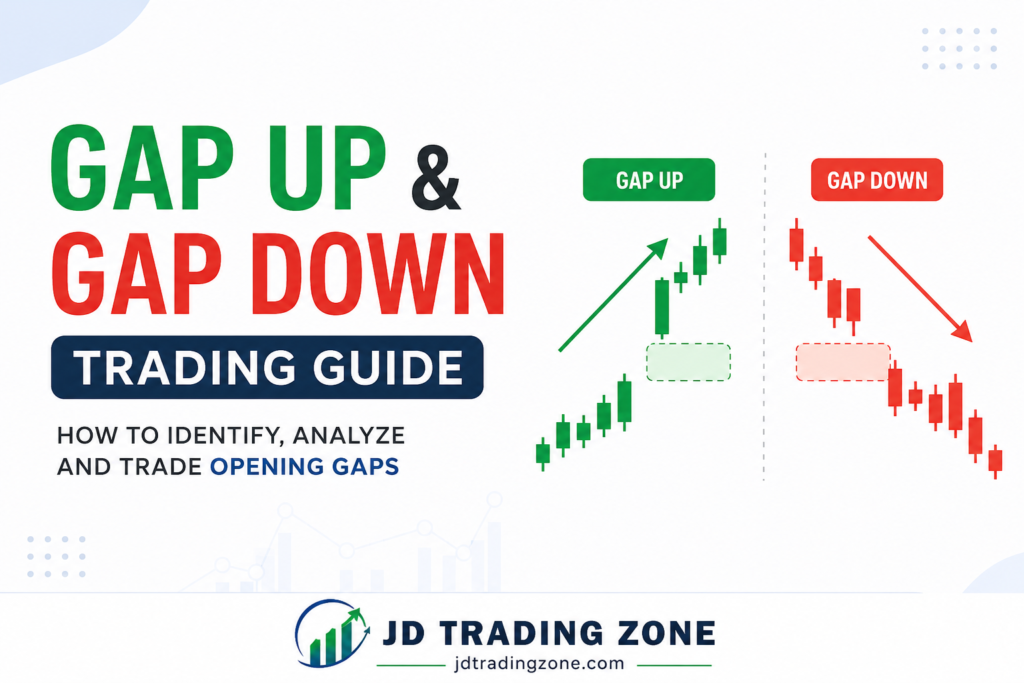
A gap occurs when a stock or index opens significantly above or below its previous closing price, leaving a visible space on the price chart between the previous session’s price area and the new opening price.
A simple example:
Previous close: ₹1,000
Next opening: ₹1,050
The market has opened ₹50 higher than the previous close. This is an upside gap or gap-up.
If the stock instead opens at ₹950, it creates a downside gap or gap-down.
Gaps are particularly noticeable when looking at daily candlestick charts, although smaller gaps can also occur on intraday timeframes.
What Is a Gap-Up?
A gap-up happens when the current session opens above the previous session’s closing price.
Example
Suppose a stock closes at:
₹800
The following morning, it opens at:
₹835
The stock has created a:
₹35 gap-up
A gap-up indicates that there was strong buying interest, positive sentiment, or new information affecting the market before regular trading began.
However, a gap-up itself is not a buy signal.
The important question is:
→ What does price do after the market opens?
If buyers continue pushing the price higher after the opening, the gap may develop into a continuation move. If sellers quickly enter and push the stock lower, the gap may fail.
What Is a Gap-Down?
A gap-down occurs when the current session opens below the previous session’s closing price.
Example
Suppose a stock closes at:
₹800
The next session opens at:
₹760
The stock has created a:
₹40 gap-down
A gap-down can occur because of negative news, weak market sentiment, disappointing earnings, global market movements, or other factors.
Again, a gap-down does not automatically mean that traders should immediately short the stock.
The price action after the opening is usually more important than the gap itself.
Why Do Stocks Gap Up or Gap Down?
Opening gaps can occur for several reasons.
1. Company News
Important company announcements can significantly change investor expectations.
Examples include:
• Earnings results
• Major business announcements
• Management changes
• Large orders
• Regulatory developments
• Mergers or acquisitions
• Corporate actions
If investors react strongly to the information, the stock may open far away from its previous closing price.
2. Global Market Movements
Indian markets can be influenced by international markets and overnight developments.
For example, major movements in global equity markets, crude oil, currencies, or other financial markets can influence sentiment before the Indian market opens.
3. Earnings Results
Quarterly results can create significant gaps.
If the market expected moderate earnings but the company reports much stronger results, buyers may aggressively bid for the stock.
The opposite can happen when results disappoint expectations.
4. Market-Wide News
Sometimes the gap is not specific to one company.
Events affecting the broader market can cause several stocks or indices to open higher or lower.
For example:
• Major economic announcements
• Central-bank decisions
• Unexpected geopolitical developments
• Large global market moves
• Changes in investor sentiment
5. Pre-Market Demand and Supply
Before normal market trading begins, orders can accumulate on both sides of the market.
If buying demand significantly exceeds available selling supply, the stock may open higher.
If selling pressure dominates, the stock may open lower.
Types of Gaps Traders Should Know
Not every gap behaves in the same way.
Understanding the context behind the gap can help traders avoid treating every opening gap as the same setup.
1. Breakaway Gap
A breakaway gap occurs when price moves away from an important consolidation or trading range.
For example, imagine a stock has traded between ₹500 and ₹530 for several weeks.
If it suddenly opens above ₹530 and holds the breakout level, the gap could represent a meaningful change in market sentiment.
→ What traders watch for
• Important resistance being crossed
• Strong opening participation
• Price holding above the breakout zone
• Follow-through buying
A breakaway gap can sometimes mark the beginning of a larger trend.
2. Continuation Gap
A continuation gap occurs during an existing strong trend.
For example, a stock may already be making higher highs and higher lows. It then gaps higher and continues moving upward.
This can indicate that the existing trend remains strong.
However, traders should still confirm the move rather than assuming every gap in a trend will continue.
3. Exhaustion Gap
An exhaustion gap can occur near the later stages of a strong move.
For example, a stock has already risen significantly over several sessions. It then gaps higher again, but buyers fail to maintain the momentum.
Price may subsequently reverse.
This type of situation can be difficult to identify in real time because a genuine continuation move can initially look similar.
Therefore, traders should wait for confirmation instead of trying to predict the top.
4. Common Gap
A common gap usually occurs within a normal trading range and may not represent a major change in the underlying trend.
These gaps are often less significant than gaps occurring at important support, resistance, or breakout levels.
Gap-Up Trading Strategy for Beginners
A common beginner mistake is:
Gap-up = Buy immediately.
That approach can be dangerous.
Instead, consider waiting for the market to reveal whether buyers can actually maintain control.
Here is a simple framework.
Step 1: Identify the Gap
Before the market opens, compare the expected opening price with the previous close.
For example:
Previous close = ₹1,000
Expected opening = ₹1,040
Approximate gap = ₹40
Step 2: Mark Important Levels
Before entering a trade, identify:
• Previous day’s high
• Previous day’s low
• Previous close
• Major support
• Major resistance
• Pre-market high or low, where relevant
• Recent swing levels
• VWAP after the market opens
These levels can provide context for the gap.
Step 3: Wait for the Opening Price Action
Instead of entering immediately, observe the first few minutes.
Ask:
• Is price holding above the opening level?
• Is buying volume strong?
• Is price breaking an important resistance?
• Are sellers immediately rejecting higher prices?
• Is price trading above or below VWAP after enough data has formed?
The goal is to avoid making a decision based solely on the opening gap.
Step 4: Look for Confirmation
One possible bullish setup is:
Gap-up → consolidation → breakout above the opening range → continuation
For example:
Previous close: ₹1,000
Opening price: ₹1,035
Price moves between ₹1,030 and ₹1,045 for several minutes.
If price later breaks ₹1,045 with strong participation and holds the level, a trader may consider a long setup according to their trading plan.
The exact entry, stop-loss, and position size should depend on the trader’s strategy and risk tolerance.
Gap-Down Trading Strategy for Beginners
The same principle applies to gap-downs.
A gap-down is not automatically a short signal.
Example
Previous close: ₹1,000
Opening price: ₹960
Instead of immediately shorting, observe what happens after the open.
If price remains below important levels and sellers continue controlling the market, a continuation setup may develop.
A simple structure could be:
Gap-down → weak pullback → rejection → breakdown → continuation
For example:
The stock opens at ₹960 and initially falls to ₹945.
It then pulls back toward ₹960 but fails to reclaim the level.
If sellers subsequently push price below ₹945, the breakdown may provide confirmation for a bearish setup, depending on the trader’s strategy.
Gap-and-Go Strategy
One popular approach is known as the gap-and-go concept.
The basic idea is that a strong opening gap continues in the same direction instead of immediately reversing.
→ Bullish structure
Gap-up → opening strength → consolidation → breakout → continuation
→ Bearish structure
Gap-down → opening weakness → consolidation → breakdown → continuation
The key idea is confirmation.
Traders should not assume that every gap will become a gap-and-go trade.
Gap-Fill Trading
Another concept frequently discussed by traders is the gap fill.
A gap is considered filled when price moves back toward the previous session’s closing level and covers the gap area.
Example
Previous close = ₹500
Opening price = ₹530
The gap is ₹30.
If price later declines toward ₹500, the gap has been filled.
But an important point for beginners is:
A gap does not have to fill.
Some gaps continue strongly in the original direction.
Therefore, “all gaps fill” should not be treated as a reliable trading rule.
Instead, traders should look at the broader trend, support and resistance, volume, market conditions, and price action.
Gap-Up Reversal Setup
Sometimes a stock gaps higher but fails to sustain the move.
For example:
Previous close: ₹500
Opening price: ₹540
The stock initially rises to ₹550 but then selling pressure appears.
Price falls below the opening price and starts forming lower highs.
This can indicate that the initial bullish sentiment is weakening.
A trader following a reversal strategy may wait for additional confirmation before considering a short position.
→ Possible confirmation signals
• Failure at resistance
• Strong bearish candle
• Break below opening range
• Loss of VWAP
• Increasing selling volume
• Lower high followed by a breakdown
No single signal guarantees a successful trade.
Gap-Down Reversal Setup
The opposite situation can happen after a gap-down.
Example:
Previous close: ₹500
Opening price: ₹460
The stock initially falls to ₹450 but buyers appear.
Price then moves back above the opening price and begins forming higher lows.
This may indicate that sellers are losing control.
A trader using a reversal strategy may wait for confirmation before considering a bullish trade.
How VWAP Can Help With Gap Trading
VWAP, or Volume Weighted Average Price, can provide useful intraday context.
After the market opens, traders can observe the relationship between price and VWAP.
→ Bullish context
If a gap-up stock:
• Holds above VWAP
• Maintains higher highs and higher lows
• Breaks resistance
Shows healthy buying participation
the bullish structure may remain intact.
→ Bearish context
If a gap-down stock:
• Remains below VWAP
• Makes lower highs and lower lows
• Breaks support
Shows continued selling pressure
the bearish structure may remain stronger.
VWAP should be treated as one piece of information rather than a standalone buy or sell signal.
How Volume Helps Confirm a Gap
Volume can provide important context.
A large gap accompanied by meaningful trading activity can be more informative than a small gap occurring with limited participation.
For example:
Gap-up + breakout + strong volume
may provide stronger confirmation than:
Gap-up + breakout + weak volume
However, volume should always be interpreted in context.
High volume does not automatically mean that price must rise.
Opening Range and Gap Trading
The first few minutes of the session can establish an opening range.
For example, a trader may define the first 15 minutes:
Opening range high
Opening range low
A possible bullish setup is a gap-up followed by a breakout above the opening range high.
A possible bearish setup is a gap-down followed by a breakdown below the opening range low.
The exact opening-range period can vary according to the trader’s strategy and market.
The important point is to use a predefined rule rather than entering randomly.
Gap Trading Example
Let’s consider a hypothetical stock.
Previous session
Closing price: ₹1,000
Previous day’s high: ₹1,025
Previous day’s low: ₹980
Current session
Opening price: ₹1,045
The stock has opened with a ₹45 gap-up.
Instead of buying immediately, a trader observes the first 15 minutes.
Price moves:
₹1,045 → ₹1,038 → ₹1,052 → ₹1,048
The opening range high becomes approximately ₹1,052.
Later, price breaks above ₹1,052 with stronger participation.
A trader whose predefined strategy requires an opening-range breakout may consider this a potential bullish setup.
The trade still requires:
• A predefined stop-loss
• Appropriate position sizing
• A realistic target or exit plan
• A maximum daily loss limit
The example is purely educational and does not predict what any real stock will do.
Where Should You Place a Stop-Loss?
There is no universal stop-loss level for every gap trade.
A stop-loss should be connected to the trade’s invalidation point.
For a bullish setup, possible technical locations include:
• Below the breakout level
• Below the opening range low
• Below a recent swing low
• Below an important support level
For a bearish setup:
• Above the breakdown level
• Above the opening range high
• Above a recent swing high
• Above significant resistance
The stop should not simply be placed at an arbitrary percentage.
Position Sizing Is More Important Than the Entry
Suppose your trading plan allows a maximum loss of ₹1,000 on one trade.
If your entry is ₹1,050 and your planned stop is ₹1,040, your risk per share is:
₹10
Maximum position size based on that risk:
₹1,000 ÷ ₹10 = 100 shares
This is a simplified example and does not include brokerage, taxes, slippage, or other costs.
The calculation demonstrates an important principle:
Determine your acceptable loss first, then calculate your position size.
Do not calculate position size based only on how much money you have available.
Common Mistakes Beginners Make With Gap Trading
1. Buying Every Gap-Up
A gap-up does not guarantee further upside.
Price can reverse immediately.
2. Shorting Every Gap-Down
A gap-down can be followed by a strong recovery.
Do not assume that weakness at the open will continue throughout the day.
3. Entering Immediately at the Open
The opening minutes can be highly volatile.
Waiting for a defined setup can help reduce impulsive decisions.
4. Ignoring the Broader Market
A stock may show a bullish gap while the broader market is weak.
Market context can matter, particularly for highly correlated stocks.
5. Trading Without a Stop-Loss
A gap trade can move quickly in the wrong direction.
Without predefined risk, a small trading idea can turn into a disproportionately large loss.
6. Using Excessive Leverage
Leverage can magnify both gains and losses.
A gap can move much faster than expected, making excessive leverage particularly dangerous for inexperienced traders.
7. Chasing a Large Move
If a stock has already moved significantly after the open, entering late can create poor risk-to-reward conditions.
Sometimes the best trade is the one you do not take.
8. Assuming Every Gap Will Fill
This is one of the most common misconceptions.
Some gaps fill quickly, while others remain open for a long time.
There is no guarantee that a particular gap will be filled during the same trading session.
Gap Trading Checklist for Beginners
Before entering a gap trade, ask yourself:
→ Before the market opens
☐ Why has the stock gapped?
☐ How large is the gap?
☐ What happened in the broader market?
☐ Where are important support and resistance levels?
☐ Is there major company or economic news?
→ After the market opens
☐ Is price holding the gap direction?
☐ What is the opening range?
☐ Is there meaningful volume?
☐ Is price above or below VWAP?
☐ Is the breakout or breakdown confirmed?
→ Before entering
☐ Where is my entry?
☐ Where is my stop-loss?
☐ Where will I exit if the trade works?
☐ How much money can I lose?
☐ Is the risk-to-reward acceptable?
☐ Am I entering because of a setup or because I am afraid of missing the move?
If you cannot clearly answer these questions, consider staying out of the trade.
Best Timeframe for Gap Trading
There is no single best timeframe for every trader.
For intraday gap analysis, traders commonly examine:
• 1-minute charts
• 3-minute charts
• 5-minute charts
• 15-minute charts
Beginners may find a slightly higher timeframe easier to interpret because extremely short charts can contain a lot of market noise.
One practical approach is to use a higher timeframe for overall structure and a lower timeframe for entry confirmation.
For example:
15-minute chart → market structure
5-minute chart → setup and entry
The best combination depends on the trader’s strategy and experience.
Should Beginners Trade Gap-Ups and Gap-Downs?
Gap trading can be attractive because price movement can be fast and clear.
However, it also has risks:
• High volatility
• Fast reversals
• Slippage
• False breakouts
• Emotional decision-making
• Unexpected news
• Larger-than-expected opening moves
Beginners should first understand the strategy using historical charts or paper trading before risking real money.
The objective should not be to trade every gap.
The objective should be to identify high-quality situations that match a predefined trading plan.
A Simple Gap Trading Framework
Beginners can simplify the process into five stages:
1. Identify
→ Find stocks or indices showing a meaningful gap.
2. Understand
→ Determine why the gap occurred and identify important technical levels.
3. Observe
→ Watch the opening price action rather than immediately entering.
4. Confirm
→ Wait for a breakout, breakdown, rejection, VWAP confirmation, volume confirmation, or another predefined signal.
5. Manage Risk
→ Calculate the position size, define the stop-loss, and accept the possibility of losing the trade.
This process helps shift the focus from predicting the market to managing uncertainty.
Final Thoughts
Gap-up and gap-down trading can provide interesting intraday opportunities, but the opening gap itself is not a complete trading strategy.
A successful gap analysis requires more than simply seeing a stock open higher or lower than the previous close.
Traders should consider:
• Why the gap occurred
• The size of the gap
• Previous support and resistance
• Opening-range price action
• Volume
• VWAP
• Broader market conditions
• Risk-to-reward
• Position sizing
• Stop-loss placement
Most importantly, do not trade simply because a stock has gapped.
Wait for your setup.
A gap-up can continue, reverse, or move sideways. A gap-down can continue lower, recover, or consolidate. Your job as a trader is not to predict which outcome is guaranteed—it is to create a plan for each possibility and control the amount you can lose.
Frequently Asked Questions
What is a gap-up in trading?
→ A gap-up occurs when a stock or index opens above its previous session’s closing price.
What is a gap-down?
→ A gap-down occurs when a stock or index opens below its previous session’s closing price.
Is gap-up always bullish?
→ No. A gap-up can fail and reverse lower. Traders should wait for price-action confirmation.
Is gap-down always bearish?
→ No. A gap-down can reverse higher if buyers regain control.
Do all gaps get filled?
→ No. Some gaps fill quickly, while others can remain open for a long time.
Is gap trading suitable for beginners?
→ Beginners should be cautious because gap trading can involve high volatility. Learning the setup, practicing with historical charts or paper trading, and using strict risk management can be more appropriate than immediately trading with significant real money.
Can VWAP be used with gap trading?
→ Yes. VWAP can help traders assess whether intraday price action is maintaining bullish or bearish control, but it should not be used as the only reason to enter a trade.
What is the biggest mistake in gap trading?
→ One of the biggest mistakes is assuming that the opening direction will continue. Waiting for confirmation and managing risk can be more useful than trying to predict the entire day’s movement.
Disclaimer: This article is intended for educational and informational purposes only. It is not investment advice, a recommendation to buy or sell securities, or a promise of trading profits. Stock and derivatives trading involve substantial risk, and past market behavior does not guarantee future results. Always conduct your own research and consider your risk tolerance before making financial decisions.
About JD Trading Zone: JD Trading Zone publishes educational content about stock-market concepts, technical analysis, trading strategies, risk management, and market psychology to help beginners develop a better understanding of financial markets.
If this blog makes sense to you give your feedback in comments and stay tuned for more information about JD Trading Zone.
Pingback: How to Avoid Overtrading - jdtradingzone.com
Pingback: Best Risk Management Strategy for a Small Trading Account - jdtradingzone