It is important to understand How to Avoid Overtrading, why it happens, how to recognize it, and practical ways beginners can reduce unnecessary trades.
Welcome to JD Trading Zone
Risk warning: Trading involves financial risk. No strategy guarantees profits. The examples in this article are educational and should not be considered financial advice.
Overtrading is one of the most common problems faced by new traders. It usually happens when a trader takes too many trades, enters without a proper setup, increases trading frequency after a loss, or trades simply because they feel they should be doing something in the market.
The problem is not necessarily the number of trades itself. A trader can take several valid trades in a day and still be disciplined. Overtrading happens when trade decisions are driven by emotions, boredom, revenge, fear of missing out (FOMO), or the desire to recover losses quickly instead of following a defined trading plan.
Learning how to avoid overtrading is therefore an important part of becoming a consistent trader.
Also check:- (Gap-Up and Gap-Down Trading Guide) (Opening Range Breakout Strategy) (EMA Crossover Strategy Explained) (VWAP Trading Strategy Step by Step) (Volume Price Analysis (VPA) for Beginners)
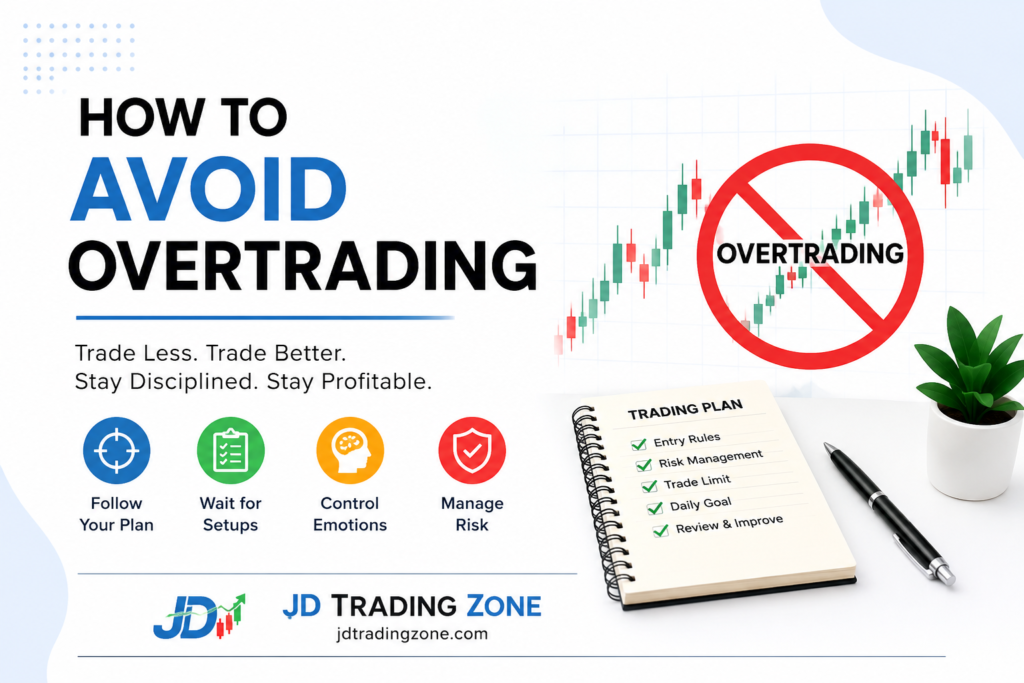
How to Avoid Overtrading
Overtrading means taking trades that are more frequent, larger, or less selective than your trading plan allows.
For example, imagine a trader normally waits for a specific breakout setup. One morning, the setup does not appear.
Instead of waiting, the trader starts entering trades based on small price movements.
After one trade loses money, the trader immediately takes another trade to recover the loss. That trade also fails, so the trader enters again with an even stronger urge to make the money back.
This cycle can continue throughout the session.
That is overtrading.
Overtrading can also happen when a trader:
• Enters trades without a defined setup
• Trades because the market feels exciting
• Takes revenge trades after a loss
• Keeps trading after reaching their daily target
• Increases position size emotionally
• Chases a move after missing the initial entry
• Trades during unsuitable market conditions
• Takes multiple low-quality setups instead of waiting for one high-quality opportunity
The key point is simple:
More trades do not automatically mean more opportunities to make money.
Sometimes, the best trading decision is to do nothing.
Why Do Traders Overtrade?
Overtrading usually has an emotional or behavioral cause. Understanding the reason behind it makes it easier to control.
1. Revenge Trading
A trader loses ₹1,000 and immediately wants to recover it.
Instead of waiting for the next valid setup, they enter another trade simply because they want their money back.
If that trade loses too, frustration increases.
This can create a dangerous cycle:
Loss → frustration → impulsive trade → another loss → larger trade → bigger loss
The market does not know that you lost money on your previous trade. Your next trade should therefore be evaluated independently.
2. Fear of Missing Out
FOMO occurs when traders see a stock moving rapidly and feel that they must enter immediately.
For example, a stock suddenly breaks resistance and moves sharply upward. A trader who missed the initial breakout may buy at a much worse price simply because they are afraid the move will continue without them.
But a missed trade is not a loss.
There will always be another market opportunity.
A disciplined trader should be comfortable saying:
“I missed this setup, so I will wait for the next one.”
3. Boredom
Markets can remain quiet for long periods.
Beginners sometimes feel that they need to trade because they are sitting in front of a chart.
This creates a dangerous mindset:
“Nothing is happening, so I should find a trade.”
Instead, use:
“Nothing is happening, so I should wait.”
Trading is not a game where you need to stay active continuously.
4. Trying to Recover Losses Quickly
One of the biggest mistakes is believing that a large trade can quickly recover a small loss.
Suppose a trader loses ₹500.
They then increase their position size because they want to make ₹1,000 on the next trade.
If the next trade loses, the problem becomes larger.
This is why risk should be determined before entering the trade, not after a loss.
5. Overconfidence After Winning
Overtrading does not happen only after losses.
A trader who wins three trades in a row may start believing that they cannot lose.
They may:
• Increase position size
• Ignore their entry rules
• Take weaker setups
• Trade more frequently
• Move their stop-loss
• Continue trading after reaching their daily goal
A winning streak can create the same discipline problem as a losing streak.
Common Signs That You Are Overtrading
You may be overtrading if several of these behaviors regularly occur.
→ Before entering a trade
• You cannot clearly explain why you are entering.
• You are entering because the price is moving quickly.
• You missed an earlier entry and are chasing the market.
• Your setup does not match your trading plan.
• You feel anxious about missing the opportunity.
→ After a losing trade
• You immediately look for another trade.
• You increase your position size.
• You want to “get the money back.”
• You become angry at the market.
• You stop following your rules.
→ After a winning trade
• You feel unusually confident.
• You increase your risk.
• You start taking weaker setups.
• You believe the next trade will also win.
→ At the end of the session
• You cannot explain why you took some trades.
• You took significantly more trades than planned.
• You traded even after reaching your daily loss limit.
• You feel mentally exhausted.
• You regret several entries.
These are useful warning signs.
Overtrading
The good news is that overtrading can be controlled with a structured process.
1. Create a Written Trading Plan
A trading plan should tell you when you can trade and when you must stay out.
Your plan can include:
• Market or instrument
• Trading session
• Preferred timeframe
• Entry conditions
• Stop-loss rules
• Target rules
• Maximum risk per trade
• Maximum number of trades
• Daily loss limit
• Conditions for stopping trading
For example:
Trading rule
“I will only enter when my predefined setup appears and all required conditions are satisfied.”
This simple rule can eliminate many impulsive trades.
2. Set a Maximum Number of Trades
A maximum trade limit can help prevent emotional decision-making.
For example, a beginner might create a rule such as:
Maximum: 2–3 planned trades per session.
The exact number should depend on the trader’s strategy and market.
The important part is not the number itself.
The purpose is to prevent:
“I will keep trading until I make money.”
Instead, the mindset becomes:
“I will take only the opportunities that meet my rules.”
A trade limit should not be treated as a magic number. A strategy that genuinely produces more valid setups may require a different structure.
3. Use a Pre-Trade Checklist
Before clicking the Buy or Sell button, ask yourself a few questions.
• Pre-trade checklist
• Is this my planned setup?
• Is the market condition suitable?
• Where is my entry?
• Where is my stop-loss?
• Where is my target?
• What is my risk-to-reward relationship?
• Am I entering because of my rules or because of an emotion?
• Have I already reached my daily trade limit?
• Am I trying to recover a previous loss?
If you cannot answer these questions clearly, consider skipping the trade.
A checklist creates a small pause between emotion and action.
4. Define Your Daily Loss Limit
A daily loss limit tells you when to stop trading for the day.
For example, a trader may decide:
“If my total loss reaches my predetermined daily limit, I stop trading.”
The purpose is not to prevent every losing day.
Losing trades are part of trading.
The purpose is to prevent one bad session from becoming a much larger loss.
Once the limit is reached, continuing to trade simply because you want to recover the loss can turn a manageable day into a serious problem.
5. Take a Break After a Loss
A short break after a losing trade can help prevent impulsive decisions.
Instead of immediately searching for another entry:
1. Close the trade.
2. Record the result.
3. Step away from the chart for a few minutes.
4. Review whether the trade followed your plan.
5. Return only when you are calm.
If the loss followed your rules, it was simply a losing trade.
If the loss happened because you broke your rules, the priority should be correcting the behavior—not immediately making another trade.
6. Stop Chasing the Market
A common overtrading pattern looks like this:
Breakout starts → trader misses entry → price moves further → trader enters late → price pulls back → trader panics
Instead of chasing, wait for a new opportunity.
Depending on your strategy, that could be:
• A pullback
• A retest
• A new breakout
• A fresh support/resistance reaction
• Another valid setup
If none occurs, do nothing.
No trade is better than a low-quality trade.
7. Avoid Trading Just Because You Are
Watching the Chart
Being in front of a chart does not mean you need to trade.
This is especially important for beginners who spend several hours watching price movements.
Try changing your mindset:
Chart watching ≠ trading opportunity
You are there to identify your setup.
If your setup does not appear, your job is simply to wait.
8. Use Alerts Instead of Constantly
Watching Price
Constant chart monitoring can encourage impulsive entries.
Instead, identify important price levels and use alerts where your trading platform supports them.
For example:
• Support level
• Resistance level
• Breakout level
• Retest area
• Indicator condition
When an alert triggers, check whether the complete setup is present.
An alert should notify you about an opportunity—not automatically become a reason to enter.
9. Keep Position Size Consistent
Changing position size based on emotions is another form of overtrading.
A trader may use a small position after a few losses and suddenly take a much larger position after a winning streak.
This makes risk unpredictable.
Instead, define your risk before entering.
For example:
“I will risk only a predetermined portion of my trading capital on each planned trade.”
The exact percentage depends on your personal circumstances, strategy, and risk tolerance.
What matters most is consistency.
10. Create a “No Trade” List
Most beginners focus only on entry rules.
Experienced traders also define situations where they will not trade.
Your no-trade conditions might include:
• No clear setup
• Very low-quality price action
• Extremely choppy market conditions
• You have reached your daily loss limit
• You have reached your maximum number of trades
• You are emotionally frustrated
• You are trying to recover a previous loss
• You are entering because of FOMO
• The risk-to-reward setup is poor
Knowing when not to trade is an important part of a trading strategy.
A Simple Anti-Overtrading Routine
Here is a practical routine beginners can use.
→ Before the Market Opens
Write down:
1. What will I trade?
Example: One selected instrument.
2. What setup am I waiting for?
Example: Breakout followed by confirmation.
3. What is my maximum risk?
Decide before the session.
4. What is my maximum number of trades?
Set a reasonable limit.
5. What is my daily loss limit?
Define it before trading begins.
→ During the Trading Session
Wait for your setup.
When an opportunity appears, check:
Setup → Entry → Stop-loss → Target → Risk → Execute
If one of the important conditions is missing, wait.
After a trade closes, record the result instead of immediately searching for another trade.
After the Trading Session
Review your trades.
Ask:
• Did I follow my setup?
• Did I respect my risk?
• Did I take unnecessary trades?
• Did I chase any move?
• Did I revenge trade?
• Did I follow my maximum trade limit?
• Did I stop when I was supposed to stop?
This review is often more valuable than simply looking at whether you made money.
Example: How Overtrading Can Develop
Imagine a trader starts the day with a predefined strategy.
The first trade loses ₹500.
Instead of waiting, the trader immediately enters another trade.
That trade loses ₹700.
The trader becomes frustrated and increases the position size.
The third trade loses ₹1,200.
Now the trader wants to recover everything quickly and takes two more trades.
Even if the original strategy was reasonable, the trader has now turned one normal losing trade into a much larger problem.
The issue was not necessarily the first loss.
The issue was the behavior after the loss.
A disciplined alternative would be:
Trade 1 loses → review → pause → wait for next valid setup → continue only if rules are satisfied.
And if the predetermined daily loss limit is reached:
Stop trading.
Overtrading vs. Active Trading
It is important to understand that taking several trades does not automatically mean you are overtrading.
→ Active trading
• Trades follow a tested strategy
• Risk is predefined
• Entries meet specific conditions
• Position size is controlled
• Trades are recorded
• The trader accepts losses
• There is a clear reason for each trade
→ Overtrading
• Trades are taken impulsively
• Entries are based on emotions
• Risk changes frequently
• Losses trigger more trades
• The trader chases price
• There is no clear setup
• The trader continues despite reaching limits
The difference is discipline and process, not simply the number of trades.
A 5-Question Rule Before Every Trade
If you want something extremely simple, use these five questions:
1. What is my setup?
If you cannot name it, don’t trade.
2. Why now?
You should have a specific reason for the entry.
3. Where am I wrong?
Know your stop-loss or invalidation point before entering.
4. How much am I risking?
Know the potential loss before clicking the order button.
5. Am I trading my plan or my emotions?
This final question can prevent many impulsive trades.
Keep a Trading Journal
A trading journal is one of the simplest ways to identify overtrading patterns.
“Was this trade necessary?”
After 20–30 trades, patterns may become easier to identify.
You might discover that most of your unnecessary losses happen after your first losing trade, late in the session, or when you chase fast-moving stocks.
That information can help you improve your rules.
What to Do After a Losing Day
A losing day does not automatically mean your strategy is bad.
First separate two things:
→ Strategy problem
Your setup may genuinely have poor performance or may not suit the current market conditions.
→ Execution problem
You may have broken your own rules.
These require different solutions.
If you followed your plan and experienced a normal losing day, review the trade objectively.
If you broke your rules repeatedly, focus on improving execution before changing your entire strategy.
Avoid changing your strategy after every losing trade.
What to Do After a Winning Day
Winning days can also create overtrading.
Suppose your target for the day has already been reached.
You continue trading because:
“The market is moving well today.”
One unnecessary trade can give back a significant portion of your earlier profit.
Consider creating a rule such as:
Once my daily objective or maximum planned trading activity is reached, I stop unless my strategy explicitly requires otherwise.
Again, the exact rule should fit your system.
The Most Important Mindset Shift
Many beginners think:
“I need to find trades.”
A better mindset is:
“I need to find only trades that meet my rules.”
That small change can dramatically improve decision-making.
Your job is not to predict every market movement.
Your job is to wait for situations where your strategy gives you a reason to participate.
Frequently Asked Questions
Is overtrading always caused by greed?
→ No.
Overtrading can be caused by greed, but also by fear, boredom, revenge, FOMO, frustration, overconfidence, or simply a lack of a trading plan.
How many trades per day is too many?
→ There is no universal number.
The appropriate number depends on your strategy, timeframe, market, and trading plan.
Instead of copying someone else’s number, define the maximum number of trades that your own strategy reasonably allows.
Should I stop trading after one loss?
→ Not necessarily.
One losing trade does not automatically mean you should stop.
However, if you notice that losses make you emotional or cause you to break your rules, taking a break can be useful.
A predefined daily loss limit is generally more useful than making emotional decisions after individual trades.
Is taking no trade a bad thing?
→ No.
A no-trade day can be a successful day if your strategy did not provide a valid opportunity.
Protecting your capital is also part of trading.
Can a trading journal help with overtrading?
→ Yes.
A journal can reveal when, why, and under what emotional conditions you take unnecessary trades.
Reviewing your journal regularly can help you identify repeat mistakes.
Should beginners limit the number of trades?
→ A reasonable trade limit can help beginners develop discipline and prevent impulsive trading.
However, the limit should support the strategy rather than be treated as a guaranteed solution.
Final Takeaway
Overtrading is not solved by finding another indicator or a better entry strategy.
It is primarily a risk-management and discipline problem.
To reduce overtrading:
• Create a written trading plan
• Define your entry conditions
• Set a maximum trade limit
• Establish a daily loss limit
• Use a pre-trade checklist
• Avoid revenge trading
• Stop chasing the market
• Keep position size consistent
• Take breaks after emotional trades
• Record every trade in a journal
• Learn to accept no-trade days
Most importantly, remember:
You don’t have to trade every market movement. You only need to trade the opportunities that fit your plan.
A disciplined trader understands that sometimes the best position is no position at all.
Disclaimer
This article is provided for educational and informational purposes only. It is not financial, investment, or trading advice. Trading stocks, futures, options, forex, cryptocurrencies, or other financial instruments involves risk, and you can lose money. Always understand the risks involved and consider seeking advice from a qualified financial professional before making trading decisions.
unlocker.ai – The Ultimate AI Tool for Bypassing Restrictions and Unlocking Content Seamlessly!
Pingback: Best Risk Management Strategy for a Small Trading Account - jdtradingzone.com
Pingback: Best Chart Patterns for Trading - jdtradingzone