I wish I had known about this from the beginning because only a trading psychology can take long for you in trading.
Welcome to JD Trading Zone
Many beginners think that the biggest challenge in trading is finding the perfect strategy or indicator. In reality, the biggest challenge is controlling your own emotions.
Two traders can use the same strategy, enter at the same price, and have the same risk management. Yet one makes consistent profits while the other keeps losing money. The difference is often trading psychology.
Fear, greed, and FOMO (Fear of Missing Out) are responsible for many poor trading decisions. Learning how to manage these emotions can improve your consistency far more than constantly changing strategies.
Also check:- (What Is Risk-Reward Ratio? Why Every Trader Should Use It) (How to Choose Stocks for Intraday Trading Every Morning) (Best Time Frame for Intraday Trading) (Top 10 mistakes new traders make and how to avoid them) (Price action trading explained learn without indicator)
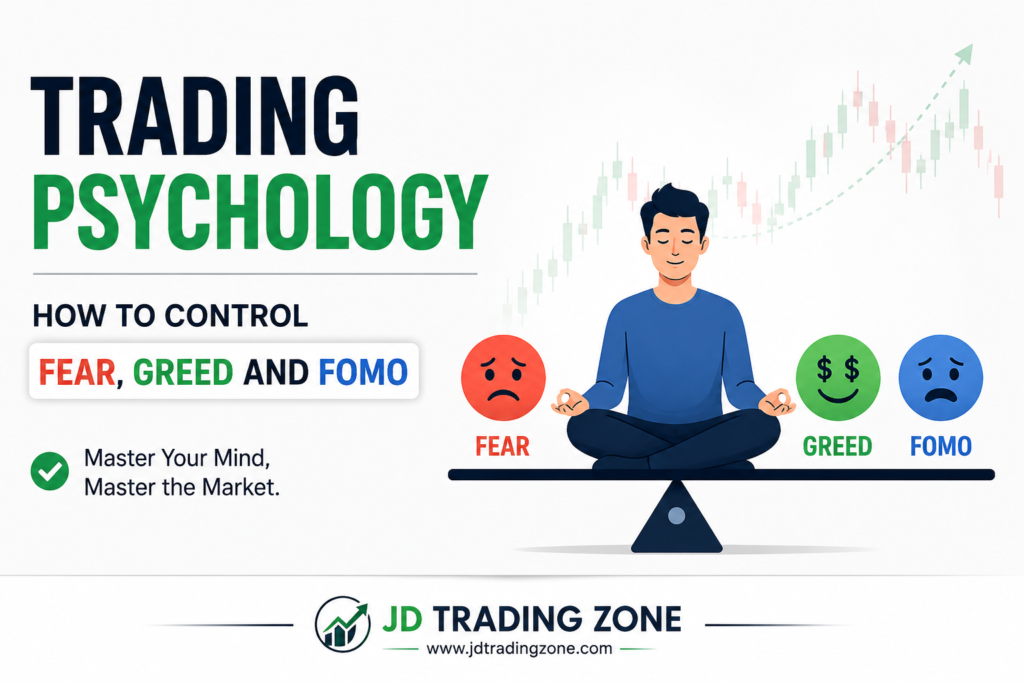
Trading Psychology and How to Control Fear, Greed, and FOMO
What Is Trading Psychology?
Trading psychology refers to the emotions, thoughts, and mental habits that influence your trading decisions.
Every trade involves uncertainty. Since no setup guarantees success, emotions naturally appear. Successful traders don’t eliminate emotions—they learn how to manage them.
Good trading psychology helps you:
• Follow your trading plan
• Accept losses calmly
• Avoid emotional decisions
• Stay disciplined
• Think in probabilities instead of certainties
Why Psychology Is More Important Than Strategy
Imagine two traders using the same profitable strategy.
→ Trader A
• Waits patiently for valid setups.
• Uses proper position sizing.
• Accepts small losses.
• Follows the trading plan.
→ Trader B
• Takes random trades.
• Increases position size after losses.
• Closes winners too early.
• Holds losing trades hoping they recover.
Although both use the same strategy, Trader A is far more likely to succeed because of discipline.
A good strategy without emotional control often performs worse than a simple strategy followed consistently.
The Three Biggest Emotional Enemies in Trading
1. Fear
Fear is one of the strongest emotions in financial markets.
It often appears after a few losing trades or during highly volatile market conditions.
→ Common Signs of Fear
• Not taking good trading setups
• Closing profitable trades too early
• Constantly changing stop-loss
• Hesitating before entering trades
• Avoiding trading completely after losses
→ Why Fear Happens
Fear usually comes from:
• Risking too much money
• Previous large losses
• Lack of confidence
• Unrealistic expectations
→ How to Control Fear
Risk Only What You Can Afford to Lose
If every trade feels stressful, your position size is probably too large.
Lower your risk until losses become emotionally manageable.
2. Greed
Greed causes traders to ignore their trading plans in the hope of making more money.
Instead of protecting profits, greedy traders often take unnecessary risks.
→ Common Signs of Greed
• Overtrading
• Increasing lot size without reason
• Ignoring risk management
• Holding profitable trades too long
• Trading without proper setups
→ Why Greed Is Dangerous
Greed often turns profitable days into losing days.
Many traders make good profits in the morning but continue trading simply because they want more.
Eventually, they give everything back.
→ How to Control Greed
Set Daily Profit Goals:
Once your planned target is achieved, consider stopping for the day.
This prevents unnecessary emotional trades.
Follow Fixed Risk-Reward Ratios:
Decide your target before entering a trade.
Avoid changing targets based on emotions.
Don’t Increase Position Size Emotionally:
Increase position size only after consistent performance—not after one winning trade.
Remember That Opportunities Never End:
The stock market opens regularly.
Missing one opportunity is far better than losing your capital.
3. FOMO (Fear of Missing Out)
FOMO is the urge to enter trades simply because the market is moving.
This is one of the biggest reasons beginners buy at the top or sell at the bottom.
→ Signs of FOMO
• Chasing fast-moving stocks
• Entering after a large candle
• Buying because everyone else is buying
• Trading based on social media excitement
Ignoring your trading rules
→ Why FOMO Happens
People naturally dislike feeling left behind.
When traders see others posting profits, they feel pressured to trade immediately.
However, social media usually shows winning trades—not losing ones.
→ How to Control FOMO
Wait for Confirmation
Never enter a trade simply because price is moving quickly.
Wait until your strategy gives a proper signal.
Create a Trading Checklist
Before every trade, ask:
• Does this setup match my strategy?
• Is risk acceptable?
• Is stop-loss defined?
• Is reward greater than risk?
• Am I trading emotionally?
If the answer is “No” to any important rule, skip the trade.
Limit Social Media During Market Hours
Constantly watching other traders can create unnecessary pressure.
Focus on your own trading plan instead.
Accept That Missing Trades Is Normal
Professional traders skip many opportunities.
Patience is part of successful trading.
Other Psychological Mistakes Beginners Make
→ Revenge Trading
Trying to recover losses immediately often leads to even bigger losses.
Take a short break after consecutive losing trades.
→ Overconfidence
A few winning trades do not make you invincible.
Continue following your rules regardless of recent success.
→ Lack of Patience
Many beginners feel they must trade every day.
In reality, sometimes the best trade is no trade.
→ Confirmation Bias
Some traders only look for information that supports their opinion.
Always consider both bullish and bearish possibilities.
Daily Habits That Improve Trading Psychology
Developing good habits is more effective than relying on willpower.
Here are simple habits that help:
• Create a written trading plan.
• Maintain a trading journal.
• Review every trade weekly.
• Sleep properly before trading.
• Avoid trading when emotionally stressed.
• Exercise regularly.
• Follow proper risk management.
• Take breaks after losses.
• Avoid comparing yourself with others.
• Keep realistic expectations.
The Importance of a Trading Journal
A trading journal helps identify emotional mistakes.
Record details such as:
• Entry price
• Exit price
• Stop-loss
• Target
• Risk percentage
• Reason for entry
• Emotional state
• Lessons learned
After reviewing dozens of trades, patterns become much easier to identify.
Example of Emotional vs Disciplined Trading
→ Emotional Trader
• Sees price rising rapidly.
• Buys without confirmation.
• Moves stop-loss.
• Holds losing trade.
• Exits with a large loss.
→ Disciplined Trader
• Waits for confirmation.
• Follows trading rules.
• Uses fixed stop-loss.
• Accepts small losses.
• Protects capital for future opportunities.
The second trader may not win every trade, but they have a much better chance of long-term success.
Practical Tips to Build Strong Trading Discipline
• Trade only according to your written strategy.
• Never risk more than a small percentage of your capital on one trade.
• Accept that losses are part of trading.
• Avoid chasing the market.
• Stick to your stop-loss.
• Focus on consistency instead of quick profits.
• Review your mistakes regularly.
• Continue learning and improving.
Frequently Asked Questions (FAQs)
Can trading psychology really improve profitability?
→ Yes. Emotional discipline helps traders follow their strategy consistently, avoid unnecessary mistakes, and manage risk more effectively.
What is the biggest emotional problem for beginners?
→ FOMO is one of the most common challenges. Many beginners enter trades too late because they fear missing a price move.
How can I stop emotional trading?
→ Create a trading plan, follow risk management rules, maintain a trading journal, and only trade when your setup meets all your conditions.
Can meditation help traders?
→ Many traders find meditation, deep breathing, or mindfulness exercises useful for improving focus and reducing emotional reactions during market hours.
Final takeaway
Success in trading is not determined only by technical analysis or indicators. It also depends on your ability to manage your emotions.
Fear can stop you from taking good trades. Greed can make you risk too much. FOMO can push you into poor-quality setups.
The goal is not to eliminate emotions but to prevent them from controlling your decisions.
With a solid trading plan, proper risk management, patience, and continuous self-improvement, you can build the mental discipline needed for long-term success.
Remember, protecting your capital and following your rules consistently are often more important than trying to catch every market move.
Pingback: How to Create a Trading Plan That Actually Works - jdtradingzone.com
Pingback: Swing Trading vs Intraday Trading: Which Is Better for Beginners? - jdtradingzone