In trading mist important thing to learn is risk management and this guide explain a best risk management strategy for a small trading account, including how much to risk per trade, how to calculate position size, where to use stop-losses, how to set daily loss limits, and how to avoid common mistakes.
Welcome to JD Trading Zone
Trading with a small account can be challenging. A few losing trades can feel significant, while the temptation to take bigger risks to grow the account quickly can lead to even larger losses.
This is why risk management is more important than finding the perfect trading strategy.
A good risk management plan does not guarantee profits. Instead, it helps protect your trading capital, control losses, reduce emotional decision-making, and give your strategy enough time to work.
For beginners, the goal should not be to double a small account quickly. The first goal should be to survive, learn, and build consistency.
Also check:- (How to Avoid Overtrading) (Gap-Up and Gap-Down Trading Guide) (Opening Range Breakout Strategy) (EMA Crossover Strategy Explained) (VWAP Trading Strategy Step by Step)
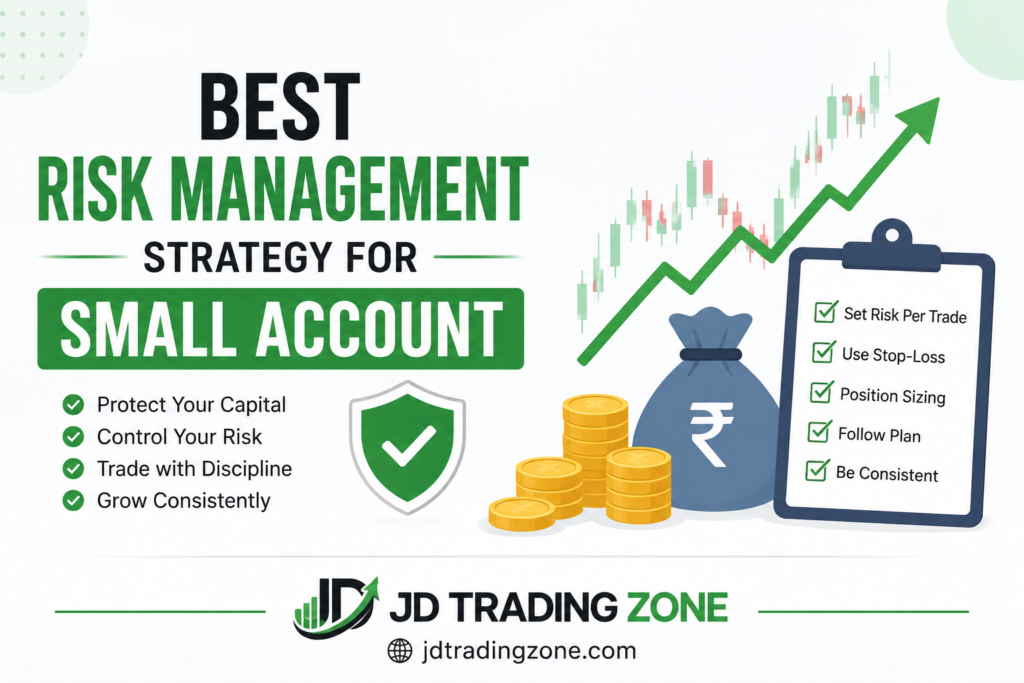
Best Risk Management Strategy for a Small Trading Account
What Is Risk Management in Trading?
Risk management is the process of deciding how much money you are willing to lose before entering a trade.
Before placing a trade, a trader should know:
• How much capital is available
• How much can be lost on the trade
• Where the stop-loss will be placed
• How many shares or contracts can be traded
• Where the trade becomes invalid
• What risk-to-reward ratio is acceptable
• How much can be lost in a single day
The purpose is simple:
One losing trade should never have the power to seriously damage your trading account.
A profitable strategy without proper risk management can still destroy an account if position sizes are too large.
Why Risk Management Is Especially Important for Small Accounts
Small accounts have less room for error.
Suppose a trader has ₹20,000 and loses ₹4,000 on one trade. That is a 20% loss of the account.
Recovering from large losses becomes increasingly difficult.
A trader who loses 50% of their account needs another 100% return just to get back to the starting point.
Therefore, small-account traders should focus on loss control rather than aggressive account growth.
The Best Risk Management Strategy for a Small Account
There is no single risk management rule that is perfect for every trader. However, a simple framework can work well for beginners.
A practical approach is:
1. Risk only a small percentage per trade
For many beginners, 0.5% to 1% of account equity per trade is a reasonable educational starting point.
For example, with a ₹50,000 account:
• 0.5% risk = ₹250
• 1% risk = ₹500
That means if your stop-loss is hit, the planned loss should be approximately within that amount, excluding applicable trading costs and slippage.
More experienced traders may use different risk levels, but beginners should generally avoid risking a large percentage simply because the account is small.
2. Use a Stop-Loss Before Entering the Trade
A stop-loss defines the point where your trading idea is considered wrong.
For example:
You buy a stock at ₹500.
Your analysis says the trade becomes invalid below ₹490.
Your stop-loss could therefore be placed around ₹490, depending on the strategy and market conditions.
The important point is that the stop-loss should be based on market structure or trade invalidation, not simply an arbitrary amount of money.
Avoid thinking:
“I will put my stop-loss exactly ₹5 away because I only want to lose ₹500.”
Instead, first determine where the trade setup becomes invalid.
Then calculate the position size according to your acceptable risk.
This is a major difference between risk-based trading and randomly choosing a quantity.
3. Calculate Position Size Before Entering
Position sizing is one of the most useful tools for small-account traders.
The basic formula is:
Position Size = Maximum Risk ÷ Risk Per Share
For example:
• Account size = ₹50,000
• Maximum risk = 1%
• Maximum loss = ₹500
• Entry price = ₹250
• Stop-loss = ₹240
• Risk per share = ₹10
Therefore:
Position Size = ₹500 ÷ ₹10 = 50 shares
If the stop-loss is hit, the planned loss is approximately:
50 × ₹10 = ₹500
This approach automatically adjusts your position size according to the distance between your entry and stop-loss.
4. Don’t Increase Position Size Just Because
Your Account Is Small
A common beginner mistake is thinking:
“My account is small, so I need to take bigger trades to make meaningful money.”
This mindset can be dangerous.
Suppose you have ₹20,000 and decide to risk ₹2,000 on every trade.
That is 10% of your account per trade.
Five consecutive losses could reduce the account by approximately 50%, before considering compounding effects and costs.
Instead, focus on keeping losses manageable.
A small account does not need an aggressive strategy.
It needs a survival strategy.
5. Set a Maximum Daily Loss Limit
A daily loss limit can prevent emotional trading after a bad start.
For example, if your account is ₹50,000 and you decide your maximum daily loss is 2%:
₹50,000 × 2% = ₹1,000
Once your realized trading losses reach your daily limit, stop trading for that session.
This can help prevent:
• Revenge trading
• Overtrading
• Increasing position size after a loss
• Taking low-quality setups
• Trying to recover losses immediately
The purpose of a daily loss limit is not to prevent every losing day.
It is to prevent one bad day from becoming a disastrous day.
6. Limit the Number of Trades
More trades do not automatically mean more profits.
A small-account trader may benefit from focusing on a limited number of high-quality setups instead of taking every market movement.
For example, you might create a personal rule such as:
Maximum 2–3 trades per session
This is not a universal rule. Your strategy may require a different number.
The important principle is:
Trade your setup, not your boredom.
If there is no valid setup, staying out of the market is also a decision.
7. Maintain a Minimum Risk-to-Reward Ratio
Risk-to-reward ratio compares the amount you are willing to lose with the potential profit.
Suppose:
• Risk = ₹500
• Potential reward = ₹1,000
Your risk-to-reward ratio is:
1:2
This means you are risking ₹1 to potentially make ₹2.
A favorable risk-to-reward ratio can allow a strategy to remain profitable even when not every trade wins.
For example, consider 10 trades:
• 4 winners × ₹1,000 = ₹4,000
• 6 losers × ₹500 = ₹3,000
Result:
₹4,000 − ₹3,000 = ₹1,000 profit
This is only an illustration. Actual results depend on execution, trading costs, slippage, and the strategy’s real performance.
Win Rate Is Not the Only Thing That Matters
Beginners often search for a strategy with the highest win rate.
But win rate alone does not determine profitability.
Consider two systems:
→ Strategy A
• Win rate: 70%
• Average win: ₹300
• Average loss: ₹700
→ Strategy B
• Win rate: 40%
• Average win: ₹1,000
• Average loss: ₹500
A lower win-rate strategy can potentially be profitable if its average winning trades are sufficiently larger than its average losing trades.
This is why you should evaluate:
• Win rate
• Average win
• Average loss
• Risk-to-reward ratio
• Maximum drawdown
• Number of trades
• Trading costs
rather than focusing only on accuracy.
8. Never Move Your Stop-Loss Further Away to Avoid a Loss
This is one of the most common mistakes among beginners.
Suppose you enter a trade at ₹500 and set your stop-loss at ₹490.
Price falls to ₹491.
Instead of accepting the planned loss, you move the stop-loss to ₹480.
Then price falls further.
You move it again.
Eventually, a manageable loss can become a large loss.
If your original trading idea is invalidated, accepting the small planned loss is usually better than repeatedly expanding your risk.
A stop-loss should be part of your trading plan before the trade is entered.
9. Don’t Risk Your Entire Account on One Trade
Avoid putting a large portion of your account into a single speculative trade simply because you believe the setup is “sure.”
There is no guaranteed trade in the market.
Unexpected events can cause:
• Sudden price movements
• Gaps
• Slippage
• Liquidity problems
• News-driven volatility
Risk management exists because even a good-looking setup can fail.
10. Be Extra Careful With Leverage and Options
Leverage can make a small account appear larger than it actually is.
It can increase both potential gains and potential losses.
Options trading can be particularly risky for beginners because option prices are influenced by factors beyond the underlying price, including volatility and time decay.
A small account should not be treated as a reason to use maximum leverage.
Instead, understand:
• Contract size
• Premium movement
• Stop-loss risk
• Liquidity
• Volatility
• Expiry-related risks
• Brokerage and other costs
Before trading leveraged products, make sure you understand how the product works.
A Simple Small-Account Risk Management Plan
Here is an example framework that beginners can adapt to their own trading system.
→ Account Size
₹50,000
→ Risk Per Trade
0.5%–1%
→ Maximum planned risk:
₹250–₹500
→ Maximum Daily Loss
Around 2% as an example:
₹1,000
→ Maximum Trades
2–3 quality setups per session
→ Stop-Loss
Based on the technical invalidation point
→ Position Size
Calculated from the distance between entry and stop-loss
→ Risk-to-Reward
Prefer setups where the potential reward reasonably justifies the risk.
→ After Reaching Daily Loss Limit
Stop trading for the day.
This is an example framework, not a guaranteed formula. Traders should adjust it according to their strategy, experience, financial situation, and risk tolerance.
Example: Complete Risk Calculation
Let’s use a simple example.
Your account:
₹30,000
You decide to risk:
1% per trade
Maximum risk:
₹300
Suppose your setup gives:
Entry = ₹150
Stop-loss = ₹144
Risk per share = ₹6
Position size:
₹300 ÷ ₹6 = 50 shares
So your maximum planned trade risk is:
50 × ₹6 = ₹300
Now suppose your target is ₹162.
Potential reward per share:
₹162 − ₹150 = ₹12
Total potential reward:
50 × ₹12 = ₹600
Therefore:
Risk = ₹300
Potential Reward = ₹600
Risk-to-Reward = 1:2
Again, this is an educational example. Real execution may differ because of brokerage, taxes, slippage, gaps, and other trading costs.
What If the Stop-Loss Is Too Wide?
Sometimes the technically correct stop-loss is far away.
For example:
• Account risk = ₹300
• Entry = ₹100
• Technical stop = ₹90
• Risk per share = ₹10
Position size:
₹300 ÷ ₹10 = 30 shares
You do not need to increase your risk simply because the stop-loss is wider.
Instead, reduce your position size.
This is the essence of position sizing:
The stop determines the risk per unit. Your account risk determines the quantity.
The Small Account Growth Trap
One of the biggest dangers for small-account traders is unrealistic return expectations.
A trader may think:
“I have ₹10,000. I want to make ₹1,000 every day.”
That means trying to make 10% of the account every day.
Such expectations can encourage:
• Excessive leverage
• Oversized positions
• Revenge trading
• Overtrading
• Ignoring stop-losses
• Taking low-quality setups
Instead, focus on improving your process.
A better question is:
“Did I follow my trading plan today?”
If the answer is yes, you are building the habit that matters.
Keep a Trading Journal
Risk management becomes much more effective when you record your trades.
For every trade, record:
• Date
• Instrument
• Entry price
• Stop-loss
• Target
• Position size
• Planned risk
• Actual result
• Risk-to-reward ratio
• Reason for entry
• Reason for exit
• Mistakes
• Emotional state
After 30–50 trades, review the data.
You may discover that:
• Certain setups perform better
• You trade too frequently
• Your losses are larger than planned
• You move stop-losses
• You perform poorly during certain market conditions
A trading journal turns random experience into measurable feedback.
Common Risk Management Mistakes
1. Risking Too Much on One Trade
→ A single loss should not seriously damage your account.
2. Trading Without a Stop-Loss
→ Without predefined risk, losses can become difficult to control.
3. Increasing Size After a Loss
→ Trying to recover immediately often creates even larger losses.
4. Revenge Trading
→ Trading emotionally after a loss can lead to poor-quality setups.
5. Moving the Stop-Loss
→ Changing your stop simply because you do not want to accept a loss can destroy your original risk calculation.
6. Ignoring Trading Costs
→ Brokerage, taxes, exchange charges, and slippage can affect actual returns.
7. Using Excessive Leverage
→ Leverage can magnify losses just as quickly as gains.
8. Chasing Every Breakout
→ Not every breakout is a high-quality setup.
9. Focusing Only on Win Rate
→ A high win rate does not automatically mean a profitable strategy.
10. Trying to Become Rich Quickly
→Aggressive return expectations often encourage aggressive risk-taking.
A 5-Step Risk Management Checklist
Before every trade, ask:
Step 1: What is my setup?
→ Can I clearly explain why I am entering?
Step 2: Where is my stop-loss?
→ Where does my trading idea become invalid?
Step 3: How much can I lose?
→ Calculate the maximum acceptable loss before entering.
Step 4: What is my position size?
→ Calculate quantity based on account risk and stop-loss distance.
Step 5: Is the potential reward worth the risk?
→ If the setup does not provide a reasonable opportunity, skip it.
If you cannot answer these five questions, you may not be ready to enter the trade.
Best Risk Management Rules for Small Accounts
If you want a simple set of rules to remember, use this framework:
Rule 1: Protect capital first.
Rule 2: Keep risk per trade small.
Rule 3: Always know your stop-loss before entering.
Rule 4: Calculate position size instead of choosing quantity randomly.
Rule 5: Set a daily loss limit.
Rule 6: Stop trading after reaching your daily loss limit.
Rule 7: Never increase risk to recover a previous loss.
Rule 8: Avoid excessive leverage.
Rule 9: Keep a trading journal.
Rule 10: Focus on consistency instead of quick account growth.
Final wodrs
The best risk management strategy for a small trading account is not the strategy that produces the biggest daily profit. It is the strategy that keeps losses controlled while giving your trading system enough opportunities to work.
A small account should be treated as a learning account, not a shortcut to becoming rich quickly.
Start by defining your maximum risk, calculating position size, using a logical stop-loss, limiting daily losses, and reviewing your trades regularly.
Remember:
You don’t need to win every trade. You need to make sure that losing trades don’t destroy your ability to keep trading.
Good trading is not only about finding entries. It is also about managing what happens when you are wrong.
Disclaimer: This article is for educational and informational purposes only. It is not financial, investment, or trading advice. Trading stocks, futures, options, and other financial instruments involves risk, and you can lose money. Always understand the product and risks involved before trading and consider seeking advice from a qualified financial professional where appropriate.
Pingback: How to Build Consistency in Trading - jdtradingzone.com
Pingback: Best Chart Patterns for Trading - jdtradingzone.com
Helpful info. Fortunate me I found your site unintentionally, and I’m stunned why
this coincidence didn’t took place in advance! I bookmarked it.