
Hello guys today we will learn everything about the EMA crossover strategy explained, including how it works, the best EMA combinations, entry and exit rules, advantages, disadvantages, and practical tips for beginners.
Welcome to JD Trading Zone
Important: This article is for educational purposes only and should not be considered financial advice.
The EMA crossover strategy is one of the most popular trading strategies used by beginners and experienced traders. It helps traders identify potential trend changes by comparing two Exponential Moving Averages (EMAs).
Whether you trade stocks, indices, futures, or options, an EMA crossover can provide simple and objective trading signals. However, like every trading strategy, it works best when combined with proper risk management and confirmation tools.
Also check:- (VWAP Trading Strategy Step by Step) (Volume Price Analysis (VPA) for Beginners) (Fake Breakouts vs Real Breakouts) (How to Trade Breakouts Successfully) (Best Candlestick Patterns for Intraday Trading)
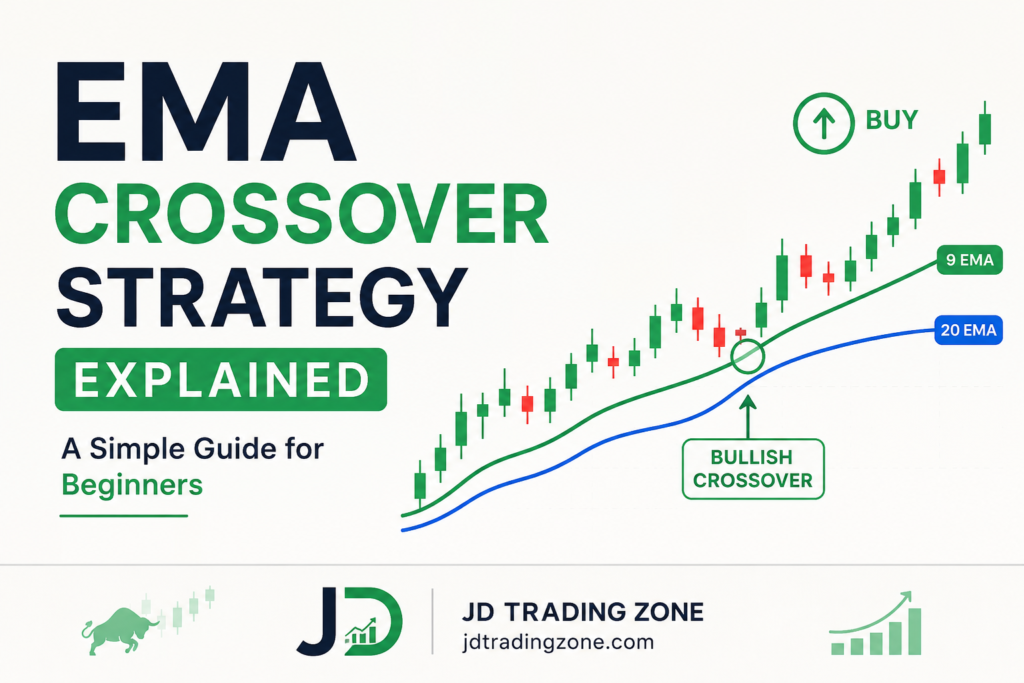
EMA Crossover Strategy Explained
EMA stands for Exponential Moving Average.
An EMA is a moving average that gives more importance to recent prices than older prices. Because it reacts faster to price changes than a Simple Moving
Average (SMA), many traders prefer EMA for short-term and intraday trading.
For example:
• 9 EMA reacts very quickly
• 20 EMA reacts moderately
• 50 EMA shows medium-term trends
• 200 EMA identifies the long-term trend
What is an EMA Crossover?
An EMA crossover happens when one EMA crosses another EMA.
This crossover often signals that market momentum may be changing.
There are two types of crossovers:
→ Bullish Crossover
A bullish crossover occurs when the shorter EMA crosses above the longer EMA.
Example:
9 EMA crosses above 20 EMA
This indicates buyers may be gaining control.
→ Bearish Crossover
A bearish crossover occurs when the shorter EMA crosses below the longer EMA.
Example:
9 EMA crosses below 20 EMA
This suggests sellers may be taking control.
Why Do Traders Use EMA Crossovers?
EMA crossovers help traders:
• Identify new trends
• Filter market noise
• Find entry opportunities
• Define exit signals
• Trade with objective rules instead of emotions
Best EMA Combinations
Different traders use different EMA settings depending on their trading style.
→ Trading Style
• Scalping
• Intraday Trading
• Swing Trading
• Long-Term Investing
→ Popular EMA Combination
• EMA & 13 EMA
• EMA & 20 EMA
• 20 EMA & 50 EMA
• 50 EMA & 200 EMA
There is no perfect setting. Choose one that matches your trading style and test it before using real money.
How the EMA Crossover Strategy Works
Imagine you’re using:
• 9 EMA
• 20 EMA
→ Buy Signal
Look for:
• 9 EMA crosses above 20 EMA
• Price closes above both EMAs
• Volume increases (optional confirmation)
Entry: Buy after the candle closes.
Stop Loss: Below the recent swing low.
Target: Use a Risk-Reward Ratio of at least 1:2 or trail the stop loss as the trend
develops.
→ Sell Signal
Look for:
• 9 EMA crosses below 20 EMA
• Price closes below both EMAs
• Selling volume increases
Entry: Sell after candle confirmation.
Stop Loss: Above the recent swing high.
Target: Use a fixed target or trail your stop loss.
Step-by-Step Example
Suppose a stock has been falling for several days.
Then:
• 9 EMA starts moving upward.
• It crosses above the 20 EMA.
• Price closes above both EMAs.
• Volume is higher than average.
This setup suggests a possible trend reversal, giving traders a potential buying opportunity.
Best Timeframes for EMA Crossover
The strategy can work on multiple timeframes.
→ Scalping
• 1-minute
• 3-minute
• 5-minute
→ Intraday
• 5-minute
• 15-minute
• 30-minute
→ Swing Trading
• Daily chart
• 4-hour chart
Beginners often find the 15-minute or 1-hour timeframe easier because they contain less market noise.
How to Improve EMA Crossover Accuracy
EMA crossovers can generate false signals in sideways markets. Combining them with other tools can improve decision-making.
Useful confirmations include:
• Volume analysis
• VWAP
• RSI
• Price Action
• Support and Resistance
• Trendlines
• Breakouts
The crossover should be one part of your analysis, not the only reason to enter a trade.
Advantages of the EMA Crossover Strategy
Easy to understand
• Beginner-friendly
• Works in many markets
• Removes emotional decision-making
• Identifies trends quickly
• Suitable for stocks, ETFs, futures, forex, and indices
Disadvantages
• Produces false signals in sideways markets
• Sometimes gives late entries after a trend has already started
• Doesn’t predict market reversals perfectly
• Requires risk management
• Needs confirmation during volatile conditions
Common Mistakes Beginners Make
Many new traders misuse EMA crossovers. Avoid these common errors:
→ Trading Every Crossover
Not every crossover leads to a strong trend.
→ Ignoring Market Trend
Buying against a strong downtrend or selling against a strong uptrend increases risk.
→ No Stop Loss
A crossover is not a guarantee. Always define your risk before entering a trade.
→ Chasing the Market
Wait for the candle to close after the crossover instead of entering too early.
→ Using Too Many Indicators
A clean chart with a few reliable tools is often more effective than using many indicators together.
Risk Management Rules
No trading strategy wins every time.
Follow these rules:
• Risk only 1–2% of your trading capital on a single trade.
• Maintain a positive risk-reward ratio such as 1:2 or better.
• Avoid overtrading.
• Keep a trading journal.
• Review your trades regularly.
• Never increase position size to recover losses.
Who Should Use This Strategy?
The EMA crossover strategy is suitable for:
• Beginners learning technical analysis
• Intraday traders
• Swing traders
• Trend-following traders
• Traders looking for simple rule-based systems
It may not suit traders who prefer range-bound or very short-term news-based trading.
Frequently Asked Questions (FAQs)
Is the EMA crossover strategy profitable?
→ It can be profitable when combined with discipline, confirmation tools, and proper risk management. No strategy guarantees profits.
Which EMA crossover is best?
→ The 9 EMA and 20 EMA combination is widely used for intraday trading, while 20 EMA and 50 EMA are popular for swing trading.
Can beginners use EMA crossovers?
→ Yes. It is one of the simplest trend-following strategies for new traders.
Does EMA crossover work in sideways markets?
→ It can produce false signals during sideways conditions. Many traders wait for confirmation from volume, price action, or support and resistance.
Should I use EMA alone?
→ Using EMA with additional analysis often provides better trade quality than relying on EMA alone.
EMA Crossover Strategy Explained
Final words
The EMA crossover strategy is one of the easiest ways to understand trend-following trading. It offers clear entry and exit rules, making it especially helpful for beginners.
However, no indicator is perfect. The most successful traders combine EMA crossovers with sound risk management, patience, and continuous practice. Focus on consistency rather than trying to win every trade.
Remember that trading involves risk. Spend time practicing on historical charts or a demo account before trading with real money.
Pingback: Opening Range Breakout Strategy - jdtradingzone.com
Pingback: Gap-Up and Gap-Down Trading Guide - jdtradingzone.com
Pingback: Best Risk Management Strategy for a Small Trading Account - jdtradingzone.com
Pingback: How to Build Consistency in Trading - jdtradingzone.com
Pingback: How to Avoid Overtrading - jdtradingzone