Hmm what is pre market data analysis if you don’t know, don’t worry about JD Trading Zone is here to explain about pre market data.
Welcome to JD Trading
Many beginners jump into trades as soon as the market opens without understanding what happened before the opening bell. This often leads to emotional decisions and unnecessary losses.
Professional traders know that a good trading day starts before the market opens. By analysing pre-market data, you can identify important price levels, understand market sentiment, and prepare a trading plan instead of reacting emotionally.
Also check:- (VWAP with RSI Strategy for More Accurate Trades) (10 Risk Management Rules Every Trader Must Know) (What Is VWAP in Share Market?) (How is trading better than other professions) (Why Is It So Difficult to Learn Trading?)
How to Use Pre-Market Data for Better Intraday Trades
What Is Pre-Market Data?
Pre-market data refers to the information available before the regular stock market opens. It helps traders understand how the market may behave after the opening bell.
Pre-market information includes:
• Gap Up and Gap Down stocks
• Global market performance
• SGX Gift Nifty (Gift Nifty)
• FII and DII activity
• Corporate announcements
• Earnings reports
• High trading volume stocks
• Sector strength
• Economic news
• Support and resistance levels from the previous day
Instead of guessing, traders use these clues to prepare for the day.
Why Is Pre-Market Analysis Important?
Why Is Pre-Market Analysis Important?
Pre-market analysis helps you:
• Avoid random trades
• Prepare your watchlist
• Understand market sentiment
• Identify strong momentum stocks
• Reduce emotional trading
• Improve trade confidence
• Plan entry, stop loss, and target before market opens
Preparation gives traders an advantage over those who trade without a plan.
Step 1: Check the Overall Market Trend
Before looking at individual stocks, understand the overall market direction.
Ask yourself:
• Is the market expected to open higher?
• Is it likely to open lower?
• Is sentiment positive or negative?
• Are global markets bullish or bearish?
If the overall market is weak, avoid buying weak stocks.
Step 2: Look for Gap Up and Gap Down Stocks
Gap movements often create excellent intraday opportunities.
→ Gap Up
A stock opens significantly above yesterday’s closing price.
Possible reasons:
• Positive earnings
• Strong news
• Heavy buying
• Sector strength
→ Gap Down
A stock opens below yesterday’s close.
Possible reasons:
• Negative news
• Weak earnings
• Selling pressure
• Poor market sentiment
Do not trade every gap immediately.
Wait for price confirmation after the market opens.
Step 3: Analyse Pre-Market Volume
Volume tells you whether institutions and large traders are active.
High pre-market volume usually means:
• Strong interest
• Higher volatility
• Better trading opportunities
Low volume often produces false breakouts and slow price movement.
Always compare volume with previous trading sessions.
Step 4: Check Global Market Performance
Indian markets are often influenced by international markets.
Important markets include:
• US Markets
• Asian Markets
• European Markets
• Commodity prices
• Crude Oil
• Gold
• US Dollar Index
If global markets are strongly bullish, Indian markets may also open with positive sentiment.
However, always confirm with price action.
Step 5: Follow Important News
News can completely change market behaviour.
Important news includes:
• Quarterly earnings
• RBI announcements
• Inflation data
• Interest rate decisions
• Government policies
• Large company announcements
• Sector-specific news
Avoid entering trades without understanding the reason behind sudden movements.
Step 6: Identify Strong Sectors
Sometimes the entire sector performs well.
For example:
• Banking stocks
• IT stocks
• Pharma stocks
• Auto stocks
• Energy stocks
If the banking sector is strong, many banking stocks may move in the same direction.
Sector strength often provides better trading opportunities than random stock selection.
Step 7: Mark Important Support and Resistance Levels
Before the market opens, draw:
• Previous day’s High
• Previous day’s Low
• Previous day’s Close
• VWAP (after market opens)
• Pivot Points
• Important demand zones
• Important supply zones
These levels often act as entry and exit points during intraday trading.
Step 8: Create a Watchlist
Do not monitor hundreds of stocks.
Instead, select only 5–10 quality stocks.
Your watchlist should include:
• High volume stocks
• Trending stocks
• News-based stocks
• Strong sector leaders
• Liquid stocks
A focused watchlist helps you make better decisions.
Step 9: Wait for Market Confirmation
Many beginners buy or sell immediately after 9:15 AM.
This is one of the biggest mistakes.
Instead:
• Wait for the first 10–20 minutes.
• Observe price behaviour.
• Confirm trend direction.
• Trade only when your setup appears.
Patience often improves trade quality.
Step 10: Combine Pre-Market Data with Technical Analysis
Pre-market data should not be used alone.
Combine it with:
• Price Action
• VWAP
• RSI
• Moving Averages
• Pivot Points
• Support and Resistance
• Volume Analysis
Multiple confirmations generally improve the quality of trade setups.
How to Use Pre-Market Data for Better Intraday Trades
Simple Daily Pre-Market Routine
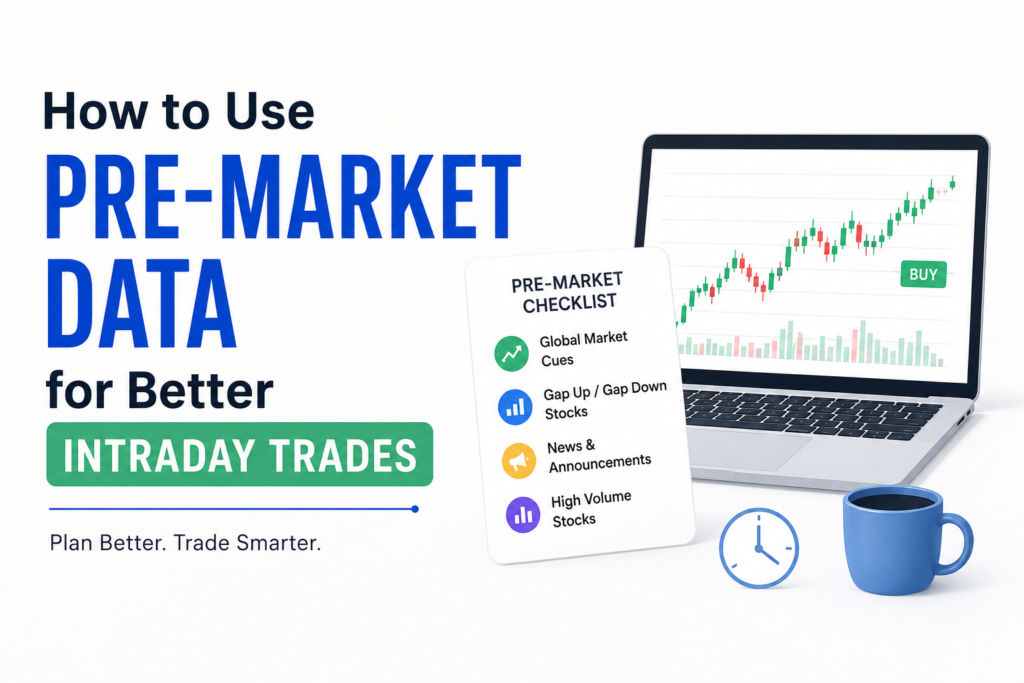
Use this checklist every trading day:
✅ Check global markets
✅ Review Gift Nifty
✅ Read important news
✅ Check FII and DII activity
✅ Identify gap up and gap down stocks
✅ Look for high-volume stocks
✅ Mark support and resistance
✅ Prepare a watchlist
✅ Decide your trading plan
✅ Wait for confirmation after market open
Common Mistakes Beginners Make
Avoid these mistakes:
• Trading only because of a gap up
• Ignoring market trend
• Following social media tips blindly
• Trading without a stop loss
• Chasing fast-moving stocks
• Ignoring volume
• Overtrading
• Entering during high volatility without confirmation
Best Free Sources for Pre-Market Data
You can use trusted platforms such as:
• NSE India
• BSE India
• TradingView
• Chartink
• Moneycontrol
• Investing.com
Always verify information from reliable sources before making trading decisions.
Tips to Improve Intraday Trading Using Pre-Market Data
• Prepare before the market opens.
• Focus on quality setups instead of many trades.
• Keep a written trading plan.
• Follow risk management.
• Trade only when price confirms your analysis.
• Review your trades at the end of the day.
• Stay disciplined even after winning trades.
Frequently Asked Questions (FAQs)
Is pre-market data useful for beginners?
→ Yes. It helps beginners understand market sentiment, prepare a watchlist, and avoid impulsive trades.
Can I trade only using pre-market data?
→ No. Pre-market data should be combined with technical analysis, price action, and proper risk management before taking any trade.
What is the best time for pre-market analysis?
→ A good routine is to analyse the market between 8:45 AM and 9:10 AM (IST), giving you enough time to review news, market sentiment, and key levels before the market opens.
Does every gap-up stock continue to rise?
→ No. Some gap-up stocks reverse after the opening. Wait for price confirmation instead of buying immediately.
Is pre-market analysis enough for consistent profits?
→ No. Consistency comes from combining preparation, technical analysis, risk management, and disciplined execution. No method can guarantee profits.
→
Pre-market data is one of the most valuable tools for intraday traders because it allows you to prepare before the market opens rather than reacting emotionally after trading begins. By analysing market sentiment, gap movements, volume, sector strength, and key support and resistance levels, you can build a clear trading plan and avoid many common beginner mistakes.
Remember, pre-market analysis is not a trading signal on its own. Use it alongside price action, technical indicators, and sound risk management. Over time, following a consistent pre-market routine can help you make more informed decisions and improve the quality of your intraday trades.
Pingback: Complete beginners guidance about the stock market - jdtradingzone.com
Pingback: How to Read Candlestick Charts for Beginners - jdtradingzone.com