Are you interested in stock market trading , i think yes then you should first know the 10 most important risk management rules every trader must follow to survive and grow consistently in the stock market.
Risk management is the backbone of successful trading. You may have the best strategy, indicators like VWAP, MACD, or Pivot Points, but without proper risk control, losses can wipe out your capital quickly. Professional traders focus more on managing risk than chasing profits.
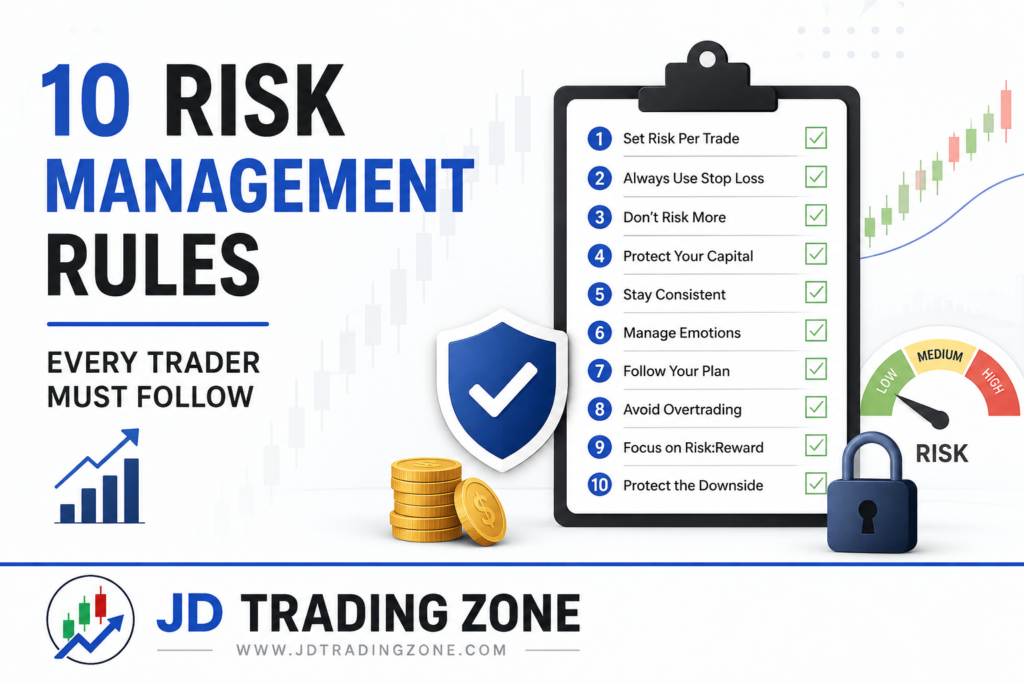
Here is Step by step guide
1. Decide your maximum loss before you enter
Before clicking Buy or Sell, I want to know exactly how much I am willing to lose if the trade goes wrong. If I cannot define that number, I don’t consider the trade ready.
2. Never increase your position just because the trade is going against you
One of the easiest ways to turn a manageable loss into a serious one is adding more quantity to “recover” the trade. A losing position doesn’t become safer simply because more money is added to it.
3. Keep your risk per trade small enough to stay mentally comfortable
If one losing trade makes you nervous about the next trade, the position was probably too large. Risk management isn’t only about protecting the account—it also protects your decision-making.
4. Your stop-loss should have a reason, not just a number
Don’t place a stop-loss at an arbitrary 1% or 2% simply because someone recommended it. Look at the market structure. Your stop should generally sit beyond the price level that invalidates your trade idea.
5. Don’t move your stop-loss farther away to avoid taking a loss
I’ve found that the moment you start changing your original risk because you don’t want to accept the loss, you’re no longer following your trading plan. If the setup is invalid, accepting the loss is part of the trade.
6. Don’t risk more after a winning streak
A few profitable trades can create overconfidence. You may start thinking your next trade is “almost certain.” The market doesn’t care about your previous wins. Keep your risk rules unchanged.
7. After a losing streak, don’t try to recover everything in one trade
This is where revenge trading begins. If you lose three trades, increasing your next position dramatically doesn’t recover the previous losses—it increases the damage if you’re wrong again.
8. Risk-to-reward matters, but don’t chase unrealistic R:R
A 1:5 setup looks attractive on paper, but if the target is unrealistic for the market structure, the ratio means very little. I would rather take a realistic setup with a logical target than manufacture a huge R:R just to make the numbers look impressive.
9. Reduce risk when market conditions become unclear
Not every trading session deserves the same level of aggression. During choppy price action, unexpected volatility, or unclear market structure, protecting capital can be more valuable than forcing another trade.
10. Protect your ability to take the next trade
The biggest purpose of risk management is simple: one trade should never be capable of ending your trading career. A loss is normal. Losing so much that you become afraid to take the next valid setup is a risk-management failure.
The rule I would put at the center of everything
Your first job as a trader isn’t to make money from every trade. It’s to make sure one bad trade cannot take you out of the game.
📈 Trade Safely with a Trusted Broker
Risk management works best when you trade on a fast & reliable platform.
I personally recommend Zerodha for beginners and active traders because of:
✔ Low brokerage
✔ Fast order execution
✔ Powerful tools like Kite & Coin
👉 Open your Zerodha account here
Final Thoughts
Risk management is not optional — it is mandatory for every serious trader.
Even average strategies can become profitable with strong risk control, but no strategy can survive without it.
💡 “Good traders focus on risk, great traders survive because of it.”
- How to Plan an Intraday Trade Before the Market OpensMost intraday trades are not decided when you click Buy or Sell. The decision is usually shaped much earlier—while the market is still closed. A… Read more: How to Plan an Intraday Trade Before the Market Opens
- How to Plan a Trade Before Clicking BuyThe most important part of a trade often happens before you enter it. A common trading mistake looks simple: a trader sees a stock moving… Read more: How to Plan a Trade Before Clicking Buy
- How to Use Volume Before Taking an Intraday TradeMost beginners look at volume only after entering a trade. They see a breakout, click Buy, and then notice that the volume suddenly looks weak.… Read more: How to Use Volume Before Taking an Intraday Trade
- Which Timeframe Is Better for Intraday Trading?Also check:- (Best Time to Trade in the Indian Stock Market) (Why Good Trading Setups Fail: 9 Reasons Behind Losing Trades) (One Complete Intraday Trading… Read more: Which Timeframe Is Better for Intraday Trading?
- Best Time to Trade in the Indian Stock MarketIf you ask ten intraday traders, “What is the best time to trade in the Indian stock market?”, you may get ten different answers. Some… Read more: Best Time to Trade in the Indian Stock Market
Thinking of joining ss66. Has anyone had a good experience with them? Any tips or advice would be hugely appreciated. Check it out yourselves: ss66!
Pingback: How to use Vwap with RSI for more accurate trades - jdtradingzone.com
Pingback: Complete beginners guidance of candlestick patterns - jdtradingzone.com
Pingback: What is Support and Resistance & Supply and Demand in stock market - jdtradingzone.com
Pingback: Why do 90% traders lose money and how to avoid mistakes. - jdtradingzone.com
Pingback: Importance of consistency and discipline in trading - jdtradingzone.com
Pingback: What is mutual funds investing? - jdtradingzone.com
Pingback: Investing vs positional trading - jdtradingzone.com
Pingback: What is future and option trading? - jdtradingzone.com
Pingback: Option trading for beginners in a simple way - jdtradingzone.com
Pingback: What is option greeks? - jdtradingzone.com
Pingback: What is price action analysis? - jdtradingzone.com
Pingback: Chart patterns complete beginners guidance - jdtradingzone.com
Pingback: Complete beginners guidance about the stock market - jdtradingzone.com
Pingback: Rules of options trading for beginners - jdtradingzone.com
Pingback: How to make your own strategy in trading - jdtradingzone.com
Pingback: How to start stock market investing in India - jdtradingzone.com