
In this guide, you’ll learn how to use VWAP with RSI to filter intraday trades, with clear strategies, rules, and common mistakes to avoid.
What is VWAP?
I don’t use VWAP and RSI together simply because two indicators are supposed to be “better than one.” In fact, putting more indicators on a chart can sometimes make a trade more confusing.
In intraday trading, taking entries without confirmation often leads to false signals and losses. Two of the most reliable indicators traders use are VWAP (Volume
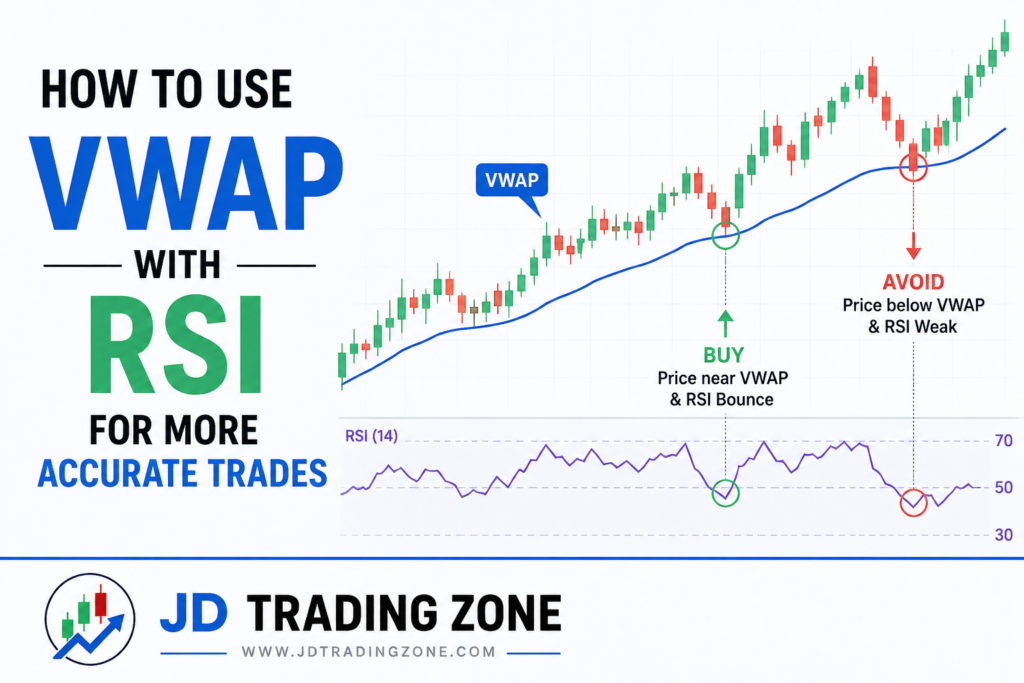
The reason I like looking at VWAP and RSI together is that they answer different questions.
VWAP helps me understand where price is trading relative to the session’s volume-weighted average. RSI helps me judge the strength and momentum behind the current price movement.
The useful part comes when the two tell a similar story.
For example, if price is holding above VWAP and RSI is staying above the 50 level, I have more evidence that buyers are controlling the short-term move. But I still don’t enter just because those two conditions are present.
I want to see how price behaves around VWAP.
If price pulls back toward VWAP, holds the level, and RSI remains above 50 or starts turning higher again, the setup becomes much more interesting to me. I’m not predicting that the trade must work—I’m simply getting confirmation from different parts of the chart.
VWAP (Volume Weighted Average Price) shows the average price of a stock based on price and volume during the trading session.
Why VWAP is Important:
Acts as dynamic support & resistance
Used by institutional traders
Best indicator for intraday trading
Helps identify fair price zones
Rule:
Price above VWAP → Bullish bias
Price below VWAP → Bearish bias
What is RSI?
RSI (Relative Strength Index) is a momentum indicator that measures buying and selling strength on a scale of 0 to 100.
Key RSI Levels:
Above 70 → Overbought
Below 30 → Oversold
40–60 zone → Healthy trend zone
RSI helps confirm whether a move has strength or weakness.
Why Combine VWAP with RSI?
VWAP tells you where price should trade, while RSI tells you whether momentum supports the move.
Benefits of VWAP + RSI:
✔ Reduces false breakouts
✔ Filters weak trades
✔ Improves entry timing
✔ Works well in stocks, indices & options
Best VWAP + RSI Settings
Recommended Settings:
VWAP: Default (Session VWAP)
RSI Period: 14
RSI Levels: 30, 50, 70
(Advanced traders may use RSI 9 or RSI 21 based on volatility.)
What I Look for Before a Long Trade
First: Where is price relative to VWAP?
If price is consistently above VWAP, I consider the intraday structure more favorable for buyers.
Second: What is RSI doing?
I don’t automatically look for RSI above 70. In a strong trend, RSI can remain elevated for a long time. Instead, I pay attention to whether RSI is holding above 50 and whether momentum is improving after a pullback.
Third: What happens when price comes back toward VWAP?
This is often more important than the initial breakout.If price approaches VWAP, buyers defend the area, a bullish candle or structure appears, and RSI begins recovering, I have a much clearer setup than simply buying because price is above VWAP.
A Situation I Would Avoid
Suppose price is above VWAP, but RSI is falling rapidly and price is struggling to make new highs.A beginner might say:
“Price is above VWAP, so the trend is bullish. I’ll buy.”
I would be more cautious.The disagreement between price/VWAP and momentum is a reason to wait for better confirmation rather than forcing an entry.
VWAP tells me where price is trading relative to the session’s average weighted by volume.
RSI gives me information about recent price momentum.I don’t need both indicators to predict the future.
I use them to ask better questions:
Is the market holding above or below VWAP?Is momentum supporting that direction?What happens during the pullback?Is price actually confirming the setup?
Best Timeframe for VWAP + RSI Trading Style ( best time frame for intraday trading)
Timeframe
Scalping
1–3 min
Intraday
5–15 min
Options Trading
5 min
Index Trading
5 / 15 min
Risk Management Rules (Must Follow) (trading risk management rules)
Trade only after market opens (9:20 AM+)
Risk max 1–2% per trade
Avoid trading during low volatility
One setup = one trade
Always wait for candle close confirmation
Common Mistakes to Avoid
❌ Trading RSI overbought/oversold blindly
❌ Ignoring market trend
❌ Taking VWAP trades in sideways markets
❌ Overtrading without confirmation
VWAP + RSI for Options Trading
For NIFTY / BANKNIFTY options:
Trade only ATM or ITM
Enter after spot index confirms VWAP
RSI should be above 50 for CALL, below 50 for PUT
Avoid option buying near market close
📈 Trade Safely with a Trusted Broker
Risk management works best when you trade on a fast & reliable platform.
I personally recommend Zerodha for beginners and active traders because of:
✔ Low brokerage
✔ Fast order execution
✔ Powerful tools like Kite & Coin
👉 Open your Zerodha account here
Final Thoughts
VWAP with RSI is a powerful intraday trading combination when used with price action and discipline.
Instead of chasing trades, let the market come to your setup.
Remember:
👉 VWAP gives direction
👉 RSI confirms strength
👉 Risk management protects capital
Pingback: % - jdtradingzone.com
PlusAce is my new favorite spot! Great bonuses and a really cool interface. Been on a hot streak lately, so I’m definitely sticking around. Head to plusace now.