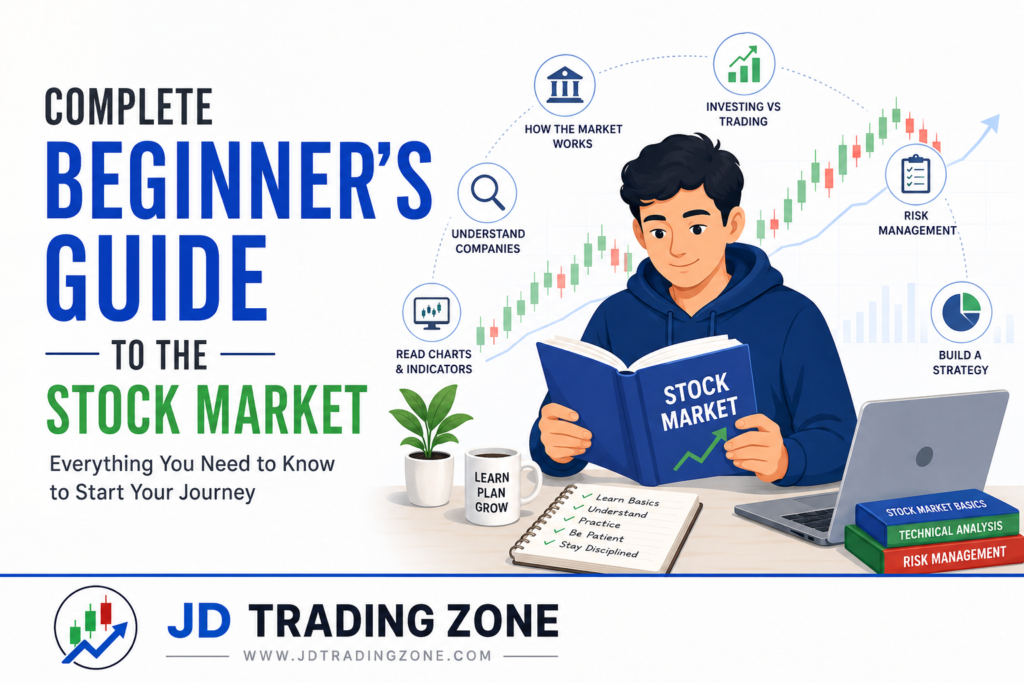
This post explains complete beginners guidance about the stock market ,what the stock market is, how it works, how to start investing or trading, and the basic rules every beginner must know.
When I first became interested in the stock market, the confusing part wasn’t opening a demat account or seeing prices move on a chart. The confusing part was understanding what all those numbers, candles, percentages, orders, and financial terms actually meant.
At first, everything seemed connected to everything else—stocks, indexes, trading, investing, options, charts, news, dividends, market capitalization. It was easy to consume a lot of information without actually understanding how the market worked.
If you’re starting from zero, don’t try to learn everything at once.
The better approach is to understand how the market works first, and only then move toward trading or investing.
The stock market may look risky and confusing at first, but with proper knowledge and discipline, it can become one of the best ways to build wealth.
1. First Understand What You Are Actually Buying
A stock isn’t just a number moving from ₹100 to ₹110.
When you buy a company’s share, you’re buying a small ownership interest in that company.
That simple idea helped me understand why company performance, earnings, business growth, debt, competition and investor expectations can eventually affect its stock price.
2. Don’t Confuse the Stock Market With Trading
This is one of the first distinctions a beginner should make.
Investing generally focuses on owning assets for the longer term.
Trading focuses more on taking advantage of shorter-term price movements.
Neither automatically makes someone successful.
A person can lose money investing in a poor company, and a trader can lose money by taking poorly planned short-term trades.
The important thing is knowing which game you’re actually playing.
Who Are the Main Participants?
• Investors – Buy shares for long-term wealth
• Traders – Buy & sell for short-term profit
• Stock Brokers – Platforms like Zerodha, Upstox, Angel One
• Regulator – SEBI (protects investors)
What Is a Share?
A share represents ownership in a company.
• Share price goes up → you make profit
• Share price goes down → you face loss
Companies may also give dividends (profit sharing).
Types of Stock Market Investment
1. Long-Term Investing
• Hold stocks for years
• Lower risk
• Best for beginners
• Based on company fundamentals
2. Short-Term Trading
• Intraday, swing, or options
• Higher risk
• Needs technical knowledge
👉 Beginners should start with investing, not trading.
What Is Demat and Trading Account?
To invest or trade, you need two accounts:
Demat Account
• Holds your shares digitally
Trading Account
• Used to buy & sell shares
Most brokers provide both accounts together.
How to Open a Stock Market Account in India?
Steps:
1.Choose a broker (Zerodha, Upstox, Angel One)
2.Submit PAN, Aadhaar, bank details
3.Complete KYC online
4.Account activated in 1–2 days
What Are Stock Market Indices?
Indices show overall market performance.
Popular Indian indices:
• NIFTY 50
• BANK NIFTY
• SENSEX
If NIFTY goes up, it means most top companies are performing well.
Basic Stock Market Terms Beginners Must Know
• Bull Market – Market going up
• Bear Market – Market going down
• IPO – Company launching shares to public
• Market Cap – Company size
• Volume – Number of shares traded
• Liquidity – Ease of buying/selling
What Moves Share Prices?
Share prices move due to:
• Company profits or losses
• News & announcements
• Market demand & supply
• Economic data
• Global markets
Fundamental Analysis (Basics)
Used for long-term investing.
Check:
• Company profits
• Debt
• Business model
• Future growth
• Management quality
Technical Analysis (Basics)
Used mainly for trading.
It involves:
• Charts
• Indicators (RSI, MACD, VWAP)
• Support & resistance
• Candlestick patterns
⚠️ Beginners should learn basics slowly before using real money.
How Much Money Is Needed to Start?
You can start with:
• ₹500 – ₹1,000 for investing
• No minimum limit
👉 Start small and increase gradually.
Common Beginner Mistakes to Avoid
❌ Trading without learning
❌ Following tips blindly
❌ Using full capital in one stock
❌ Over-trading
❌ No stop loss
Risk Management Rules for Beginners
• Never invest money you can’t afford to lose
• Diversify your investment
• Use stop loss in trading
• Avoid emotional decisions
• Focus on learning first
Is the Stock Market Safe for Beginners?
Yes, if you follow these rules:
• Start with long-term investing
• Learn before trading
• Avoid shortcuts
• Be patient
The stock market is risky only when approached without knowledge.
Best Learning Path for Beginners
1.Learn stock market basics
2.Understand long-term investing
3.Practice with small capital
4.Learn technical analysis
5.Slowly explore trading
Complete beginners guidance about the stock market.
(📈 Trade Safely with a Trusted Broker
Risk management works best when you trade on a fast & reliable platform.
I personally recommend Zerodha for beginners and active traders because of:
✔ Low brokerage
✔ Fast order execution
✔ Powerful tools like Kite & Coin
👉 Open your Zerodha account here)
The Most Important Beginner Lesson
You don’t need to become an expert before making your first investment or trade—but you should understand what you’re doing and what you can lose.
Don’t rush from learning candlesticks to options trading in a week.Build your knowledge in layers:
Stock market basics → Investing vs trading → Orders → Charts → Fundamental/technical analysis → Risk management → Strategy → Psychology → Consistency
The stock market isn’t difficult because there aren’t enough strategies.
It’s difficult because there is always more information than you need.
As a beginner, your advantage isn’t knowing everything.
It’s knowing what to learn first.
88vin.stone seems legit. I dug around a bit before signing up and it looks solid. Bonuses look decent too. Starting small but feeling good. 88vin.stone
Alright, I tried out 58jlxyz. Pretty Cool selection, I gotta say. Games were running smoothly, too. Worth checking if you wanna play. Check it out right here 58jlxyz
Yeah, mxrojawin popped up on my radar. Not my first choice, but also not the worst I’ve seen. See if it’s your thing: mxrojawin