
A good trading setup can still lose. Here is why—and how to tell the difference between a bad setup and a normal losing trade.
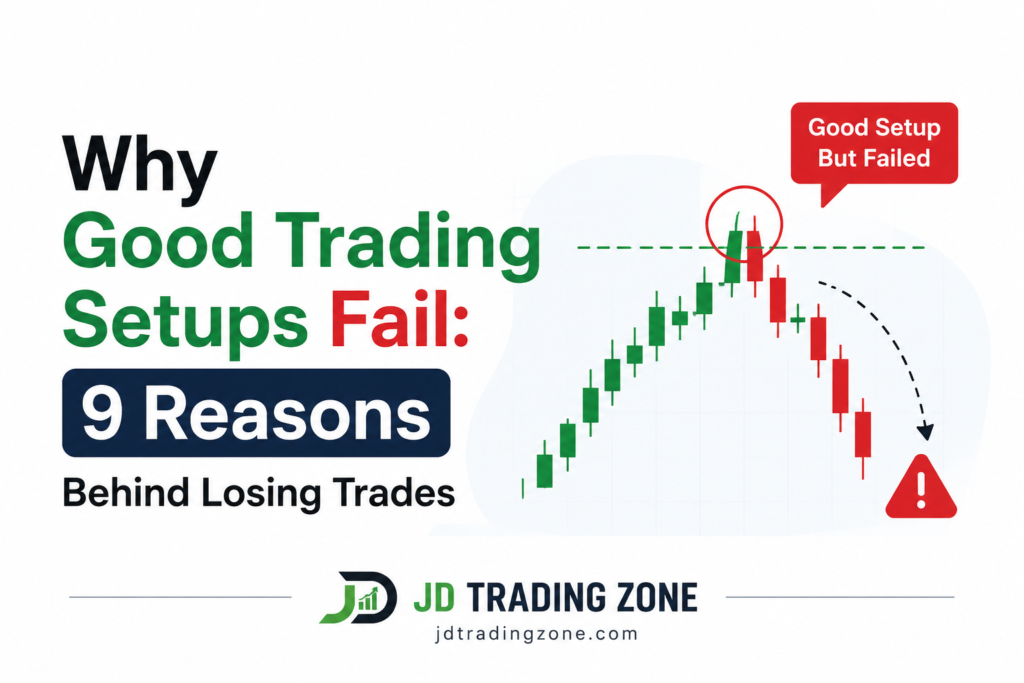
One of the most frustrating experiences in trading is watching a setup develop exactly as planned, taking the trade according to your rules, and then seeing the market move straight toward your stop-loss.
• You check the chart again.
• The trend looked correct.
• The level was respected.
• The indicator gave confirmation.
• Your entry followed the plan.
• And yet, the trade lost.
This is where many traders make a costly mistake: they immediately assume that the strategy is broken.
But a losing trade does not automatically mean that the setup was bad.
Trading is a probability game. Even a well-defined setup can fail because the market environment changes, liquidity shifts, a breakout lacks participation, or the entry simply occurs on the wrong side of a short-term move.
The more useful question is not:
“Why did my strategy fail?”
It is:
“Was this actually a valid setup that lost, or did I make a mistake while trading the setup?”
That distinction can completely change how you improve.
Also check:- (One Complete Intraday Trading Setup) (Opening Range Breakout Strategy: A Practical Guide for Intraday Traders in India) (How to Choose Stocks for Intraday Trading in India) (Volume and Price Action Trading Strategy) (Breakout Retest Strategy Explained)
What Is a “Good” Trading Setup?
Before discussing why setups fail, we need to define what a good setup actually means.
A good setup is not one that guarantees a profitable trade.
Instead, it is a trade where:
• the market conditions match your strategy,
• your entry has a logical reason,
• the invalidation level is clearly defined,
• the potential reward justifies the risk,
• position size is appropriate,
• and you execute according to your predefined rules.
For example, suppose you trade an intraday breakout strategy.
You identify resistance at ₹500.
The stock moves above ₹500, volume increases, and the candle closes above the level. You enter at ₹503 with a predefined stop below the breakout structure.
The stock then falls back to ₹498 and hits your stop.
That trade may have been perfectly valid.
The result was negative, but the process was not necessarily wrong.
This is one of the hardest lessons for developing traders:
A good process can produce a bad outcome.
And a bad process can occasionally produce a profitable outcome.
Judging your strategy only by individual trade results can therefore be misleading.
9 Reasons Good Trading Setups Fail
1. The Market Environment Does Not Match the Setup
A strategy may work well under one type of market condition and perform poorly under another.
This is one of the most overlooked reasons for losing trades.
Imagine you have a breakout strategy.
During a strong trending session, price breaks resistance, holds above it, and continues higher.
But on a sideways day, the same breakout may move only a few points before returning inside the range.
The entry pattern looks almost identical.
The market environment is not.
Trending market
In a trending market, breakouts can receive follow-through because buyers or sellers continue pushing price in the same direction.
Range-bound market
In a sideways market, price repeatedly moves between support and resistance. Breakouts can become false signals.
This means your strategy may not actually be broken.
You may simply be using the right strategy in the wrong environment.
Practical check
Before entering, ask:
• Is the market trending or ranging?
• Is price making higher highs and higher lows?
• Is volatility expanding or contracting?
• Is the stock moving independently or simply following the index?
• Has the same level already been tested multiple times?
The setup should be judged together with the environment.
2. You Enter Too Late
A setup can be correct while the entry is poor.
This happens frequently after a strong breakout.
Suppose a stock breaks ₹1,000 and quickly moves to ₹1,020.
You were waiting for confirmation.
Instead of entering near your planned trigger, you become afraid of missing the move and buy at ₹1,020.
Now your stop may still need to remain below ₹1,000.
Your risk has suddenly become much larger.
More importantly, much of the initial move has already happened.
The market then pulls back to ₹1,005.
You are stopped out.
Later, the stock moves higher again.
You might think:
“The strategy failed.”
But perhaps the strategy didn’t fail.
Your entry was late.
A useful rule
Define your entry zone before the trade begins.
If price moves too far away from that zone, allow the trade to go without you.
Missing a trade is usually cheaper than chasing one.
3. The Setup Appears at the Wrong Location
A pattern alone is not enough.
Location matters.
For example, a bullish candlestick pattern in the middle of a noisy range may not carry the same significance as the same pattern appearing near a clearly established support zone.
The same applies to breakouts.
A breakout occurring directly below a major resistance level may have limited room to travel.
Consider this example:
• Entry: ₹250
• Immediate resistance: ₹254
• Stop-loss: ₹247
• Potential reward before resistance: ₹4
• Risk: ₹3
The chart may look bullish, but the trade does not offer much room.
The setup is technically present.
The location makes the trade unattractive.
Ask yourself:
“If this trade works, where is price realistically going next?”
If there is a major obstacle immediately ahead, the setup may not be worth taking.
4. The Breakout Has No Real Participation
A price breakout is not automatically a strong breakout.
Sometimes price crosses a resistance level for only a few seconds or one candle and then immediately returns below it.
This is often referred to as a false breakout.
Volume can provide useful context, although volume should never be treated as a standalone guarantee.
For example:
Scenario A
Price breaks resistance + strong participation + candle closes above level + follow-through.
Scenario B
Price barely crosses resistance + weak participation + long upper wick + immediate rejection.
Both may technically be called breakouts.
But their quality is very different.
T
his is why blindly buying every breakout can create a frustrating series of losses.
Better approach
Look for evidence that the market is actually accepting the new price area.
Depending on your strategy, that could include:
• strong closing candle,
• increased volume,
• successful retest,
• continuation after the breakout,
• broader market alignment.
No single confirmation is perfect.
The objective is to build a repeatable decision process.
5. You Ignore the Bigger Market Context
A stock can have a bullish setup while the broader market is strongly bearish.
That does not mean the stock cannot rise.
It means the trade may have additional resistance working against it.
For intraday traders, this can be particularly important.
For example:
• Nifty is falling sharply.
• The sector is weak.
• Your stock shows a small bullish breakout.
• You immediately take a long trade.
The stock moves up briefly, attracts buyers, and then follows the broader market lower.
The setup may have been technically valid.
But the surrounding market context reduced its probability.
A simple pre-trade check
Before taking an intraday trade, look at:
• The broader index.
• The relevant sector.
• The stock’s own structure.
• Major support and resistance.
• Current volatility.
This does not mean you should always trade in the same direction as the index.
It simply means you should know what environment your trade is operating inside.
6. Your Stop-Loss Is Based on Money
Instead of Market Structure
This is a subtle but important mistake.
Some traders decide:
“I can afford to lose ₹500, so I’ll place the stop where the loss becomes ₹500.”
But the chart does not know your preferred loss amount.
A stop should generally be placed where your trade idea becomes invalid, while your position size should be adjusted to keep the monetary risk within your limit.
For example, suppose you buy a stock at ₹400 because a support level has formed around ₹392.
If your trade thesis becomes invalid below ₹390, that area may make more structural sense than randomly placing the stop at ₹397 simply because that produces a smaller rupee loss.
Then position size can be calculated around the chosen risk.
Simple risk formula
Risk per share = Entry Price − Stop-Loss Price
For a long trade:
Position Size = Maximum Rupee Risk ÷ Risk Per Share
Example:
• Entry = ₹400
• Stop = ₹390
• Risk per share = ₹10
• Maximum planned risk = ₹1,000
Position size:
₹1,000 ÷ ₹10 = 100 shares
The important point is that position size adapts to the stop, rather than forcing the stop into an arbitrary monetary amount.
Risk management should be designed before entering the trade, not after the trade starts moving against you.
7. You Change the Rules After Entering
This is where a normal losing trade can become a much larger problem.
You enter with a ₹10 stop.
Price falls ₹10.
Instead of accepting the planned loss, you move the stop to ₹15.
Then ₹20.
Then ₹30.
Now the original trading setup has disappeared.
You are no longer trading the strategy.
You are negotiating with the market.
This often happens because the trader thinks:
“It will come back.”
Sometimes it does.
Sometimes it does not.
But neither outcome changes the problem with the decision.
A predefined stop is supposed to answer one important question:
“At what point is my original trade idea no longer valid?”
If that level is reached, exiting is not necessarily a failure.
It is the execution of the plan.
Also remember that stop orders can execute at a price different from the specified stop price, particularly during fast-moving markets; the stop price acts as a trigger rather than a guaranteed execution price.
8. You Expect Every Valid Setup to Win
This is probably the most damaging psychological mistake.
Imagine your strategy wins 45% of the time.
That means more than half of the trades may lose over a sufficiently large sample.
A trader who expects every setup to work will eventually lose confidence in the strategy.
They may start:
• changing indicators,
• moving stops,
• skipping valid trades,
• entering random trades,
• increasing position size,
• switching strategies every few days.
The problem was not necessarily the strategy.
The problem was the expectation.
Think in batches, not individual trades
Instead of asking:
“Will this trade win?”
Ask:
“Does this trade meet the conditions of my tested setup?”
That small change can improve decision-making.
Your job is not to predict every market movement.
Your job is to execute a positive-expectancy process consistently.
9. The Setup Has Never Been Properly Tested
This is perhaps the most important reason of all.
Many traders call something a “strategy” after seeing it work five or ten times on a chart.
That is not enough evidence.
Suppose you notice that:
VWAP + breakout + volume = good trade
You test it on a few recent charts.
It looks excellent.
You start trading it.
A few losses appear.
You immediately conclude:
“The strategy stopped working.”
But perhaps there was never enough evidence to know whether the strategy had an edge in the first place.
What should be tested?
At minimum, record:
• Market
• Stock
• Date
• Time
• Setup type
• Entry
• Stop-loss
• Target
• Risk in ₹
• Result in ₹
• Result in R
• Market condition
• Screenshot
• Reason for entry
• Reason for exit
• Rule violation, if any
After a meaningful sample, patterns start becoming visible.
You may discover that your setup works much better:
• during trending sessions,
• during the first two hours,
• after a clean retest,
• in high-volume stocks,
• when the broader index agrees.
That information is far more useful than simply looking at your total profit or loss.
A Losing Trade Is Not Always a Bad Trade
This distinction deserves its own section.
Consider two traders.
Trader A
• Takes a setup that follows every rule.
• The setup has been tested.
• The position size is correct.
• The stop is predefined.
• The trade loses 1R.
Trader B
• Enters randomly.
• No defined setup.
• No proper stop.
• Moves the stop when price falls.
• Eventually the market reverses and the trader exits with a ₹500 profit.
Who traded better?
Trader A.
Even though Trader A lost money.
Trader B made money, but the process was dangerous.
This is why experienced traders often focus heavily on process quality rather than judging themselves by a single result.
A Practical Post-Trade Review
Instead of simply writing:
“Lost ₹1,200.”
Write something more useful.
Trade Review
Setup: Opening range breakout
Entry: ₹512
Stop: ₹506
Target: ₹524
Risk: ₹6 per share
Market condition: Mildly bullish
Reason for entry: Breakout above opening range with increasing volume
What happened: Price moved to ₹515, reversed, and hit stop.
Rule followed? Yes
Was the setup valid? Yes
Mistake? None
Lesson: Normal losing trade; continue collecting data.
Now compare that with:
Setup: Opening range breakout
Entry: ₹520
Planned entry zone: ₹512–₹515
Reason for entry: Fear of missing the move
Stop: ₹506
Result: Loss
Rule followed? No
Lesson: Chased the breakout.
These two losses may have the same rupee result.
But they require completely different responses.
A Simple “Why Did This Trade Lose?” Checklist
Before blaming your strategy, check these 10 points:
Market
• Was the market trending or ranging?
• Was volatility unusually high or low?
• Was there a major event affecting price?
Setup
• Did every setup condition appear?
• Was the setup forming at a meaningful level?
• Was there enough room toward the target?
Execution
• Did you enter at the planned price?
• Did you chase the move?
• Did you move your stop?
• Did you exit according to your rules?
Risk
• Was the position size appropriate?
• Was the potential reward worth the risk?
Psychology
• Were you trading because the setup appeared?
• Or because you wanted to recover an earlier loss?
These questions can turn a losing trade into useful information.
What to Do After 3–5 Losing Trades in a Row
A losing streak can make even a good strategy feel broken.
But do not immediately double your position size or completely change your system.
First, review the trades.
Separate them into three groups:
Group 1: Valid losses
The setup was correct and the trade followed all rules.
These are normal trading outcomes.
Group 2: Execution losses
The setup was good, but you:
entered late,
ignored the stop,
exited too early,
overtraded,
or changed the plan.
These require execution improvement.
Group 3: Invalid setups
The trade should never have been taken.
These require better filtering.
This classification is much more useful than simply saying:
“My strategy has stopped working.”
The 1R Method for Measuring Trading Performance
One of the easiest ways to remove emotional noise from your trading journal is to measure results in R.
If your planned risk on one trade is ₹500:
• ₹500 loss = −1R
• ₹1,000 profit = +2R
• ₹250 profit = +0.5R
• ₹750 loss = −1.5R
Suppose your last five trades were:
+2R, −1R, −1R, +3R, −1R
Total:
+2R
You had three losing trades out of five, but the overall result was still positive.
This illustrates why win rate alone cannot tell you whether a strategy is viable.
The relationship between winning trades, losing trades, average win, average loss, costs, and execution all matter.
How to Make a Good Trading Setup More Reliable
You cannot eliminate losing trades.
But you can improve the quality of your decision-making.
1. Define the setup precisely
Avoid rules such as:
“Buy when the chart looks strong.”
Instead define measurable conditions.
2. Define invalidation before entry
Know exactly what would prove your trade idea wrong.
3. Check market context
A setup should not be evaluated in isolation.
4. Avoid chasing
If the price has already moved too far, wait for a better opportunity or skip it.
5. Keep risk consistent
One unusual trade should not have the power to damage your entire account.
6. Track every trade
A journal converts random experiences into data.
7. Review losing trades objectively
Do not automatically label every loss as a strategy failure.
8. Test before increasing size
A strategy needs evidence, not excitement.
9. Accept uncertainty
Even a high-quality setup can fail.
That is part of trading.
The Real Lesson: Your Strategy Does Not
Need to Be Right Every Time
Many new traders spend months searching for the perfect strategy.
They change indicators.
They change timeframes.
They add more confirmations.
They watch more YouTube videos.
They download another indicator.
But there is a point where adding more information creates more confusion rather than better decisions.
A trading setup does not need to predict every move.
It needs to provide a repeatable situation where the potential reward and risk make sense over a sufficiently large sample.
Some trades will work.
Some will fail quickly.
Some will almost reach the target before reversing.
Some will hit the stop and then move exactly in your original direction.
You cannot control those individual outcomes.
You can control:
• whether you followed your rules,
• how much you risked,
• where your trade became invalid,
• whether you chased the entry,
• and whether you learned from the result.
That is where real improvement happens.
Final Takeaway
A good trading setup can fail for many reasons.
The market can change.
A breakout can become a false breakout.
A strong-looking setup can appear at a poor location.
Your entry can be late.
The broader market can move against you.
Or the trade may simply be one of the losing outcomes that every probabilistic strategy produces.
The biggest mistake is treating every loss as proof that your strategy is useless.
Instead, ask:
“Was this a bad trade, or was it a good trade with a bad outcome?”
That question forces you to examine the process rather than react emotionally to the result.
And remember: no setup can remove market risk. SEBI’s investor-education material emphasizes understanding the risks involved and matching investments or trading exposure to your ability to handle those risks.
The goal of trading is not to create a setup that never loses.
The goal is to build a process that can survive losing trades.
Important Risk Disclaimer
This article is for educational and informational purposes only. It is not investment advice, financial advice, or a recommendation to buy or sell any security, derivative, or trading strategy. Trading and investing involve the risk of loss, and past performance or historical testing does not guarantee future results. Before trading, understand the product, costs, risks, and your own risk capacity. Never risk money you cannot afford to lose.
Pingback: Best Time to Trade in the Indian Stock Market - jdtradingzone
Pingback: How to Use Volume Before Taking an Intraday Trade - jdtradingzone