
This guide explains position sizing in simple terms, including the basic formula, practical examples, Position Sizing Explained,common mistakes, and how beginners can use it in their trading plan.
Welcome to JD Trading Zone
Introduction
Many beginners focus on finding the perfect trading strategy. They spend hours studying indicators, chart patterns, support and resistance, and entry signals.
But there is another decision that can have an equally important impact on trading results:
How much should you buy or sell in each trade?
This is where position sizing becomes important.
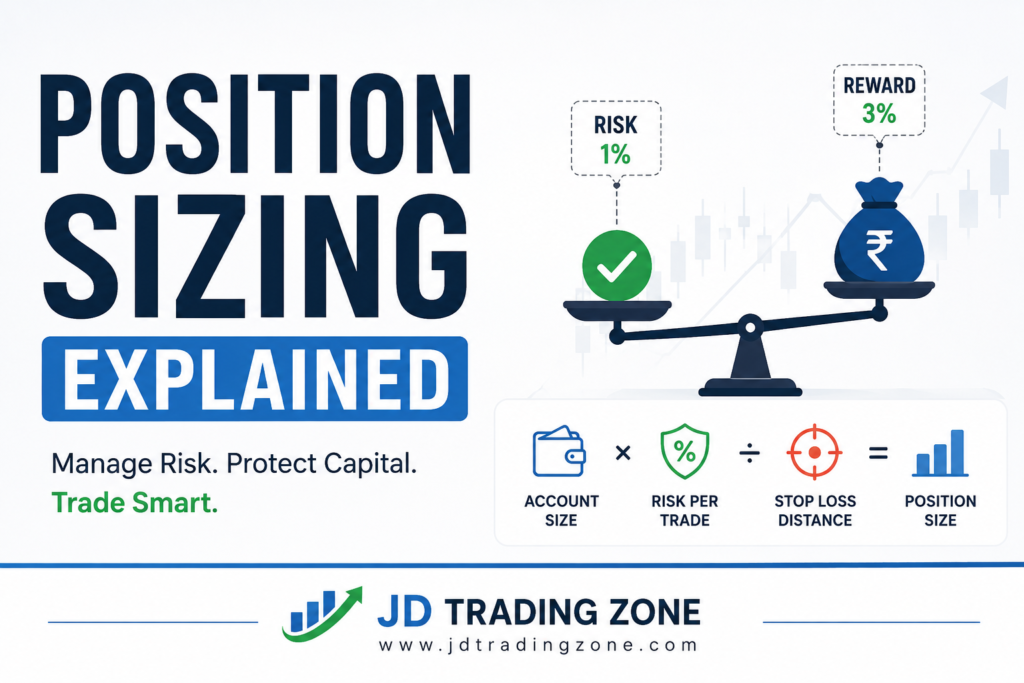
Position sizing is the process of deciding how many shares, contracts, or units to trade based on your account size, risk tolerance, and stop-loss level. Instead of choosing a trade size randomly, you use a defined method to control how much money you are willing to lose if the trade goes against you.
A good position-sizing method cannot guarantee profits. However, it can help prevent one bad trade from causing disproportionate damage to your trading account.
Also check:- (Trading Journal: Why Every Trader Needs One) (How to Backtest a Trading Strategy) (Daily Routine of Successful Traders) (Common Trading Myths That Cost Traders Money) (Nifty vs Bank Nifty: Which Is Better for Beginners?)
Position size calculator
What Is Position Sizing?
Position sizing is the process of determining the quantity of an asset to trade while keeping the potential loss within a predefined risk limit.
For example, suppose you have a ₹1,00,000 trading account and decide that you will risk only 1% of your capital on one trade.
Your maximum planned risk would be:
₹1,00,000 × 1% = ₹1,000
If your stop-loss is ₹20 away from your entry price, your position size would be:
₹1,000 ÷ ₹20 = 50 shares
So, instead of deciding to buy 100 or 200 shares based on confidence, you determine the quantity from your account size and the trade’s risk.
This is the basic idea behind position sizing.
Why Is Position Sizing Important?
Position sizing matters because even a good trading strategy can experience losing trades.
No strategy wins every time.
If your position size is too large, a few losing trades can significantly reduce your capital. A smaller account can then require much more effort to recover.
For example:
• A 10% loss requires an approximately 11.1% gain to recover.
• A 20% loss requires a 25% gain.
• A 30% loss requires about a 42.9% gain.
• A 50% loss requires a 100% gain.
This is why protecting trading capital is so important.
Position sizing helps traders focus on controlling risk rather than predicting every market movement correctly.
The Basic Position Sizing Formula
For a simple stock trade, you can use:
Position Size = Maximum Risk Amount ÷ Risk Per Share
Where:
Maximum Risk Amount = Account Size × Risk Percentage
And:
Risk Per Share = Entry Price − Stop-Loss Price
Example
Suppose:
• Account size = ₹2,00,000
• Risk per trade = 1%
• Entry price = ₹500
• Stop-loss = ₹480
First calculate the maximum risk:
₹2,00,000 × 1% = ₹2,000
Then calculate the risk per share:
₹500 − ₹480 = ₹20
Now calculate position size:
₹2,000 ÷ ₹20 = 100 shares
Therefore, the theoretical position size is 100 shares.
If the stop-loss is executed at the planned price, the intended loss would be approximately ₹2,000, excluding brokerage, taxes, slippage, and other trading costs.
Position Size and Stop-Loss Are Connected
Position sizing cannot be considered separately from your stop-loss.
Consider two trades with the same account and risk limit.
→ Trade A
• Maximum risk: ₹1,000
• Entry: ₹200
• Stop-loss: ₹190
• Risk per share: ₹10
• Position size: 100 shares
→ Trade B
• Maximum risk: ₹1,000
• Entry: ₹200
• Stop-loss: ₹180
• Risk per share: ₹20
• Position size: 50 shares
The wider stop-loss in Trade B means you need fewer shares to keep the same maximum planned risk.
This demonstrates an important principle:
A wider stop-loss generally requires a smaller position size, while a tighter stop-loss generally allows a larger position size—assuming the same account and risk limit.
However, a stop-loss should not be placed at an arbitrary distance just to increase position size. It should be based on the trade’s market structure, strategy, and invalidation level.
How Much Should a Beginner Risk Per Trade?
There is no universal percentage that is appropriate for every trader.
Your risk level depends on factors such as:
• Account size
• Trading experience
• Strategy
• Risk tolerance
• Trading frequency
• Market volatility
• Financial situation
Many traders use a relatively small percentage of their account for individual trades, such as 0.5% or 1%, rather than risking a large portion of their capital on a single position.
For beginners, the important lesson is not to blindly copy a percentage.
Instead, choose a risk limit that you can consistently follow without making emotional decisions after a losing streak.
Position Sizing Example for a ₹50,000 Account
Suppose you have:
Account size: ₹50,000
Risk per trade: 1%
Entry price: ₹250
Stop-loss: ₹240
Maximum risk:
₹50,000 × 1% = ₹500
Risk per share:
₹250 − ₹240 = ₹10
Position size:
₹500 ÷ ₹10 = 50 shares
So the calculated position is 50 shares.
The total position value would be:
50 × ₹250 = ₹12,500
Notice something important: You are not risking the entire ₹12,500.
Your planned loss based on the entry and stop-loss is approximately ₹500, before costs and execution differences.
What Happens When the Stop-Loss Is Far Away?
Suppose your account is ₹1,00,000 and you risk 1%, giving you a maximum planned risk of ₹1,000.
→ Scenario 1
Entry = ₹100
Stop-loss = ₹95
Risk per share = ₹5
Position size:
₹1,000 ÷ ₹5 = 200 shares
→ Scenario 2
Entry = ₹100
Stop-loss = ₹90
Risk per share = ₹10
Position size:
₹1,000 ÷ ₹10 = 100 shares
The second trade has a wider stop, so the position size is smaller.
This helps maintain a similar monetary risk even though the chart setup has a different stop-loss distance.
What About Risk-Reward Ratio?
Position sizing controls how much you can lose.
Risk-reward ratio helps you evaluate how much you are attempting to make relative to that risk.
Suppose your trade has:
• Entry = ₹500
• Stop-loss = ₹480
• Risk = ₹20
• Target = ₹560
• Potential reward = ₹60
Your risk-reward ratio is:
₹60 ÷ ₹20 = 3
So the trade has a potential 1:3 risk-reward ratio.
If your calculated position size is 50 shares:
• Potential loss = ₹1,000
• Potential profit = ₹3,000
These are planned figures, not guaranteed outcomes.
A favorable risk-reward ratio does not automatically make a trade profitable. The strategy still needs a reasonable probability of success.
Position Sizing for Different Trading Styles
Position sizing principles can be applied to different markets and trading styles, but the calculations can become more complex.
1. Equity Trading
For a stock trade, the calculation is relatively straightforward:
Position Size = Risk Amount ÷ Risk Per Share
You also need to make sure the resulting position does not exceed your available capital or broker requirements.
2. Intraday Trading
Intraday traders should consider:
• Entry price
• Stop-loss
• Risk per trade
• Market volatility
• Brokerage and other costs
• Available margin
• Slippage
A position that looks acceptable mathematically may still be too large when execution costs or rapid price movement are considered.
3. Options Trading
Options require additional caution.
The premium paid is not always the same thing as the amount you should automatically risk.
For example, an options trader may define a maximum acceptable loss based on the strategy and stop-loss rather than simply deciding to use all available capital.
Options can also experience rapid price changes, time decay, changes in implied volatility, and liquidity differences.
Therefore, beginners should avoid treating options position sizing exactly like simple stock position sizing.
4. Futures Trading
For futures, position sizing depends on the value of each price movement.
A useful concept is:
Risk per contract = Stop-loss distance × Value per point
Then:
Number of contracts = Maximum Risk ÷ Risk per contract
Because futures can provide substantial exposure through leverage, position sizing becomes especially important.
Position Sizing vs. Capital Allocation
These two concepts are related but not identical.
Capital allocation asks:
How much capital am I putting into this position?
Position sizing asks:
How large should this position be based on my acceptable risk?
For example, you might have ₹2,00,000 in your account but only use ₹50,000 for a particular stock position.
That does not automatically mean your risk is ₹50,000.
Your actual trade risk depends on your entry, stop-loss, position quantity, and execution.
Why Account Size Matters
The same trade setup can require different quantities for different accounts.
Suppose the trade risks ₹10 per share.
₹50,000 account at 1% risk
Maximum risk = ₹500
Position size:
₹500 ÷ ₹10 = 50 shares
₹2,00,000 account at 1% risk
Maximum risk = ₹2,000
Position size:
₹2,000 ÷ ₹10 = 200 shares
The setup is identical, but the position size changes because the account size is different.
This is why copying another trader’s quantity can be dangerous.
Their account, risk tolerance, stop-loss, and financial situation may be completely different from yours.
Common Position Sizing Mistakes Beginners Make
1. Trading the Same Quantity Every Time
Some traders always buy the same number of shares.
For example, they may always trade 100 shares regardless of the stop-loss distance.
This can create inconsistent risk.
A trade with a ₹5 stop has very different risk from a trade with a ₹25 stop.
2. Increasing Size After a Loss
A common emotional mistake is increasing the next position to recover previous losses.
For example:
• Trade 1 loss = ₹500
• Trade 2 risk = ₹1,000
• Trade 3 risk = ₹2,000
This can quickly turn a normal losing streak into serious account damage.
Position size should be determined by your trading plan—not by your desire to recover money quickly.
3. Moving the Stop-Loss to Avoid a Loss
A trader may calculate a position size based on a ₹10 stop-loss but later move the stop to ₹5 because they do not want to take the loss.
This changes the original trade plan and can increase the probability of being stopped out by normal market noise.
A worse habit is moving the stop farther away while keeping the same large position.
That can dramatically increase the actual risk.
4. Ignoring Slippage
The calculated loss may not equal the actual loss.
During fast markets, news events, gaps, or low-liquidity conditions, an order can be executed at a worse price than expected.
Therefore, position sizing should leave some room for real-world execution differences.
5. Using Maximum Available Margin
Just because a broker allows you to take a large position does not mean you should.
Brokerage margin is not the same as sensible risk management.
Leverage can increase both the potential gains and losses relative to your capital.
6. Risking Too Much on Multiple Trades
Suppose you risk 1% on five trades.
If all five positions are highly correlated and lose together, your account could experience approximately a 5% loss before considering costs and execution effects.
Therefore, traders should think about total portfolio exposure, not just the risk of one individual trade.
Correlation Can Change Your Real Risk
Imagine you take these positions simultaneously:
• Nifty-related trade
• Bank-related trade
• A banking stock trade
• A financial-services stock trade
Although these are technically different positions, they may respond to similar market factors.
If the market moves sharply against the sector, several trades could lose at the same time.
This means position sizing should be considered at both levels:
1. Risk per trade
2. Total open risk
This is especially important when multiple positions are based on similar market conditions.
Position Sizing and Trading Psychology
Position sizing is not only a mathematical concept.
It can also affect your emotions.
If your position is too large, normal price fluctuations may feel extremely important. You may:
• Exit too early
• Move your stop-loss
• Take profits too quickly
• Revenge trade
• Avoid following your strategy
• Constantly check your position
A smaller, predefined position can make it easier to follow your trading plan.
The goal is not to eliminate emotions completely. The goal is to prevent the size of a trade from controlling your decisions.
Simple Position-Sizing Process
Before entering a trade, a beginner can follow this sequence:
Step 1: Determine Your Account Size
Know how much trading capital you currently have.
Step 2: Set Your Maximum Risk
Choose the amount or percentage you are willing to risk on the trade.
Step 3: Identify Your Entry
Determine the price at which your strategy gives you a valid entry.
Step 4: Determine Your Stop-Loss
Place the stop where your trade idea would be considered invalid according to your strategy.
Step 5: Calculate Risk Per Unit
Subtract the stop-loss price from the entry price for a long trade.
Step 6: Calculate Position Size
Use:
Position Size = Maximum Risk ÷ Risk Per Unit
Step 7: Check the Position
Before entering, consider:
• Available capital
• Leverage
• Liquidity
• Slippage
• Brokerage and taxes
• Correlated positions
• Market volatility
Step 8: Place the Trade
Once the position meets your trading rules, execute the trade according to your plan.
Position Sizing Calculator Example
Suppose you enter the following values:
Input
• Account Size
• Risk Per Trade
• Entry Price
• Stop-Loss
• Risk Per Share
• Maximum Risk
• Position Size
Value
• 1,50,000
• 1%
• ₹750
• ₹730
• ₹20
• ₹1,500
• 75 shares
Calculation:
Maximum Risk = ₹1,50,000 × 1% = ₹1,500
Risk Per Share = ₹750 − ₹730 = ₹20
Position Size = ₹1,500 ÷ ₹20 = 75 shares
The estimated position value is:
75 × ₹750 = ₹56,250
Again, the position value and the amount you are risking are different concepts.
What If the Calculation Gives a Decimal?
Sometimes your calculation may produce a number such as:
83.7 shares
You cannot normally buy a fractional quantity of an Indian stock in a standard equity order.
In that situation, round the quantity down, not up, so that you do not intentionally exceed your risk limit.
For example:
83.7 → 83 shares
The same principle applies when contracts or lots have fixed quantities.
Position Sizing Is Not a Guarantee of Limited Losses
This is an important point for beginners.
A position-sizing formula is based on assumptions about entry, stop-loss, and execution.
Actual losses can differ because of:
• Slippage
• Market gaps
• Sudden volatility
• Illiquid securities
• Trading halts
• Execution delays
• Brokerage and transaction costs
A stop-loss does not guarantee execution at the exact price you specify.
Therefore, risk calculations should be treated as planned risk estimates, not guaranteed maximum losses.
How to Improve Your Position-Sizing Discipline
You do not need a complicated system to start.
A simple trading journal can record:
• Account balance
• Entry price
• Stop-loss
• Planned risk
• Position quantity
• Target
• Actual exit
• Actual profit/loss
• Reason for the trade
Whether you followed your plan
After several trades, review whether you consistently respected your intended risk.
The purpose is not to create perfect trades. It is to build repeatable behavior.
Position Sizing Checklist for Beginners
Before entering a trade, ask yourself:
• What is my account size?
• How much am I willing to risk?
• Where is my valid entry?
• Where does my trade idea become invalid?
• How far is my stop-loss from the entry?
• What is my risk per share or contract?
• What quantity keeps me within my risk limit?
• Do I have enough available capital?
• Am I using excessive leverage?
• Do I already have similar positions open?
• Have I considered slippage and trading costs?
• Am I increasing the position because of emotion?
If you cannot answer these questions, consider waiting until the trade is properly planned.
Position Sizing Explained
Frequently Asked Questions
What is position sizing in trading?
→ Position sizing is the process of determining how many shares, contracts, or units to trade based on account size, acceptable risk, and the distance to the stop-loss.
What is the simplest position-sizing formula?
→ For a basic stock trade:
Position Size = Maximum Risk Amount ÷ Risk Per Share
Is 1% risk per trade mandatory?
→ No. There is no universal rule that every trader must use exactly 1%. Your risk level should match your strategy, experience, account size, and personal circumstances.
Should I use the same position size for every trade?
→ Not necessarily. If your stop-loss distance changes, the quantity may need to change to maintain a consistent level of monetary risk.
Does a larger position mean more profit?
→ A larger position can increase potential profit, but it also increases potential loss. Position size should be determined by risk, not by the desire to make more money.
Can position sizing make a losing strategy profitable?
→ No. Position sizing manages exposure and helps control losses. It cannot turn a strategy with no sustainable edge into a profitable one.
Is position sizing useful for beginners?
→ Yes. Learning position sizing early can help beginners understand that successful trading is not only about finding entries. Managing risk and preserving capital are also essential.
Position Sizing Explained
Final Thoughts
Position sizing is one of the most practical risk-management skills a trader can learn.
You do not need to predict every market move correctly. You need a process that prevents one trade—or one losing streak—from causing damage that is difficult to recover from.
The basic approach is simple:
Define your risk → determine your stop-loss → calculate risk per unit → calculate your position size → check your total exposure → execute according to your plan.
Remember that position sizing does not guarantee profits or eliminate trading risk. Markets can move unexpectedly, and actual losses can differ from planned losses.
For beginners, the objective should be to build a repeatable process rather than search for the biggest possible position.
Good trading is not just about how much you can make. It is also about how much you can afford to lose while staying in the game.
Disclaimer: This article is for educational and informational purposes only and should not be considered investment or financial advice. Trading stocks, futures, and options involves risk, and you can lose money. Consider your financial circumstances and conduct your own research or consult a qualified financial professional before making trading decisions.
If this blog makes sense to you give your feedback in comments and stay tuned for more information about JD Trading Zone.
Pingback: Best Free Websites for Stock Market Analysis - jdtradingzone.com
Pingback: Rules of Option Trading for Beginners - jdtradingzone.com
Very interesting topic, thanks for putting up. “It is much easier to try one’s hand at many things than to concentrate one’s powers on one thing.” by Quintilian.
Pingback: How to Identify Market Trend Before Taking a Trade - jdtradingzone