In this guide, we will examine Common Trading Myths That Cost Traders Money, explain why they can be dangerous, and show what beginners should consider instead.
Welcome to JD Trading Zone
Important: This article is for educational purposes only. Trading and investing involve financial risk. No strategy can guarantee profits, and past performance does not guarantee future results.
Trading can look simple from the outside: find a good setup, enter a trade, and make a profit. But in reality, successful trading requires risk management, discipline, patience, and a realistic understanding of how markets work.
Many beginners enter the market with beliefs that sound convincing but can lead to expensive mistakes. Statements such as “you need a high win rate to make money,” “more indicators mean better signals,” or “a bigger trading account means bigger profits” can influence decisions in ways that increase risk.
The problem is not simply that these ideas are inaccurate. The bigger problem is that traders may build their entire trading approach around them.
Also check:- (Nifty vs Bank Nifty: Which Is Better for Beginners?) (Best Chart Patterns for Trading) (How to Build Consistency in Trading) (Best Risk Management Strategy for a Small Trading Account) (How to Avoid Overtrading)
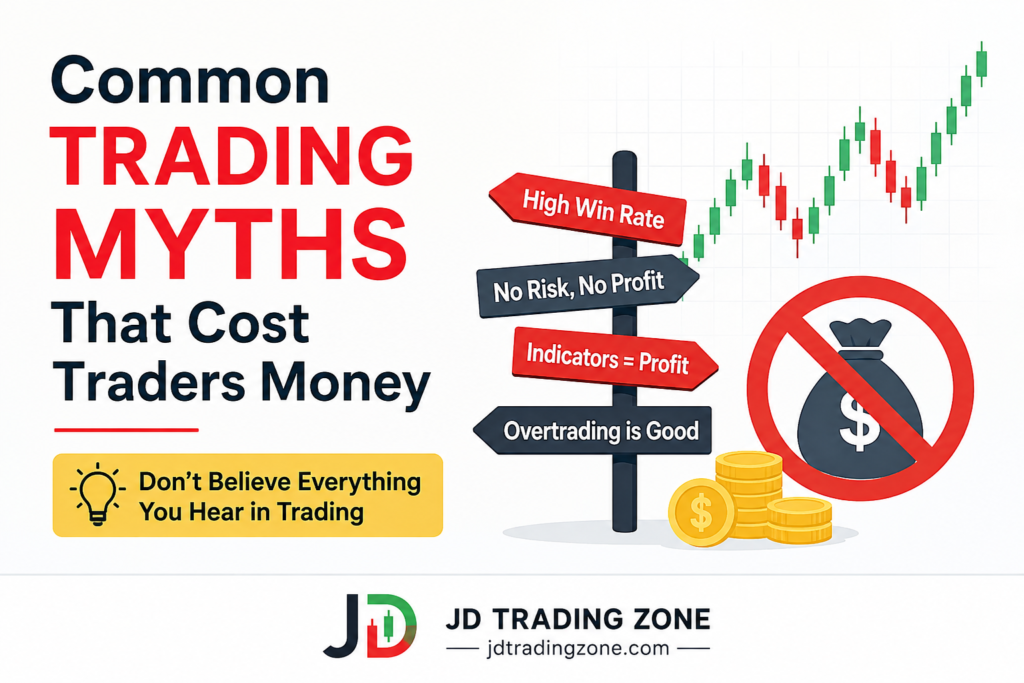
Common Trading Myths That Cost Traders Money
Why Trading Myths Are Dangerous
A trading myth becomes expensive when it changes how you manage money.
For example, a trader who believes that every trade should be profitable may refuse to accept a small loss. That small loss can eventually become a much larger one.
Similarly, someone who believes that successful traders make money every day may start overtrading after a losing morning because they feel they need to “recover” their money.
A better approach is to question popular trading beliefs and replace them with principles based on:
• Risk management
• Probability
• Market conditions
• Trading discipline
• Position sizing
• Consistent execution
• Long-term thinking
Let’s look at the myths that commonly cause problems.
Myth 1: A High Win Rate Means You Are a Successful Trader
One of the biggest misconceptions among beginners is that a trader must win most of their trades to be profitable.
This is not necessarily true.
Trading profitability depends on the relationship between your winning trades, losing trades, win rate, and average win/loss size.
Example
Imagine Trader A has:
• 70% winning trades
• Average profit: ₹500
• 30% losing trades
• Average loss: ₹1,500
Suppose the trader takes 10 trades:
• 7 × ₹500 = ₹3,500 profit
• 3 × ₹1,500 = ₹4,500 loss
The overall result is:
₹3,500 − ₹4,500 = −₹1,000
Despite having a 70% win rate, the trader loses money.
Now consider another trader with:
• 40% winning trades
• Average profit: ₹2,000
• 60% losing trades
• Average loss: ₹500
Over 10 trades:
4 × ₹2,000 = ₹8,000 profit
6 × ₹500 = ₹3,000 loss
Net result:
₹8,000 − ₹3,000 = ₹5,000 profit
The second trader wins fewer trades but has a better relationship between average gains and losses.
What beginners should learn
Don’t focus only on your win rate.
Pay attention to:
Win rate + average win + average loss + trading costs + consistency
A lower win rate can still be profitable when risk and reward are managed properly.
Myth 2: You Need to Predict the Market Correctly
Many beginners believe that successful traders know where the market will go next.
They don’t.
Markets are influenced by many factors, including:
• Economic data
• Company results
• Interest rates
• Global markets
• Institutional activity
• News
• Market sentiment
• Unexpected events
Even experienced traders cannot know the future with certainty.
Instead of trying to predict every movement, traders can build conditional plans.
For example:
“If price breaks resistance with confirmation, I will consider a long trade.
If the breakout fails, I will stay out or follow my predefined exit.”
This is very different from saying:
“The market will definitely go up.”
Better mindset
Think in terms of probabilities and scenarios, not certainty.
A trading plan should answer:
• What is my entry condition?
• Where is my stop-loss?
• Where will I exit if the trade works?
• What will invalidate my setup?
• How much am I willing to lose?
• What will I do if the market behaves differently?
You don’t need to predict every move.
You need to manage your response to different outcomes.
Myth 3: More Indicators Mean Better Trading Signals
A chart covered with indicators can look sophisticated.
But more information does not automatically mean better information.
A beginner might use:
• RSI
• MACD
• Bollinger Bands
• Multiple EMAs
• Stochastic
• VWAP
• Pivot Points
Several support and resistance indicators
The problem is that many indicators are derived from price and can provide overlapping information.
This can create analysis paralysis.
Example
Suppose:
• RSI says overbought.
• MACD says bullish.
• EMA says bullish.
• Stochastic says overbought.
• VWAP shows price above the average.
Instead of making the decision clearer, the trader may become confused because the indicators disagree.
A better approach
Start with a simple framework.
For example:
Price action → market structure → key levels → one or two supporting indicators → risk management
Indicators should support your decision-making rather than replace it.
The goal isn’t to have the most indicators.
The goal is to have a process you understand and can execute consistently.
Myth 4: You Need a Huge Amount of
Money to Start Trading
A large account can provide more flexibility, but having more capital does not automatically make someone a better trader.
A trader can lose ₹1 lakh just as easily as another trader can lose ₹10,000 if risk is poorly managed.
The important question is not:
“How much money can I make?”
It is:
“How much can I afford to lose on one trade?”
Before entering a position, consider:
• Account size
• Maximum risk per trade
• Stop-loss distance
• Position size
• Brokerage and other costs
• Market volatility
• Position sizing matters
Suppose your account is ₹50,000 and you decide that your maximum acceptable risk on one trade is ₹500.
If your stop-loss risk per share is ₹10:
Position size = ₹500 ÷ ₹10 = 50 shares
This approach connects the position size to your risk rather than choosing a quantity based on emotion.
Myth 5: You Can Make Money Every Day
This belief can be especially dangerous for intraday traders.
Markets do not provide a trading opportunity every day.
Some days may offer:
Strong trends
Clean breakouts
Clear pullbacks
Other days may produce:
• Choppy price action
• False breakouts
• Low volatility
• Sudden reversals
• Unclear setups
If your trading plan requires you to trade every day, you may eventually take trades simply because you feel you must participate.
Remember
No trade is also a decision.
A professional approach is not about being active every minute.
It is about participating when your setup meets your rules.
Myth 6: You Must Trade Every Market Move
Markets move constantly, but that doesn’t mean every movement deserves a trade.
A small price movement can be:
• Normal market noise
• A temporary pullback
• A false breakout
• A reaction to short-term liquidity
• An insignificant fluctuation
Trying to capture every move can lead to overtrading.
Better approach
Define your setup before the trading session.
For example:
“I will only consider a trade when price reaches my predefined level and my confirmation conditions are satisfied.”
If the conditions don’t appear, stay out.
You don’t get paid for the number of trades you place.
Myth 7: Stop-Losses Are Only for
Inexperienced Traders
Some traders believe that experienced traders don’t need stop-losses because they can “read the market.”
This is dangerous.
A stop-loss is not a sign that you expect to lose.
It is a way to define the point at which your original trade idea is no longer valid.
Markets can move unexpectedly because of:
• News
• Sudden volatility
• Economic announcements
• Global events
• Liquidity changes
• Unexpected order flow
Without a predefined exit, a small loss can become much larger.
Think of a stop-loss as a risk boundary
Before entering, ask:
“At what price would I admit that my trade idea is wrong?”
That level can help determine your stop-loss.
Myth 8: You Can Recover Losses by Increasing Your Position Size
This is one of the most dangerous trading habits.
Suppose a trader loses ₹1,000.
They decide:
“I’ll double my position on the next trade and recover it.”
The next trade loses ₹2,000.
Now they increase the position again.
This can create a cycle where losses grow faster than the trader expects.
This behavior is sometimes associated with revenge trading or uncontrolled position sizing.
Better response after a loss
After a losing trade:
1. Accept the result.
2. Review whether the trade followed your plan.
3. Avoid immediately increasing risk.
4. Wait for the next valid setup.
5. Keep your predefined risk limits.
A loss is part of trading.
An uncontrolled response to a loss can be much more damaging.
Myth 9: Expensive Trading Courses Guarantee Profits
A high-priced course does not guarantee that you will become profitable.
Education can help you understand:
• Market structure
• Technical analysis
• Risk management
• Trading psychology
• Trading systems
But knowledge alone does not guarantee successful execution.
A trader may understand dozens of strategies but still lose money because of:
• Overtrading
• Poor discipline
• Excessive leverage
• Emotional decisions
• Lack of risk control
• Constantly changing strategies
Before buying trading education
Ask:
• Is the content practical?
• Does it explain risk management?
• Does it discuss losing trades?
• Does it explain limitations?
• Can the concepts be tested?
• Is the focus on education rather than guaranteed returns?
Be especially cautious of anyone promising guaranteed profits or risk-free returns.
Myth 10: Trading Signals Are Enough to Become Profitable
Some beginners believe that receiving a buy or sell signal is all they need.
But a signal alone doesn’t answer every important question.
You still need to consider:
• Entry price
• Stop-loss
• Position size
• Target
• Market conditions
• Risk-to-reward relationship
• Trading costs
• Your own risk tolerance
Two traders can receive the same signal and have completely different results because they manage the position differently.
Important lesson
A signal is not a complete trading plan.
Your risk management and execution matter just as much.
Myth 11: A Winning Strategy Works in Every Market Condition
No strategy works equally well in every environment.
A trend-following strategy may perform differently during a sideways market.
A breakout strategy may struggle when breakouts frequently fail.
A mean-reversion approach may behave differently during strong trends.
Market conditions can include:
• Trending markets
• Range-bound markets
• High-volatility markets
• Low-volatility markets
• News-driven markets
• What should traders do?
Understand when your strategy tends to work and when it struggles.
Backtesting and keeping a trading journal can help identify patterns.
Instead of asking:
“Is this the best strategy?”
Ask:
“What market conditions is this strategy designed for?”
Myth 12: Paper Trading Is a Waste of Time
Some beginners want to start with real money immediately.
That can be costly.
Paper trading or simulated trading can help you understand:
• How your strategy works
• Whether you can follow your rules
• How frequently setups appear
• How stop-losses behave
• How different market conditions affect the strategy
• However, paper trading has limitations.
Real money introduces emotions that simulation may not fully reproduce.
So paper trading should be viewed as practice, not proof that future live results are guaranteed.
Myth 13: You Can Become a Profitable Trader Quickly
Social media often creates unrealistic expectations.
You may see posts showing:
• Large profits
• Luxury lifestyles
• Screenshots of winning trades
• “Easy” strategies
• Claims of quick wealth
But trading involves a learning curve.
Beginners need time to understand:
• Market behavior
• Risk management
• Their own psychology
• Strategy execution
• Position sizing
• Trading costs
• Performance evaluation
Instead of asking:
“How quickly can I make ₹1 lakh?”
Ask:
“How can I build a process that prevents one bad trade from damaging my account?”
That question is much more useful.
Myth 14: You Need to Trade With High
Leverage to Make Serious Money
Leverage can increase exposure, but it also increases the potential size of losses.
A trader may think:
“If I use more leverage, I can make money faster.”
But the same mechanism can cause losses to grow faster.
Leverage should never be treated as a shortcut to profitability.
Before using leverage, understand:
• How much exposure you are taking
• Maximum potential loss
• Margin requirements
• Volatility
• Stop-loss execution
• The risks specific to the product being traded
The objective should be controlled risk, not maximum exposure.
Myth 15: Holding a Losing Trade Until It
Becomes Profitable Is Always Better
One common mistake is refusing to exit a losing position because the trader believes:
“It will eventually come back.”
Sometimes the price may recover.
Sometimes it may continue moving against the position.
The key issue is that the original trade thesis may have become invalid.
Example
You enter a trade because price breaks above resistance.
Your plan says the breakout is invalid if price closes back below a specific level.
Price falls below that level.
At this point, continuing to hold simply because you don’t want to realize a loss changes the original trading plan.
Better approach
Separate these two ideas:
A temporary adverse move
from
A trade thesis that has been invalidated.
A predefined exit can prevent hope from replacing your trading plan.
Myth 16: Trading More Means Making More Money
Trading frequency does not automatically increase profitability.
Suppose a trader has a strategy that produces only two high-quality setups per week.
They decide that two trades are not enough.
So they begin taking 10–15 trades.
The additional trades may not have the same quality.
More trades can mean:
• More brokerage and transaction costs
• More emotional pressure
• More mistakes
• More exposure to poor setups
• Greater opportunity for revenge trading
Quality over quantity
A useful rule for beginners is:
Trade your setup, not your boredom.
If there is no valid setup, there is no obligation to trade.
Myth 17: Trading Psychology Is Only About Controlling Fear
Trading psychology is much broader than fear.
It can involve:
• Greed
• Fear
• Impatience
• Overconfidence
• Revenge
• FOMO
• Confirmation bias
• Loss aversion
• The need to be right
For example, a trader may become overconfident after five consecutive winning trades and increase position size dramatically.
That is a psychological problem even though the trader isn’t afraid.
Better psychological framework
Build rules that reduce the need for emotional decisions.
For example:
• Fixed maximum risk per trade
• Maximum daily loss
• Predefined entry conditions
• Predefined exit conditions
• Trading journal
• Break after a series of losses
• No revenge trades
Good trading psychology is not about eliminating emotions.
It is about preventing emotions from controlling your decisions.
Myth 18: Every Indicator Gives a Buy or Sell Signal
Indicators are tools for interpreting market data.
They do not know what will happen next.
For example, an RSI reading may suggest that price has moved strongly relative to recent periods, but that does not automatically mean price must reverse.
Likewise, a moving-average crossover does not guarantee a sustained trend.
Indicators can be useful for:
• Identifying momentum
• Understanding trends
• Measuring volatility
• Locating potential areas of interest
• Confirming parts of a trading setup
But they should be used within a broader decision-making framework.
Myth 19: If a Strategy Worked Before, It Will Always Work
A strategy’s historical performance does not guarantee future performance.
Markets change.
Volatility changes.
Participant behavior changes.
Economic conditions change.
A strategy can experience periods of:
• Strong performance
• Weak performance
• Drawdowns
• Sideways results
This is why traders should avoid assuming that a historical result will automatically repeat.
What can help?
Regularly review:
• Win rate
• Average profit
• Average loss
• Maximum drawdown
• Number of trades
• Market conditions
• Rule adherence
Don’t abandon a strategy after one losing trade.
But don’t blindly trust it forever either.
Myth 20: The Goal of Trading Is to Be Right
This may be the most important myth to understand.
Trading is not an exam where you receive points for correctly predicting every move.
You can be wrong about many individual trades and still have positive results if your winners and losers are managed appropriately.
Instead of focusing on:
“Was my prediction correct?”
focus on:
“Did I follow my trading process?”
A good trade can lose money.
A bad trade can make money.
The result of one trade does not necessarily tell you whether the decision was good.
Evaluate your process over a meaningful sample of trades.
What Should Beginners Believe Instead?
Instead of these myths, beginners can build their trading approach around a few practical principles.
1. Protect Capital First
Your trading capital is your business resource.
If repeated losses significantly reduce your account, recovering becomes increasingly difficult.
Capital preservation should be a priority.
2. Think in Probabilities
No setup is guaranteed.
Even a setup that historically performs well can lose.
Think in terms of:
Probability × Risk × Reward × Execution
rather than certainty.
3. Use Position Sizing
Your position size should be connected to your acceptable risk.
Don’t decide quantity simply because you want a particular rupee profit.
4. Accept Losing Trades
Losses are unavoidable in trading.
The goal is not to eliminate every losing trade.
The goal is to keep losses controlled.
5. Keep a Trading Journal
Record information such as:
• Date
• Instrument
• Setup
• Entry
• Stop-loss
• Target
• Position size
• Result
• Reason for entering
• Reason for exiting
• Emotional state
• Screenshot
After enough trades, your journal can reveal patterns that are difficult to notice during live trading.
A Simple Trading Myth Checklist
Before believing a trading claim, ask yourself:
Question 1:
→ Does it promise guaranteed profits?
If yes, be cautious.
Question 2:
→ Does it explain the risk?
If there is no discussion of losses, the information is incomplete.
Question 3:
→ Can I test the claim?
If you cannot test or measure it, avoid treating it as fact.
Question 4:
→ Does it work in every market condition?
Be skeptical of strategies claiming universal success.
Question 5:
→ Is the claim based on one successful trade?
One trade is not enough evidence.
Question 6:
→ Does the idea encourage larger risk after losses?
If yes, it can be dangerous.
Practical Example: How a Myth Can Destroy a Trading Account
Consider a beginner with a ₹50,000 trading account.
The trader believes:
“I need to recover every loss.”
They lose ₹1,000 on the first trade.
Instead of following their normal risk rules, they double their position.
The second trade loses ₹2,000.
Now they become frustrated and increase their position again.
The third trade loses ₹4,000.
The trader has now lost:
₹1,000 + ₹2,000 + ₹4,000 = ₹7,000
That’s 14% of the original ₹50,000 account.
The problem wasn’t necessarily the first losing trade.
The bigger problem was the belief that a loss must immediately be recovered.
A disciplined trader would have treated the first loss as a normal business expense and waited for the next valid setup.
How to Build a Healthier Trading Mindset
A beginner-friendly mindset can look like this:
Instead of:
“I must make money today.”
Think:
“I will follow my trading plan today.”
Instead of:
“This trade cannot lose.”
Think:
“This setup has a possibility of success, but I must control the downside.”
Instead of:
“I need more indicators.”
Think:
“I need clearer rules.”
Instead of:
“I need to recover my loss.”
Think:
“My next trade should be based on my strategy, not my previous result.”
Instead of:
“I need a 90% win rate.”
Think:
“I need a sustainable relationship between risk, reward, and execution.”
Final Thoughts
Trading myths can be expensive because they influence behavior.
Believing that you need to win every trade can make you hold losses too long.
Believing that more indicators are always better can make your charts unnecessarily complicated.
Believing that you must trade every day can lead to overtrading.
Believing that losses must immediately be recovered can lead to revenge trading and excessive risk.
The solution is not to find a magical strategy.
A more realistic approach is to develop a repeatable trading process built around risk management, probability, discipline, and continuous learning.
Remember:
• You don’t need to predict every market move.
• You don’t need to win every trade.
• You don’t need to trade every day.
• You don’t need dozens of indicators.
What you need is a process that keeps your losses controlled and allows your edge to play out over a meaningful number of trades.
Trading is a game of uncertainty. The traders who respect that uncertainty are generally better positioned to manage risk than those who believe they can eliminate it.
Common Trading Myths That Cost Traders Money
Frequently Asked Questions
Is a high win rate necessary to make money in trading?
→ No. A trader can potentially be profitable with a lower win rate if average winning trades are sufficiently larger than average losing trades and overall risk is controlled.
Can indicators guarantee profitable trades?
→ No. Indicators are analytical tools, not prediction machines. They can help traders structure decisions, but they cannot guarantee future price movements.
Should beginners trade every day?
→ No. Beginners should focus on taking only trades that meet their predefined criteria. Staying out of the market can be a valid decision.
Is stop-loss necessary for every trade?
→ Risk management should always define how much you are willing to lose before entering a trade. The exact exit method can vary by strategy, but entering without understanding your downside risk can expose you to unnecessary losses.
Can trading make money quickly?
→ Trading can produce both gains and losses, but there is no reliable shortcut to guaranteed wealth. Beginners should focus on developing skills, controlling risk, and evaluating performance over time.
What is the biggest trading myth beginners should avoid?
→ One of the most dangerous is believing that losses must be recovered immediately. Trying to recover losses by increasing position size can rapidly increase risk.
Disclaimer
This article is intended for educational and informational purposes only and should not be considered financial, investment, or trading advice. Trading involves substantial risk, and you can lose part or all of your invested capital. Always understand the risks of a financial product before trading and consider consulting a qualified financial professional if you need personalized advice.
If this blog makes sense to you give your feedback in comments and stay tuned for more information about JD Trading Zone.
Pingback: Daily Routine of Successful Traders - jdtradingzone.com
Pingback: How to Backtest a Trading Strategy - jdtradingzone.com
Thankyou for this post, I am a big big fan of this site would like to proceed updated.
Quality articles or reviews is the main to interest the visitors to pay a
visit the web site, that’s what this website is providing.
My family always say that I am killing my time here
at web, except I know I am getting know-how
all the time by reading thes pleasant posts.