Risk-Reward Ratio? What is the , is it important in trading. Yes , without risk reward ratio learning stock market trading is incomplete so let’s explore it together.
Welcome to JD Trading Zone
The risk-reward ratio (RRR) is one of the most important concepts in trading. It helps traders compare how much money they are willing to lose on a trade versus how much they expect to gain.
Many beginners spend hours searching for the perfect trading strategy, indicator, or stock. However, experienced traders know that good risk management is often more important than finding the perfect entry.
A simple risk-reward ratio can protect your trading capital and improve your chances of becoming consistently profitable over time.
Also check:- (How to Choose Stocks for Intraday Trading Every Morning) (Best Time Frame for Intraday Trading) (Top 10 mistakes new traders make and how to avoid them) (Price action trading explained learn without indicator) (What is support and resistance? complete beginner guide)
What Is Risk-Reward Ratio? Why Should Use It
What Does Risk-Reward Ratio Mean?
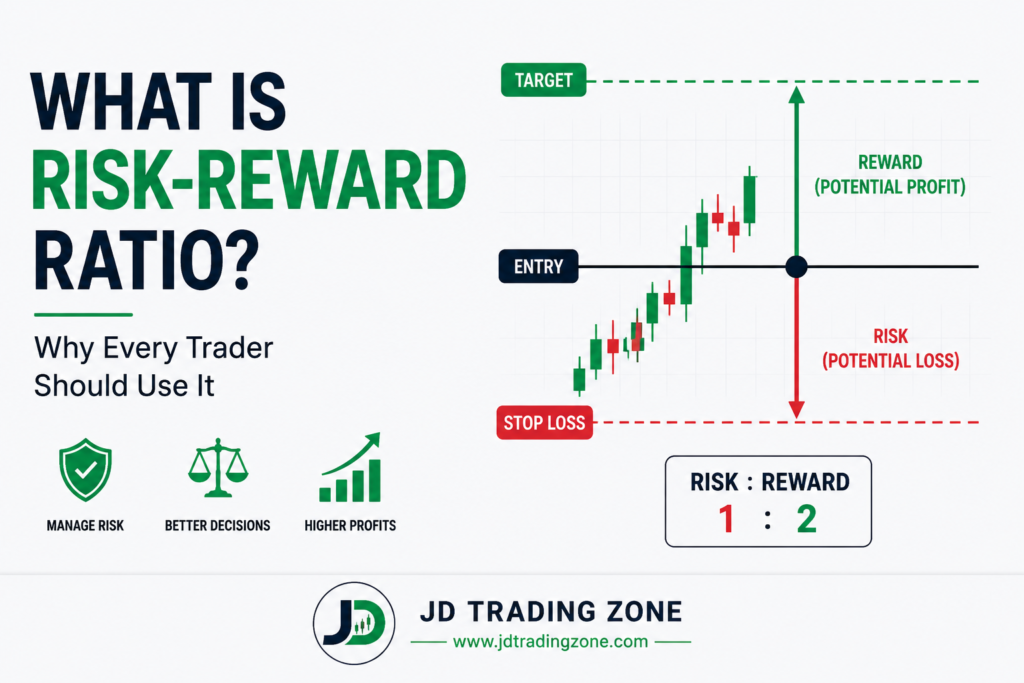
The risk-reward ratio compares:
• Risk: The amount you can lose if your stop-loss is hit.
• Reward: The amount you expect to make if your target is reached.
Formula
Risk-Reward Ratio = Potential Loss :
• Potential Profit
Example:
• Entry Price = ₹100
• Stop Loss = ₹95
• Target = ₹110
• Risk = ₹5
• Reward = ₹10
→ Risk-Reward Ratio = 1:2
This means you are risking ₹1 to potentially earn ₹2.
Why Is Risk-Reward Ratio Important?
Many traders believe winning more trades is the secret to success.
That is not always true.
A trader with only a 40% win rate can still be profitable if they maintain a good risk-reward ratio.
Likewise, a trader with a 70% win rate may still lose money if every losing trade is much larger than every winning trade.
The risk-reward ratio helps traders:
• Control losses
• Protect trading capital
• Stay disciplined
• Reduce emotional decisions
• Improve long-term profitability
Understanding Risk with a Simple Example
Imagine two traders.
→ Trader A
• Wins 8 trades
• Loses 2 trades
• Risks ₹500 to make only ₹200
Despite winning more often, Trader A may still lose money overall.
→ Trader B
Wins only 4 trades
• Loses 6 trades
• Risks ₹500 to make ₹1,500
Even with fewer winning trades, Trader B can remain profitable because the average winning trade is much larger than the average losing trade.
This is why professional traders focus on both win rate and risk-reward ratio, not just accuracy.
Common Risk-Reward Ratios
→ 1:1
Risk ₹100
Target ₹100
Suitable for some short-term trading strategies but leaves little room for mistakes.
→ 1:2
Risk ₹100
Target ₹200
A popular choice among many intraday and swing traders.
→ 1:3
Risk ₹100
Target ₹300
Requires patience but offers higher potential returns.
→ 1:4 or Higher
Often used when traders identify strong trending markets with clear price action setups.
How to Calculate Risk-Reward Ratio
Follow these simple steps:
→ Step 1: Identify Your Entry Price
Suppose you buy a stock at ₹500.
→ Step 2: Decide Your Stop Loss
You place your stop loss at ₹490.
Risk = ₹10
→ Step 3: Set Your Target
Your target is ₹520.
Reward = ₹20
Risk-Reward Ratio = 10 : 20
Simplified:
1:2
Why Every Trader Should Use Risk-Reward Ratio
1. Protects Your Capital
Your first goal in trading is not making money.
It is protecting your trading capital.
Without capital, you cannot continue trading.
2. Removes Emotional Trading
A predefined stop-loss and target reduce panic and impulsive decisions.
You know exactly when to exit before entering the trade.
3. Encourages Discipline
Successful trading depends on following a consistent trading plan.
The risk-reward ratio helps you avoid random trades.
4. Helps You Stay Profitable
You do not need to win every trade.
You only need your average winners to outweigh your average losers.
5. Improves Decision-Making
Before entering any trade, ask yourself:
“Is the potential reward worth the risk?”
If the answer is no, skip the trade.
Sometimes the best trade is no trade.
Risk-Reward Ratio in Different Trading Styles
→ Intraday Trading
Many day traders prefer ratios between 1:1.5 and 1:3, depending on market conditions.
→ Swing Trading
Swing traders often aim for 1:2 or higher because trades have more time to develop.
→ Positional Trading
Long-term traders may target much larger rewards, such as 1:3, 1:5, or even higher, while accepting that not every trade will succeed.
Common Mistakes Beginners Make
→ Ignoring Stop Loss
Trading without a stop-loss can lead to large losses.
→ Chasing Small Profits
Taking profits too early reduces the average reward and weakens your overall results.
→ Setting Unrealistic Targets
Targets should be based on market structure, support and resistance, trend strength, or your trading strategy—not wishful thinking.
→ Increasing Risk After Losses
Trying to recover losses quickly by risking more money often creates even bigger losses.
→ Focusing Only on Win Rate
A high win rate alone does not guarantee profitability.
Risk management matters just as much.
Tips to Improve Your Risk-Reward Ratio
• Always use a stop-loss.
• Plan every trade before entering.
• Avoid emotional decisions.
• Follow your trading strategy consistently.
• Keep a trading journal.
• Review your trades regularly.
• Never risk more than you are comfortable losing on a single trade.
• Wait for high-quality setups instead of forcing trades.
Frequently Asked Questions (FAQs)
What is a good risk-reward ratio for beginners?
→ Many beginners aim for 1:2 because it balances risk and potential reward while encouraging disciplined trading.
Can I be profitable with a low win rate?
→ Yes. If your average winning trades are significantly larger than your losing trades, you can still be profitable over many trades.
Is a higher risk-reward ratio always better?
→ Not necessarily. Very high targets may be difficult to achieve consistently. Your target should match your strategy and market conditions.
Should I use the same ratio for every trade?
→ No. Different market conditions and trading setups may require different targets and stop-loss placements.
What Is Risk-Reward Ratio? Why Every Trader Should Use It
Final verdict
The risk-reward ratio is one of the simplest yet most powerful tools in trading. It helps you think like a disciplined trader instead of relying on emotions or luck.
Remember, successful trading is not about winning every trade. It is about managing losses, protecting your capital, and allowing profitable trades to outweigh losing ones over time.
Whether you trade intraday, swing, or positional setups, combining a sound trading strategy with proper risk management can improve your consistency and confidence.
Start by planning your entry, stop-loss, and target before every trade. Over time, this habit can make a meaningful difference in your trading journey.
Pingback: Trading Psychology: How to Control Fear, Greed, and FOMO - jdtradingzone.com
Pingback: How to Create a Trading Plan That Actually Works - jdtradingzone.com
Pingback: Top 10 Free Trading Tools Every Trader Should Use - jdtradingzone.com