In this guide, we will explain all major types of trading in the stock market, a simple and beginner-friendly way.
When I first started learning about the stock market, I thought “trading” simply meant buying a stock and selling it later for a profit.
It didn’t take long to realize that traders can approach the same market in completely different ways.One trader may hold a position for a few minutes.
Another may keep it for several days. Someone else may hold a trade for months.The biggest difference isn’t just the holding period.
Each style requires a different amount of time, patience, capital, risk tolerance, and emotional control.
That’s why I wouldn’t choose a trading style simply because someone on social media says it can make money faster.
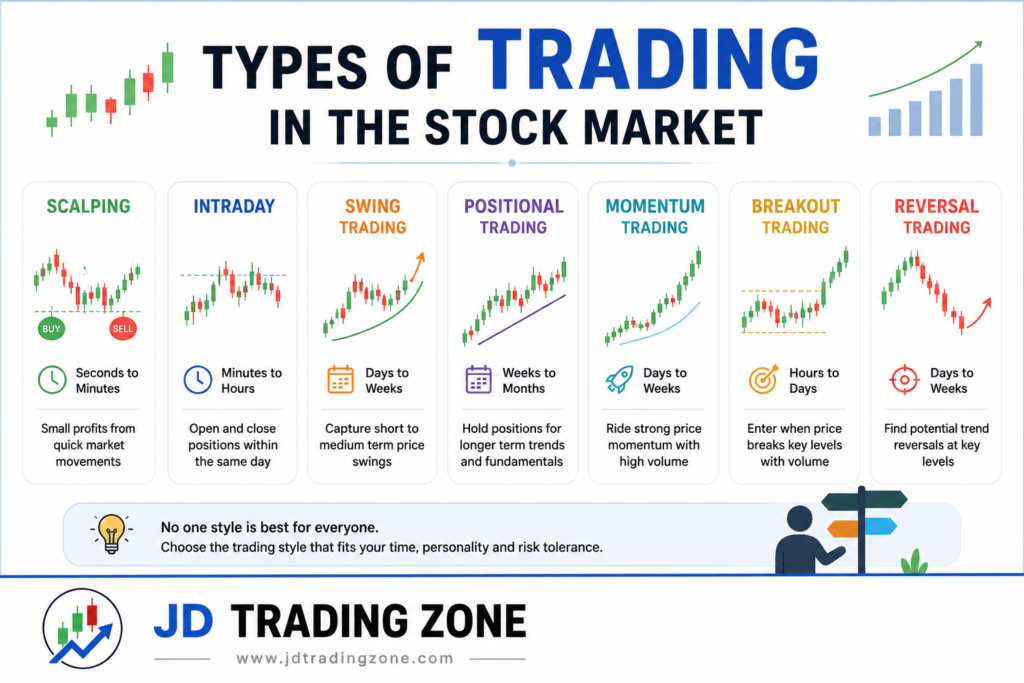
First understand how each style works.
1. Intraday Trading (Day Trading)
Intraday trading means buying and selling stocks on the same day before the market closes.
Key Features:
• No position is carried to the next day
• Fast profit & fast loss
• Requires good technical analysis
• High risk but high reward
Best For:
• Active traders
• People who can watch charts during market hours
Popular Indicators Used:
• VWAP (you already use this 😉)
• MACD
• Pivot Points
• RSI
2. Swing Trading
Swing trading means holding stocks for a few days to a few weeks to capture short-term price movement.
Key Features:
• Less stressful than intraday
• Uses technical + basic analysis
• Medium risk
• Good for part-time traders
Holding Period:
→ 2 days to 2–3 weeks
3. Positional Trading
Positional trading means holding stocks for weeks or months.
Key Features:
• Based on a big trend
• Needs patience
• Less screen time required
• Lower stress compared to intraday
Best For:
→ People who can’t watch the market daily
→ Working professionals
4. Long-Term Investing
Long-term investing means buying good stocks and holding them for years.
Key Features:
• Based mainly on fundamental analysis
• Very low stress
• Lower risk compared to trading
• Best for wealth creation
Examples:
→ Investing in TCS, Reliance, Infosys for 5–10 years
5. Scalping Trading
Scalping is a very fast trading style where traders take small profits multiple times a day.
Key Features:
• Trades last from seconds to minutes
• Needs very fast execution
• High brokerage & discipline required
• Very stressful for beginners
Option trading is done in Nifty, Bank Nifty, FinNifty, and stocks using Call & Put options.
Key Features:
• High risk, high reward
• Can lose money very fast
• Needs strong strategy and risk management
• Mostly used for intraday & swing
⚠️ Not recommended for beginners without proper knowledge.
7. Futures Trading
Futures trading means trading with margin and leverage.
Key Features:
• Very high risk
• Big profit and big loss possible
• Needs strong capital & psychology
8. Algo Trading (Automatic Trading)
Algo trading uses software and bots to place trades automatically based on a strategy.
Key Features:
• No emotions
• Fast execution
• Needs programming or paid software
• Mostly used by professionals
Which Type of Trading is Best for Beginners?
For beginners, the best options are:
✅ Swing Trading
✅ Positional Trading
✅ Long-Term Investing
After gaining experience, you can move to:
⚠️ Intraday Trading
⚠️ Options Trading
Don’t Choose a Style Because It Looks Fast
This is probably the most important point for a beginner.
Scalping can look exciting because trades happen quickly.
Intraday trading can look attractive because positions are closed every day.
Swing trading can look easier because you don’t have to stare at charts constantly.But every style has its own problems.
Instead of asking:
“Which trading style makes the most money?”
ask:
“Which trading style can I follow consistently without breaking my risk-management rules?”
That is a much better question.
Final Conclusion
Different types of trading suit different people.
• If you like fast action → Intraday / Scalping
• If you want less stress → Swing / Positional
• If you want safe wealth creation → Long-term investing
👉 Choose your trading style based on your time, capital, and risk-taking ability.
If this blog makes sense to you give your feedback in comments and stay tuned.
At the end of the day
Trading isn’t about timing in the market it’s about time in the market
Just logged into 74bet using the 74betlogin. Smooth as butter, no issues at all! Now, let’s see if my luck’s in tonight! Give it a look see: 74betlogin