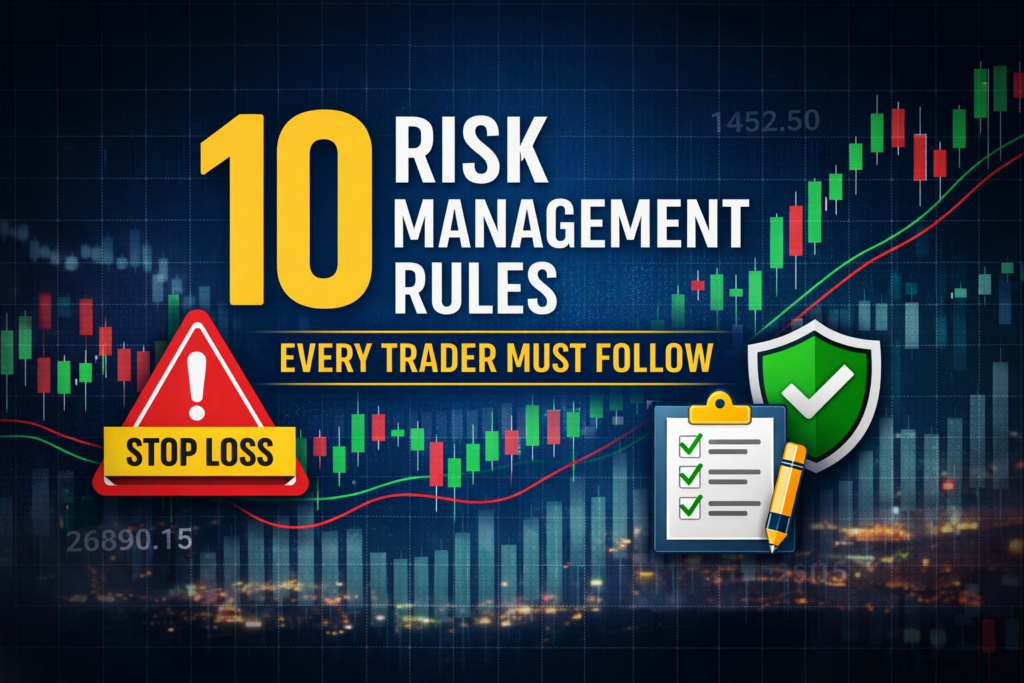
In this blog post, we will discuss the 10 most important risk management rules every trader must follow to survive and grow consistently in the stock market.
Risk management is the backbone of successful trading. You may have the best strategy, indicators like VWAP, MACD, or Pivot Points, but without proper risk control, losses can wipe out your capital quickly. Professional traders focus more on managing risk than chasing profits.
1. Never Risk More Than 1–2% of Your Capital Per Trade
This is the golden rule of trading.
If your trading capital is ₹1,00,000, your maximum loss per trade should be ₹1,000–₹2,000 only.
✅ Protects your capital
✅ Helps you recover easily after losses
✅ Reduces emotional pressure
2. Always Use a Stop Loss
Trading without a stop loss is like driving without brakes.
A stop loss: ( how to control emotions while trading)
Limits your downside risk
Protects you from sudden market moves
Keeps emotions under control
Whether you trade intraday, swing, or options, a predefined stop loss is mandatory.
3. Maintain a Minimum Risk-Reward Ratio of 1:2
Before entering any trade, ask yourself:
If I lose ₹1, how much can I gain?
A good trade setup should have:
Risk:Reward = 1:2 or higher
Example:
Risk = ₹500
Target = ₹1,000 or more
Even if you win only 40–50% trades, you can still be profitable.
4. Avoid Overtrading
More trades do NOT mean more profits.
Overtrading leads to:
High brokerage & taxes
Emotional fatigue
Poor quality trades
📌 Focus on 2–4 high-probability trades instead of trading all day.
5. Do Not Trade With Full Capital
Never put all your money into one trade.
Smart traders:
Use position sizing
Keep some capital in reserve
Trade small during volatile markets
Capital protection should always come first.
6. Follow One Strategy Consistently
Jumping between strategies causes confusion and losses.
Choose:
One or two setups (like VWAP pullback or MACD crossover)
Backtest them ( best charting platform for intraday traders)
Trade them consistently
Consistency builds confidence and discipline.
7. Control Your Emotions (Fear & Greed)
Most trading losses happen due to:
Fear (early exit)
Greed (overholding)
Revenge trading
📌 Follow your plan, not your emotions.
If emotions take over, stop trading for the day.
8. Avoid Trading During Low-Quality Market Conditions
Not every day is a trading day.
Avoid trading:
During low volatility
When market is choppy
Before major news events (if you’re a beginner)
Wait for clear trend and volume confirmation.
9. Keep a Trading Journal
A trading journal helps you:
Track mistakes
Improve strategy
Identify emotional patterns
Write down:
Entry & exit
Reason for trade
Profit or loss
What you learned
This habit can dramatically improve your performance.
10. Stop Trading After Reaching Daily Loss Limit
Set a daily loss limit (example: 2–3% of capital).
If reached: ❌ Stop trading immediately
❌ No revenge trades
📌 Surviving in the market is more important than making money in one day.
📈 Trade Safely with a Trusted Broker
Risk management works best when you trade on a fast & reliable platform.
I personally recommend Zerodha for beginners and active traders because of:
✔ Low brokerage
✔ Fast order execution
✔ Powerful tools like Kite & Coin
👉 Open your Zerodha account here
Final Thoughts
Risk management is not optional — it is mandatory for every serious trader.
Even average strategies can become profitable with strong risk control, but no strategy can survive without it.
💡 “Good traders focus on risk, great traders survive because of it.”
If this blog makes sense to you give your feedback in comments.
In the next blog i will share about the Vwap and RSI strategy stay tuned.
At the end of the day
Trading isn’t about timing in the market it’s about time in the market .
- Real Reasons Traders Lose Money mistakes to avoidIf you’re a beginner, understanding real reasons traders lose money mistakes to avoid can save you from costly errors and help you build a sustainable… Read more: Real Reasons Traders Lose Money mistakes to avoid
- Best intraday trading strategy for stocksThis guide will help you understand simple, practical, and beginner-friendly best intraday trading strategy for stocks that actually work—along with risk management rules that professionals… Read more: Best intraday trading strategy for stocks
- How to start stock market investing in IndiaIf you are new, don’t worry. This guide will walk you through how to start stock market investing in India step by step in a… Read more: How to start stock market investing in India
- How to make your own strategy in tradingIn this guide, you will learn how to make your own strategy in trading step by step, even if you are a beginner. Trading in… Read more: How to make your own strategy in trading
- Rules of options trading for beginnersIf you are new to options trading, rules of options trading for beginners, this blog can help you manage risk, make better decisions, and develop… Read more: Rules of options trading for beginners
Thinking of joining ss66. Has anyone had a good experience with them? Any tips or advice would be hugely appreciated. Check it out yourselves: ss66!
Pingback: How to use Vwap with RSI for more accurate trades - jdtradingzone.com
Pingback: Complete beginners guidance of candlestick patterns - jdtradingzone.com
Pingback: What is Support and Resistance & Supply and Demand in stock market - jdtradingzone.com
Pingback: Why do 90% traders lose money and how to avoid mistakes. - jdtradingzone.com
Pingback: Importance of consistency and discipline in trading - jdtradingzone.com
Pingback: What is mutual funds investing? - jdtradingzone.com
Pingback: Investing vs positional trading - jdtradingzone.com
Pingback: What is future and option trading? - jdtradingzone.com
Pingback: Option trading for beginners in a simple way - jdtradingzone.com
Pingback: What is option greeks? - jdtradingzone.com
Pingback: What is price action analysis? - jdtradingzone.com
Pingback: Chart patterns complete beginners guidance - jdtradingzone.com
Pingback: Complete beginners guidance about the stock market - jdtradingzone.com
Pingback: Rules of options trading for beginners - jdtradingzone.com
Pingback: How to make your own strategy in trading - jdtradingzone.com
Pingback: How to start stock market investing in India - jdtradingzone.com