
In this guide, you’ll learn how to use VWAP with RSI for more accurate trades , with clear strategies, rules, and common mistakes to avoid.
What is VWAP?
In intraday trading, taking entries without confirmation often leads to false signals and losses. Two of the most reliable indicators traders use are VWAP (Volume
Weighted Average Price) and RSI (Relative Strength Index).
When combined correctly, VWAP + RSI can help you identify high-probability entries, avoid overtrading, and improve overall accuracy.
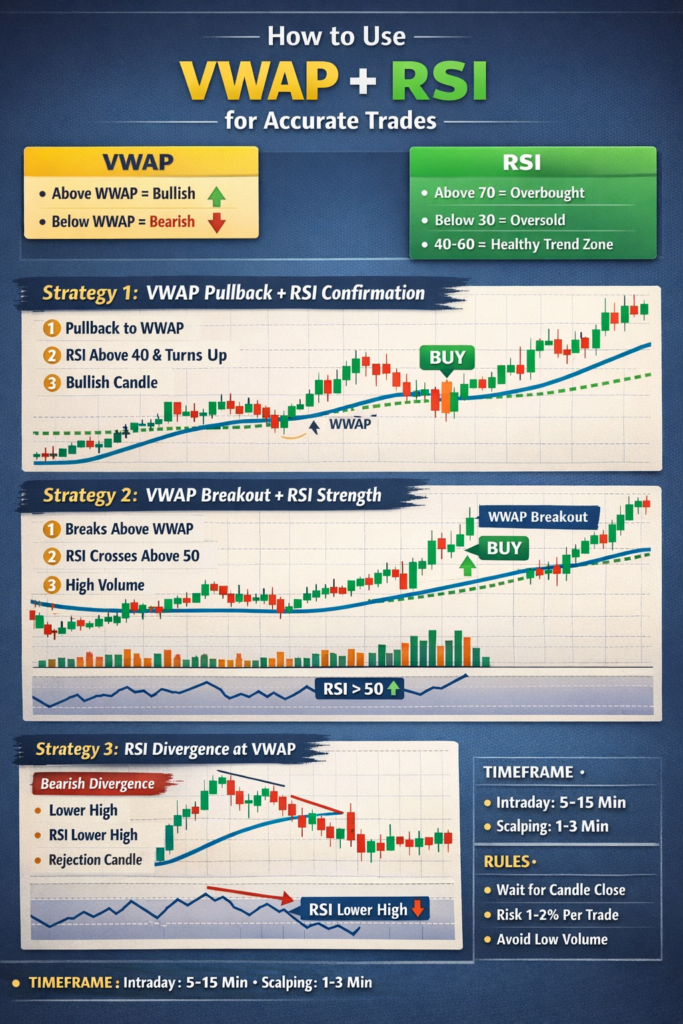
VWAP (Volume Weighted Average Price) shows the average price of a stock based on price and volume during the trading session.
Why VWAP is Important:
Acts as dynamic support & resistance
Used by institutional traders
Best indicator for intraday trading
Helps identify fair price zones
Rule:
Price above VWAP → Bullish bias
Price below VWAP → Bearish bias
What is RSI?
RSI (Relative Strength Index) is a momentum indicator that measures buying and selling strength on a scale of 0 to 100.
Key RSI Levels:
Above 70 → Overbought
Below 30 → Oversold
40–60 zone → Healthy trend zone
RSI helps confirm whether a move has strength or weakness.
Why Combine VWAP with RSI?
VWAP tells you where price should trade, while RSI tells you whether momentum supports the move.
Benefits of VWAP + RSI:
✔ Reduces false breakouts
✔ Filters weak trades
✔ Improves entry timing
✔ Works well in stocks, indices & options
Best VWAP + RSI Settings
Recommended Settings:
VWAP: Default (Session VWAP)
RSI Period: 14
RSI Levels: 30, 50, 70
(Advanced traders may use RSI 9 or RSI 21 based on volatility.)
Strategy 1: VWAP Pullback + RSI Confirmation (High Accuracy)
BUY Setup:
Price trades above VWAP
Pullback towards VWAP
RSI stays above 40 and turns upward
Bullish candle near VWAP
Entry: Above confirmation candle
Stop Loss: Below VWAP or recent low
Target: Previous high / 1:2 RR
SELL Setup:
Price trades below VWAP
Pullback towards VWAP
RSI stays below 60 and turns downward
Bearish candle near VWAP
Strategy 2: VWAP Breakout + RSI Strength
BUY Trade:
Strong candle breaks above VWAP
RSI crosses above 50
Volume increases
SELL Trade:
Strong candle breaks below VWAP
RSI crosses below 50
Volume supports the move
⚠ Avoid low-volume breakouts.
Strategy 3: RSI Divergence at VWAP (Advanced)
Bullish Setup:
Price near or below VWAP
Price makes lower low
RSI makes higher low
Rejection candle near VWAP
Bearish Setup:
Price near VWAP
Price makes higher high
RSI makes lower high
This setup works best during range-bound markets.
Best Timeframe for VWAP + RSI Trading Style ( best time frame for intraday trading)
Timeframe
Scalping
1–3 min
Intraday
5–15 min
Options Trading
5 min
Index Trading
5 / 15 min
Risk Management Rules (Must Follow) (trading risk management rules)
Trade only after market opens (9:20 AM+)
Risk max 1–2% per trade
Avoid trading during low volatility
One setup = one trade
Always wait for candle close confirmation
Common Mistakes to Avoid
❌ Trading RSI overbought/oversold blindly
❌ Ignoring market trend
❌ Taking VWAP trades in sideways markets
❌ Overtrading without confirmation
VWAP + RSI for Options Trading
For NIFTY / BANKNIFTY options:
Trade only ATM or ITM
Enter after spot index confirms VWAP
RSI should be above 50 for CALL, below 50 for PUT
Avoid option buying near market close
📈 Trade Safely with a Trusted Broker
Risk management works best when you trade on a fast & reliable platform.
I personally recommend Zerodha for beginners and active traders because of:
✔ Low brokerage
✔ Fast order execution
✔ Powerful tools like Kite & Coin
👉 Open your Zerodha account here
Final Thoughts
VWAP with RSI is a powerful intraday trading combination when used with price action and discipline.
Instead of chasing trades, let the market come to your setup.
Remember:
👉 VWAP gives direction
👉 RSI confirms strength
👉 Risk management protects capital
If this blog makes sense to you give your feedback in comments .
In the next blog i will share about the pre market trading strategy stay tuned.
At the end of the day
Trading isn’t about timing in the market it’s about time in the market.
Pingback: % - jdtradingzone.com
PlusAce is my new favorite spot! Great bonuses and a really cool interface. Been on a hot streak lately, so I’m definitely sticking around. Head to plusace now.