The most important part of a trade often happens before you enter it.
A common trading mistake looks simple: a trader sees a stock moving quickly, feels that the move is about to continue, and clicks Buy.
Only after entering does the real thinking begin:
• Where should I keep my stop-loss?
• Where should I book profit?
• How much quantity should I hold?
• What if the price immediately reverses?
• Should I exit if the market becomes weak?
This is backwards.
A better approach is to answer these questions before entering the trade.
A trade should not begin when you click the Buy button. It should begin when you can clearly explain why you want to enter, where your idea becomes invalid, how much you are willing to lose, and what you expect if the trade works.
This guide explains a simple pre-trade planning process that can be used for intraday trading, swing trading, and even options setups.
Also check:- (How to Use Volume Before Taking an Intraday Trade) (Which Timeframe Is Better for Intraday Trading?) (Why Good Trading Setups Fail: 9 Reasons Behind Losing Trades) (One Complete Intraday Trading Setup)
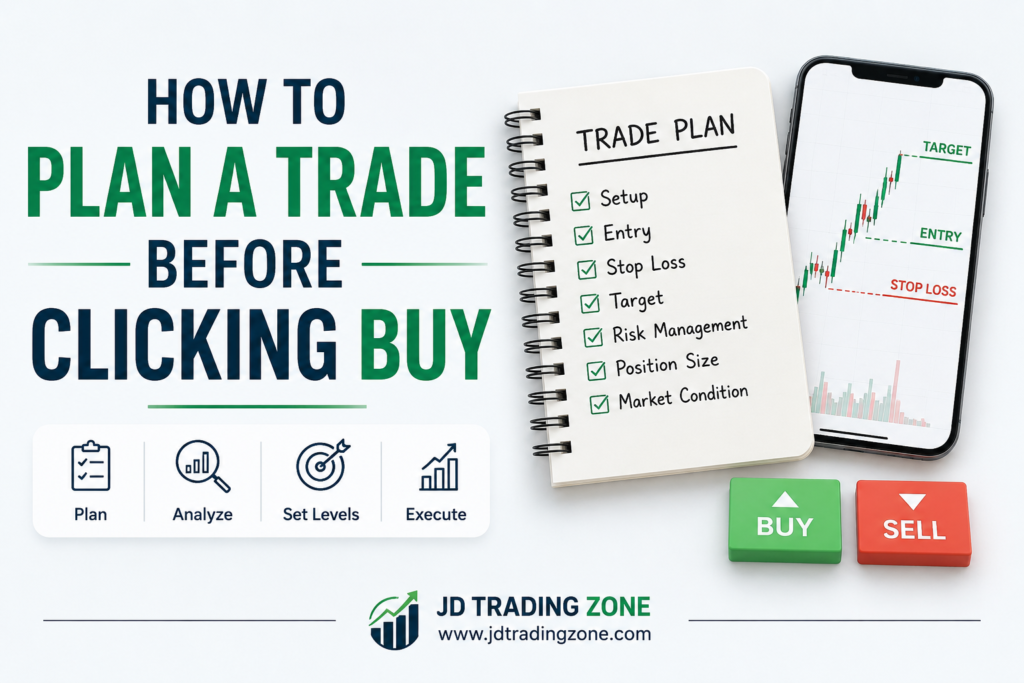
What Does It Mean to Plan a Trade?
Trade planning means deciding the important parts of a trade before your money is exposed to the market.
At minimum, you should know:
1. What is the setup?
2. Why am I interested in this stock?
3. Where is my entry?
4. Where is my stop-loss?
5. What is my target?
6. How much can I lose?
7. What position size should I take?
8. What will make me cancel the trade?
9. What will I do if the trade moves in my favour?
10. What will I do if the market behaves differently from my expectation?
This is more than a checklist.
It forces you to convert a vague prediction such as:
“I think this stock will go up.”
into a defined trading idea:
“If price breaks this level with acceptable confirmation, I will enter. If it falls below my invalidation level, my idea is wrong and I will exit.”
That difference can completely change the way you trade.
1. Start With the Market, Not the Stock
Before looking for an entry, first understand the environment.
Ask:
Is the broader market trending, ranging, weak, or highly volatile?
For an Indian intraday trader, you might look at:
• Nifty 50
• Bank Nifty
• Sector performance
• Market breadth
• Major support and resistance levels
• Important scheduled events
• Overall volatility
You don’t need to predict exactly where Nifty will close.
The purpose is simply to understand the environment.
For example, suppose your stock gives a bullish breakout while the broader market is sitting near a major resistance level and repeatedly failing to move higher.
The stock may still work.
But the trade deserves more caution than the same setup occurring when the market is strongly trending upward.
Context comes before entry.
2. Decide What Setup You Are Actually Trading
One of the biggest problems with discretionary trading is changing the reason for entry after seeing the chart.
A trader may initially think:
“This is a breakout.”
Then, after entering:
“Maybe it’s actually a pullback.”
And after the price falls:
“It is probably a fake breakdown. I’ll hold.”
This makes the trade impossible to evaluate properly.
Instead, define the setup beforehand.
For example:
Setup: VWAP Pullback
Your rules might be:
• Stock is trading above VWAP.
• The overall intraday structure is bullish.
• Price makes an upward move.
• Price pulls back toward VWAP.
• Selling pressure weakens.
• A bullish confirmation candle appears.
• Entry is taken only after confirmation.
Now you know exactly what you are looking for.
If the stock never produces the setup, there is no trade.
That’s an important distinction.
You are not looking for a reason to trade.
You are waiting for your reason to appear.
3. Mark the Important Levels Before the Market Gets Fast
Before entering, identify the levels that could influence your trade.
Depending on your strategy, these may include:
• Previous day’s high
• Previous day’s low
• Day’s high and low
• Support
• Resistance
• VWAP
• Pivot levels
• Breakout levels
• Previous swing high
• Previous swing low
• Gap levels
Don’t cover the chart with dozens of lines.
You want the levels that actually matter.
For example:
Stock: XYZ
Current price: ₹248
Resistance: ₹250
Support: ₹244
VWAP: ₹246
If you’re considering a bullish trade at ₹248, the ₹250 resistance immediately becomes relevant.
You shouldn’t discover that resistance only after buying.
4. Define the Entry Before You Click Buy
“Buy around here” is not a proper entry plan.
Try to make your entry condition specific.
For example:
Buy only if price breaks ₹250 and sustains above the level with confirmation.
Or:
Buy near VWAP only if the pullback holds and a bullish candle confirms the reversal.
The exact condition depends on your strategy.
The important point is that the entry should come from a predefined setup rather than excitement.
This also helps prevent chasing.
If a stock breaks your planned entry and suddenly runs another 2%, you don’t automatically have to chase it.
You can simply say:
“My planned entry is gone. I’ll wait for the next valid setup.”
Missing a trade is usually less damaging than turning a planned trade into an emotional one.
5. Decide Where the Trade Is Wrong
This is one of the most important parts of trade planning.
Instead of asking:
“How much loss can I tolerate?”
ask:
“At what price does my trading idea become invalid?”
That level becomes the basis for your stop-loss.
Suppose you buy because a stock breaks resistance at ₹250.
If your analysis says that a move below ₹246 would invalidate the breakout, then ₹246 may be your technical invalidation level.
Your trade plan becomes:
Entry: ₹250
Stop-loss: ₹246
Risk per share: ₹4
The stop-loss shouldn’t simply be placed at an arbitrary percentage because “2% is my rule.”
The market structure should first determine where your idea is invalid.
Then your position size can be adjusted to fit your acceptable monetary risk.
A stop-loss is designed to control risk, but it does not guarantee an exact exit price.
In fast-moving markets, execution can differ from the trigger price.
6. Calculate the Risk Before Calculating the Profit
This is where many traders approach a trade incorrectly.
They first calculate:
“How much can I make?”
Instead, calculate:
“How much can I lose if I’m wrong?”
For example:
Trading capital = ₹50,000
Maximum planned risk = ₹500
Entry = ₹250
Stop-loss = ₹246
Risk per share:
₹250 − ₹246 = ₹4
Maximum quantity:
₹500 ÷ ₹4 = 125 shares
So instead of deciding:
“I’ll buy 500 shares because I have enough margin.”
you decide the quantity based on the amount you are prepared to lose.
Position sizing is specifically intended to determine how much capital should be exposed to a trade based on the defined risk. �
Simple formula
Position Size = Maximum Rupee Risk ÷ Risk Per Share
This is one of the most useful calculations you can make before entering a trade.
7. Decide the Target Before the Trade
Now ask:
If everything goes according to plan, where can price reasonably move?
Suppose:
Entry = ₹250
Stop-loss = ₹246
Risk = ₹4
If your planned target is ₹258:
Potential reward = ₹8
Potential risk = ₹4
Reward-to-risk = 2:1
You don’t need every trade to produce a huge target.
The important thing is that the target should make sense relative to the setup and nearby market structure.
For example, if strong resistance exists at ₹253, blindly expecting ₹270 may not be realistic for a short intraday trade.
Your target should be based on where price can reasonably travel, not how much profit you want to make.
8. Ask: “What If the Trade Doesn’t Move?”
This is an overlooked part of planning.
Imagine you buy at ₹250.
The stock moves to ₹250.30.
Then ₹249.90.
Then ₹250.20.
Then ₹249.80.
Thirty minutes later, nothing has happened.
What do you do?
If you haven’t decided beforehand, you may start inventing explanations:
“It will move soon.”
“The breakout is still valid.”
“I’ll give it more time.”
This is how a planned intraday trade can accidentally become a much longer position.
Before entering, decide whether time itself is part of your trade thesis.
For example:
“If the breakout fails to develop within my planned trading window, I will reassess rather than hold indefinitely.”
Not every trade needs a strict time-based exit, but every trader should understand how long the original setup is supposed to remain valid.
9. Identify the Reason You Would Cancel the Trade
This is different from your stop-loss.
A stop-loss answers:
“What happens after I enter and the trade goes wrong?”
A cancellation rule answers:
“What happens before I enter if the setup changes?”
For example, you planned:
Buy above ₹250 after a breakout.
But before your entry:
The market suddenly becomes weak.
Volume disappears.
Price falls back below the breakout level.
A major event is approaching.
The stock becomes extremely volatile.
The setup no longer matches your rules.
You can simply cancel the trade.
This is one of the biggest advantages of planning before clicking.
You don’t have to enter just because you were waiting for an entry.
10. Check the Reward-to-Risk Ratio
Before entering, compare the potential reward with the amount you’re risking.
Example:
Entry = ₹250
Stop-loss = ₹246
Target = ₹258
Risk = ₹4
Reward = ₹8
So:
Reward-to-risk = 8 ÷ 4 = 2
That gives you a 2:1 reward-to-risk ratio.
But don’t make the mistake of thinking:
“2:1 means this trade will definitely make money.”
It doesn’t.
Reward-to-risk describes the relationship between potential gain and potential loss.
It says nothing about whether your setup will actually reach the target.
Trading outcomes remain uncertain; even a well-planned trade can hit its stop-loss.
11. Check Liquidity Before Entering
A beautiful chart is not enough.
You also need to consider whether the instrument can actually be traded efficiently.
Look at:
• Trading volume
• Bid-ask spread
• Market depth
• Sudden price jumps
• Liquidity during your trading period
This becomes particularly important in intraday and derivatives trading.
A setup that looks perfect on a chart can behave poorly if the instrument has inadequate liquidity.
Liquidity and volatility can also make exits more difficult during sudden market movements.
12. Check for Events That Could Destroy Your Setup
Sometimes the chart isn’t the biggest risk.
News can change the situation in seconds.
Before taking a trade, consider whether there is any known event that could significantly affect the stock or market.
Examples include:
• Company results
• Major corporate announcements
• RBI decisions
• Union Budget
• Major economic data
• Global market events
• Sector-specific news
Unexpected geopolitical developments
You don’t need to avoid every event.
But you should understand the additional risk.
SEBI’s risk material specifically notes that news announcements combined with volatility and lower liquidity can cause sudden unexpected price movements.
13. Don’t Confuse Margin With Risk
This is particularly important for new traders.
Suppose your broker shows that you can take a ₹2 lakh position.
That does not mean you should take a ₹2 lakh position.
Margin answers:
“How much position can I take?”
Risk management asks:
“How much am I prepared to lose if I’m wrong?”
These are completely different questions.
A large position can create a large loss even when the actual price movement against you is relatively small.
14. Build Your Trade Plan in One Minute
You don’t need a complicated spreadsheet before every trade.
Try this simple structure:
My Trade Plan
Stock: XYZ
Direction: Long
Setup: Breakout + retest
Entry: Above ₹250
Stop-loss: ₹246
Target: ₹258
Risk/share: ₹4
Maximum risk: ₹500
Quantity: 125
R:R: 1:2
Invalidation: Breakout fails and price loses ₹246
Avoid trade if: Market becomes extremely volatile or setup loses confirmation
Now the trade is defined.
Only then should you consider clicking Buy.
A Realistic Example
Let’s imagine you’re watching a stock trading around ₹420.
Your analysis shows:
• Resistance around ₹425
• VWAP around ₹421
• Previous swing high around ₹425
• Market is moderately bullish
• Stock is consolidating below resistance
Your plan:
Entry: ₹426 after confirmed breakout
Stop-loss: ₹422
Target: ₹434
Risk:
₹426 − ₹422 = ₹4
Potential reward:
₹434 − ₹426 = ₹8
Reward-to-risk:
8 ÷ 4 = 2:1
Suppose your maximum acceptable risk is ₹800.
Position size:
₹800 ÷ ₹4 = 200 shares
Now consider what happens if the stock jumps directly from ₹423 to ₹430.
A beginner might chase.
A planned trader asks:
“Does my entry condition still exist?”
If the original entry was ₹426 and the price is already ₹430, the answer may be no.
The trade can simply be missed.
That’s not failure.
Following your plan is the trade.
The 30-Second Pre-Trade Checklist
Before clicking Buy or Sell, ask:
Setup☐ What exact setup am I trading?
Context
☐ What is the broader market doing?
Entry
☐ What exact condition triggers my entry?
Stop-loss
☐ Where is my trade idea invalid?
Risk
☐ How much money can I lose?
Quantity
☐ Is my position size based on my risk?
Target
☐ Where is the realistic profit objective?
Reward/Risk
☐ Is the potential reward worth taking the defined risk?
Liquidity
☐ Can I reasonably enter and exit this position?
Events
☐ Is there any major event/news risk?
Exit
☐ What will I do if the trade moves against me?
Discipline
☐ Am I entering because of my setup—or because I’m afraid of missing the move?
If you cannot answer these questions, you probably don’t have a complete trade yet.
The Most Important Rule: Plan the Loss Before the Profit
This is perhaps the biggest mindset shift a trader can make.
Instead of starting with:
“How much can I make from this trade?”
start with:
“If I’m wrong, exactly where am I wrong and how much will that mistake cost me?”
Once that is clear, you can calculate your quantity and then evaluate the potential reward.
This approach prevents one of the most dangerous trading habits: deciding your risk after entering the position.
Risk management is not just about having a stop-loss. Position sizing, risk limits and the ability to accept that a trade can fail are all part of the process.
Why Planning Makes Trading Less Emotional
Emotions don’t disappear because you create a trading plan.
But a plan gives you something to follow when emotions appear.
Without a plan:
Price falls → fear → move stop-loss → hope → average → bigger loss
With a plan:
Price falls → predefined level reached → exit → record the trade → move on
The second process may still produce losing trades.
That’s normal.
The difference is that the loss is controlled and explainable.
A trader’s goal isn’t to eliminate losing trades.
It’s to avoid turning an ordinary losing trade into an unnecessary large one.
What I Would Write Down Before Every Trade
If you want a very simple journal, use these eight lines:
Trade:
Direction:
Setup:
Entry:
Stop-loss:
Target:
Maximum loss:
Reason for trade:
After the trade, add:
Result:
Did I follow my plan? Yes / No
What did I do well?
What did I do badly?
What will I change next time?
This creates something more valuable than a list of profits and losses.
It creates a record of your decision-making.
Final Thoughts
The Buy button should be the last step of your trading decision, not the first.
Before entering, you should already know:
Why you’re entering.
Where you’re entering.
Where you’re wrong.
How much you’re risking.
How much you’re targeting.
How much quantity you’re taking.
And what would make you walk away.
If you can’t answer those questions before entering, you’re not really executing a trade plan—you are reacting to price.
And there is a major difference between the two.
A good trade doesn’t have to be profitable.
A good trade is one where the decision, risk and execution were consistent with your plan.
That is the habit worth building.
Plan the trade first. Click Buy second.
Risk disclaimer: This article is for educational purposes only and is not financial or investment advice. Trading involves the risk of loss, and a predefined stop-loss does not guarantee that an exit will occur at exactly the planned price during fast or illiquid markets.
Pingback: How to Plan an Intraday Trade Before the Market Opens - jdtradingzone