
In this blog you will learn about, what is support and resistance & supply and demand in stock market,stay tuned for more information.
If you want to become a profitable trader, you must understand Support & Resistance and Supply & Demand zones. These concepts are the backbone of technical analysis and are used by banks, institutions, and professional traders.
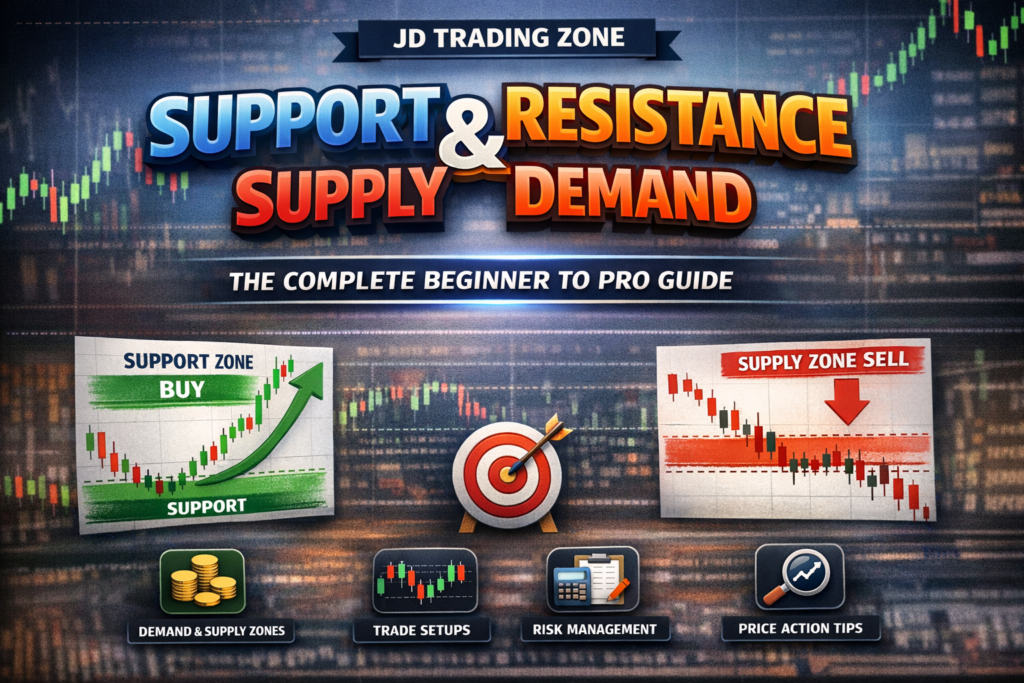
🔰 What is Support and Resistance?
✅ Support
Support is a price level where the market stops falling and starts going up because buyers become strong.
📌 Simply: Support = Buying Area
✅ Resistance
Resistance is a price level where the market stops rising and starts falling because sellers become strong.
📌 Simply: Resistance = Selling Area
🧠 Why Support and Resistance Work?
Because:
• Big traders and institutions place large orders there
• Market remembers these levels
• Demand increases at support
• Supply increases at resistance
💡 Price moves because of demand and supply imbalance.
🧱 Types of Support and Resistance
1️⃣ Horizontal Support & Resistance
• Based on previous highs and lows
• Most powerful and reliable
2️⃣ Dynamic Support & Resistance
• 20 EMA, 50 EMA, 200 EMA
• Trend lines
• VWAP (which you already use 👍)
• 100, 500, 1000, 20000, 50000
• Example: NIFTY 22000, BANKNIFTY 48000
✏️ How to Draw Support and Resistance Correctly?
✔ Use higher timeframe first (Daily / 1H)
✔ Mark strong rejection areas
✔ Draw zones, not lines
✔ Do not overdraw levels
📌 Best rule: The more times price respects a level, the stronger it becomes.
🏦 What is Supply and Demand?
Supply and Demand is an advanced version of Support and Resistance.
✅ Demand Zone
→ Area where big buying happened and price moved up fast
📌 Demand Zone = Institutional Buying Area
✅ Supply Zone
→ Area where big selling happened and price fell fast
📌 Supply Zone = Institutional Selling Area
🔍 How to Identify Supply and Demand Zones?
Look for:
✔ Strong move up or down
✔ Small base / consolidation
✔ Big candles breaking structure
Patterns:
• Rally → Base → Drop = Supply
• Drop → Base → Rally = Demand
🛒 How to Trade Using Support & Resistance?
🟢 Buy at Support
• Price near support
• Confirmation candle
• RSI/MACD/VWAP support (you already use this setup)
🔴 Sell at Resistance
• Price near resistance
• Rejection candle
• Volume spike or MACD divergence
💎 How to Trade Using Supply & Demand?
✅ Entry Rules:
• Mark zone on 15min / 1H
• Wait for price to return
• Enter near zone
• Stop loss outside zone
🎯 Target:
• Next demand or supply zone
🛡️Best Timeframes for Intraday Traders
• Zone marking: 1H / 15min
• Entry: 5min
• Confirmation: Price action + VWAP + MACD
⚠️ Common Mistakes Beginners Make
❌ Drawing too many zones
❌ Trading in the middle of zone
❌ No stop loss
❌ Trading without confirmation
❌ Ignoring trend direction
🧠 Pro Tips
✅ Always trade in trend direction
✅ Strong zones break weak zones
✅ Fresh zones work best
✅ Combine with:
• VWAP
• Pivot Points
• MACD
• RSI
(Perfect for your trading style, Javed 👍)
📌 Which is Better: Support Resistance or Supply Demand?
Answer: Both
• Use Support & Resistance for structure
• Use Supply & Demand for precision entries
( open a free demat account with zerodha)
🏁 Final Words
Support, Resistance, Supply, and Demand are not indicators — they are the real market.
If you master these, you will: ✔ Enter at perfect levels
✔ Keep small stop loss
✔ Get bigger targets
✔ Avoid overtrading
⚠️ Risk Disclaimer
Stock market trading involves risk. Always use stop loss and proper risk management.
If this blog makes sense to you give your feedback in comments and stay tuned.
In the next blog i will share about the technical analysis in simple words.
At the end of the day
Trading isn’t about timing in the market it’s about time in the market.