In this blog you will learn about why do 90% traders lose money and how to avoid mistakes, in simple words and beginners friendly stay tuned for updates.
Most aspiring traders start their journey with big dreams of financial freedom—but the statistics tell a tough truth: roughly 90% of traders lose money over time.
Let’s break down why this happens and, more importantly, how you can avoid the common pitfalls that destroy trading accounts.
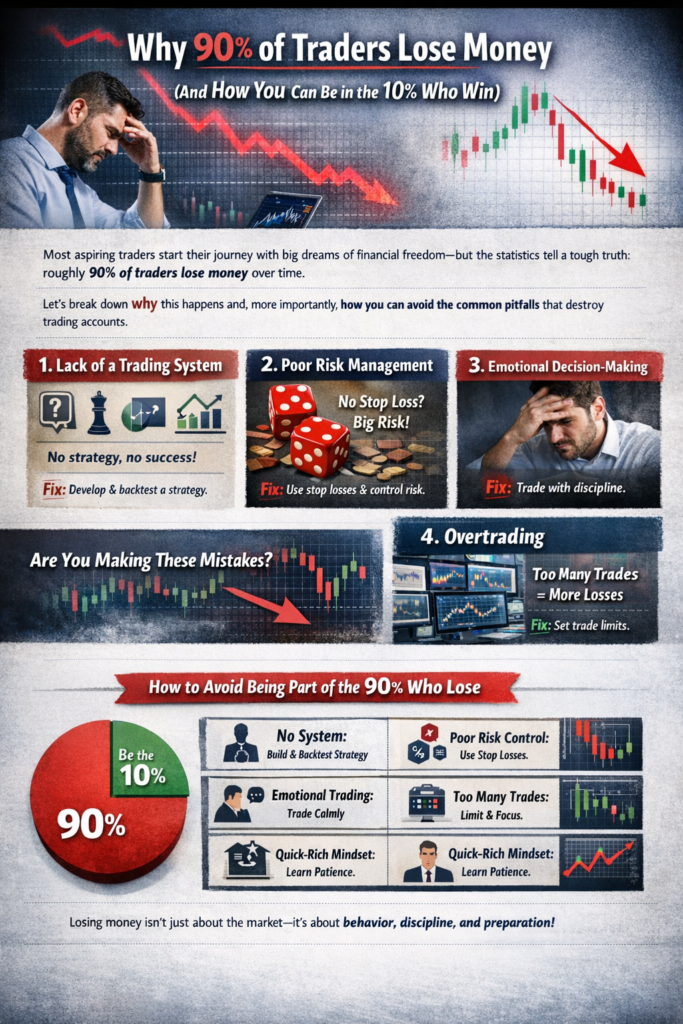
Why do maximum traders lose money
Why do maximum traders lose money .
- No trading plan
- Most traders jump in without a clear entry, exit ,or stoploss rule.
- They trade based on emotion or gut feeling instead of logic or tested strategy.
2. Lack of risk management
- They risk too much per trade.
- One or two bad trades can wipe out weeks of profits.
3. Overtrading
- Taking too many trades in one day due to excitement or revenge trading after a loss
- Leads to poor decisions and increased brokers cost.
4. No patience or discipline
- Traders often exit too early when small profit appears or hold losses too long.
- They don’t follow their own rules when emotions take over.
5. Lack of knowledge
- Many traders don’t fully understand technical, indicators, market behaviour or news impact.
- They are really on tips or social media instead of self- analysis.
6. Ignoring market conditions – a strategy that works in trending markets may fail in sideways or volatile markets.
7. No record keeping – without a trading journal, traders can’t learn from mistakes or identify patterns in their behaviour.
How to avoid these mistakes
1) build a trading plan
→ entry/ exit criteria
→ stoploss and target
→ position sizing
→ conditions for trade setups
2) use strict risk management
- Risk only 1-2% of capital per trade.
- Always set a stoploss before entering.
3) trade with patience
- What for your setup
- No setup= no trade
- Quality over quantity
4) keep a trading journal
- Record every trade: why did you take what went right/ wrong.
- Review weekly to improve consistency.
5) control emotions
- Don’t trade when angry, overconfident, or fearful.
- Accept losses as part of the game.
6) backtest and practice
- Backtest your strategy using historical data.
- Use a demo account or paper trading until consistent.
7) learn continuously
- Read trading books, watch pro traders and analyze your chart daily.
- Focus on the process, not quick profits.
How to become a disciplined trader
How to become a disciplined traders
Mindset before market
- I am calm, focused, and not emotional.
- I accept that losses are part of trading.
- I will trade based on logic , not fear or greed.
- I will follow my plan – no impulsive trades.
Pre market preparation
- Checked pre market data
- Identify key support/ resistance using Pivot point.
- Market Vwap levels and previous days high/ low.
- Noted any major news or events that may impact the market.
- Decided which stocks’ or index options/ will focus on today.
Trading plan
- I have clear entry & exit rules.
- My stoploss is pre decided before entering any trade .
- My risk per trade is not more than 1 -2% of capital.
- I have defined target levels or risk/ reward ratio.
- I will take only high probability setups no random trades.
Risk and money management
- I will not overtrade.
- I will not add to a losing position.
- I will trail my stop when in profit.
- I will stop trading for the day if I hit the daily loss limit.
Post market review
- Record all trades in my trading journal.
- Reviewed what went right and wrong.
- Checked if I followed my plan
- Planned improvement for Tomorrow.
Always Remember
- Trade the plan, not emotions.
- Protect capital first – profits come later.
- Patience+ consistency= long+ term success.
- Learn something new from every trading day.
How to deal with losses
Why do losses hurt so much?
→ Trading losses don’t just hurt financially- they affect emotions.
You feel: Anger, fear, revenge
But in truth – losses are normal and unovidable. Even top traders lose 40-50% of their trades yet remain profitable because of discipline and risk control.
- Accept losses as a business expense.
- Think like a professional, not a gambler.
- Just as a shopkeeper has rent and electricity costs, a traders cost is small, controlled losses.
- Losses are the price you pay to stay in the game.
- Mindset shift: This is not failure – it’s part of trading cost.
2. Never try to recover Instantly.
- After a loss, many traders double their lot size or take quick trades – that’s revenge trading.I
- It only increases emotional damage and losses.
- Instead pause for 10-15 minutes, calm down, and recheck your setup.
3. Analyse the loss objectively
Ask these questions after each loss:
- Did I follow my trading plan.
- Was my stoploss placed correctly .
- Did I enter too early or too late.
- Was there unexpected news or volatility?
→ If you follow your plan – it’s a good loss
→ If you brokerage your rules – it’s a lesson to correct.
4. Keep a “Loss Journal”
- Chart screenshot
- Why trade failed
- What you felt during the trade
- What you’ll do differently next time
You’ll notice emotional and pattern mistakes repeating – and slowly fix them.
5. Maintain risk control always
- Risk only 1+2% of capital per trade.
- If 3 trades hit stoploss in a row, stop trading for the day.
- Protect capital – that’s your weapon for future opportunities.
6. Practice emotional control
- Deep breathing after each trade.
- Take short breaks during losses
- Never trade to feel better.
- Avoid checking p&l after every second – focus on charts, not money.
7. Focus on process, not profit
How to protect yourself from social media brain wash
- Follow real education, not entertainment.
- Limit your screen time.
- Verify before believing
- Stick to one proven system
- Keep realistic goals
- Follow only a few genuine sources.
→ social media shows results – not reality
Real traders show discipline – not screenshots.
👉 Final Thought:
Losing money as a trader isn’t just about the market—it’s about behavior, discipline, and preparation. With proper education, risk management, and a clear plan, you can dramatically increase your chances of success.
If this post makes sense to you then give your feedback in comments.
In the next blog I will share about the best time frame for intraday trading with pivot points.
At the end of the day
trading isn’t about timing in the market- it’s about time in the market.
- What is price action analysis?In this guide, you will learn,What is price action analysis,How it works,Important concepts,Best strategies for beginners. Introduction Price Action Analysis is one of the most powerful and simple trading methods in the stock market. Instead of using many indicators, price action focuses only on… Read more: What is price action analysis?
- Importance of consistency and discipline in tradingIn this blog you will learn about the importance of consistency and discipline in trading, in simple words and beginners friendly. In the stock market, many traders search for the perfect indicator, secret strategy, or guaranteed setup. But the truth is — most successful… Read more: Importance of consistency and discipline in trading
- How to start intraday trading In India with small capitalIn this blog you will learn about how to start intraday trading in India with small capital, simple words and beginners friendly stay tuned for more information. Intraday trading is one of the most popular ways to earn money from the stock market in… Read more: How to start intraday trading In India with small capital
- What is technical analysis in the stock marketIn this guide you will learn about what is technical analysis in the stock market, in simple words and beginners friendly. If you want to become a successful trader or investor, you must understand technical analysis. It is one of the most important skills… Read more: What is technical analysis in the stock market
- What is Support and Resistance & Supply and Demand in stock marketIn this blog you will learn about, what is support and resistance & supply and demand in stock market,stay tuned for more information. If you want to become a profitable trader, you must understand Support & Resistance and Supply & Demand zones. These concepts… Read more: What is Support and Resistance & Supply and Demand in stock market