
In this guide, we will compare Investing vs Positional Trading in detail, including their benefits, risks, strategies, and suitability for beginners.
In the stock market, people earn money in different ways. Some investors prefer to stay invested for years, while others hold stocks for a few weeks or months to book profits. These two popular approaches are Investing and Positional Trading.
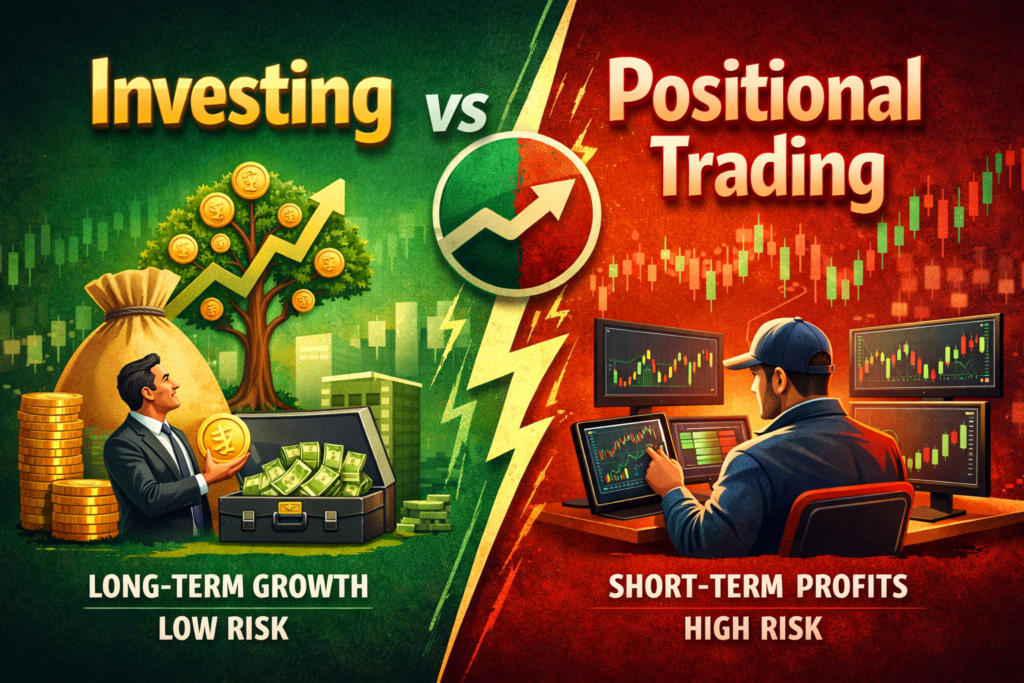
But which one is right for you?
What is investing in the stock market?
What Is Investing in the Stock Market?
Investing is a long-term strategy where you buy quality stocks, mutual funds, or ETFs and hold them for several years.
The main goal of investing is wealth creation over time through:
• Price appreciation
• Dividends
• Compounding returns
Example:
→ If you buy shares of a strong company like TCS or Reliance and hold them for 5–10 years, this is investing.
Key Features of Investing
⏳ Long-term holding (3+ years)
📈 Focus on company fundamentals
💰 Benefit of compounding
😌 Less daily monitoring
📊 Lower transaction costs
What is positional trading?
What Is Positional Trading?
Positional trading is a medium-term trading strategy where traders hold stocks for days, weeks, or months.
The main objective is to capture price movements and trends using technical and sometimes fundamental analysis.
Example:
→ Buying a stock at ₹200 and selling it at ₹260 after 2 months based on chart patterns is positional trading.
Key Features of Positional Trading
⏱️ Medium-term holding (few days to months)
📉 Based on technical analysis
🎯 Focus on trends and breakouts
⚡ Active monitoring
🔁 Higher trade frequency
Investing vs Positional Trading: Detailed Comparison
Feature
→ time period
• analysis types
• risk level
• profit frequency
• capital requirement
• monitoring
• stress level
Investing
→ long term
• fundamental analysis
• low to medium
• slow but stable
• flexible
• minimal
• low
Positional trading
→ medium term
• technical+ fundamental
• medium to high
• faster but unstable
• moderate
• regular
• high
Which Strategy Is Better for Beginners?
For beginners, investing is generally safer than positional trading.
Why Investing Is Better for Beginners?
• Lower risk
• Less emotional pressure
• Easy to manage
• Suitable for part-time investors
• Builds long-term wealth
Positional trading requires:
• Market experience
• Chart reading skills
• Discipline
• Risk management knowledge
Without these, beginners may face losses.
Advantages and Disadvantages of Investing
✅ Advantages of Investing
1. Long-term wealth creation
2. Lower risk compared to trading
3. Power of compounding
4. Suitable for working professionals
5. Tax benefits on long-term gains
❌ Disadvantages of Investing
1. Slow returns initially
2. Requires patience
3. Market crashes affect portfolio
4. Limited short-term profits
Advantages and Disadvantages of Positional Trading
✅ Advantages of Positional Trading
1. Faster profit opportunities
2. Works in trending markets
3. Flexible time frame
4. Better capital utilization
5. Suitable for active traders
❌ Disadvantages of Positional Trading
1. Higher risk
2. Emotional stress
3. Requires technical skills
4. Needs regular monitoring
5. Losses during sideways markets
Required Skills for Investing vs Positional Trading
Skills for Successful Investors
• Company analysis
• Financial statement reading
• Patience
• Risk diversification
• Long-term mindset
Skills for Positional Traders
• Chart reading
• Indicator knowledge (MACD, RSI, Moving Averages)
• Trend analysis
• Stop-loss placement
• Capital management
Note: As you use indicators like VWAP, Pivot Points, and MACD, these can be very helpful in positional trading when combined with proper risk management.
Risk Management in Both Strategies
Risk management is important in both investing and trading.
For Investors
• Diversify portfolio
• Avoid over-concentration
• Invest in quality companies
• Follow SIP strategy
• Maintain emergency fund
For Positional Traders
• Use stop-loss
• Risk only 1–2% per trade
• Avoid overtrading
• Follow trading plan
• Control emotions
Returns: Investing vs Positional Trading
Investing Returns
• 12%–18% annually (average long-term)
• Stable and consistent
• Best for retirement planning
Positional Trading Returns
• Can be higher in short term
• Unstable and inconsistent
• Depends on skill and discipline
Remember: Higher returns always come with higher risk.
Tax Implications in India
For Investors
• Long-Term Capital Gain (LTCG): 10% above ₹1 lakh
• Short-Term Capital Gain (STCG): 15%
For Positional Traders
• Mostly STCG (15%)
• More frequent tax liability
→ Requires proper record keeping
Understanding tax rules helps in better profit planning.
Who Should Choose Investing?
Choose investing if you:
• Want stable income
• Have a full-time job
• Prefer low stress
• Are building long-term wealth
• Are new to stock markets
Who Should Choose Positional Trading?
Choose positional trading if you:
• Have market experience
• Understand technical analysis
• Can monitor markets regularly
• Accept higher risk
• Want faster returns
Can You Do Both Investing and Positional Trading?
Yes, many successful traders use a hybrid approach.
Example Strategy:
• 70% Capital → Long-term investing
• 30% Capital → Positional trading
This helps in:
• Stable growth
• Regular income
• Balanced risk
• Better learning
Common Mistakes to Avoid
In Investing
• Buying without research
• Following tips blindly
• Panic selling
• Ignoring diversification
• Overconfidence
In Positional Trading
• No stop-loss
• Overtrading
• Revenge trading
• Risking too much capital
• Ignoring trends
Avoiding these mistakes improves long-term success.
Final Verdict: Investing vs Positional Trading
Both investing and positional trading have their own importance.
Summary:
• Investing = Stability + Long-term wealth
• Positional Trading = Opportunity + Higher risk
→ If you are a beginner, start with investing.
If you are experienced, you can try positional trading with proper risk control.
→ The best strategy is the one that matches your financial goals, time availability, and risk tolerance.
Frequently Asked Questions (FAQs)
Q1. Is investing safer than positional trading?
→ Yes, investing is generally safer because it focuses on strong companies and long-term growth.
Q2. Can beginners do positional trading?
→ Beginners should first learn technical analysis and practice with small capital before doing positional trading.
Q3. How much capital is needed for positional trading?
→ You can start with ₹10,000–₹25,000, but proper risk management is necessary.
Q4. Which gives more profit: investing or trading?
→ Trading can give faster profits, but investing gives stable long-term returns.
Q5. Can I switch from investing to trading later?
→ Yes, many investors move to trading after gaining market experience.
If this blog makes sense to you give your feedback in comments and stay tuned for more information about the stock market.