
Most intraday trades are not decided when you click Buy or Sell.
The decision is usually shaped much earlier—while the market is still closed.
A trader who spends the first few minutes of the session randomly searching for stocks is already reacting to the market. A trader who comes prepared with important levels, possible scenarios, a defined risk, and a condition for staying out has a very different starting point.
That does not mean a pre-market plan will predict where the market will go. It cannot.
The purpose of an intraday trading plan is simpler: know what you are looking for before the market gives you a reason to act.
This guide explains how I would structure an intraday trade plan before the market opens, from checking the broader market to writing down the exact condition that can trigger a trade.
Important: This article is for educational purposes only. Intraday trading involves substantial risk, and no setup guarantees profits. Your position size and risk should match your own financial situation and risk tolerance.
Also check:- (How to Plan a Trade Before Clicking Buy) (How to Use Volume Before Taking an Intraday Trade) (Which Timeframe Is Better for Intraday Trading?) (Best Time to Trade in the Indian Stock Market) (Why Good Trading Setups Fail: 9 Reasons Behind Losing Trades)
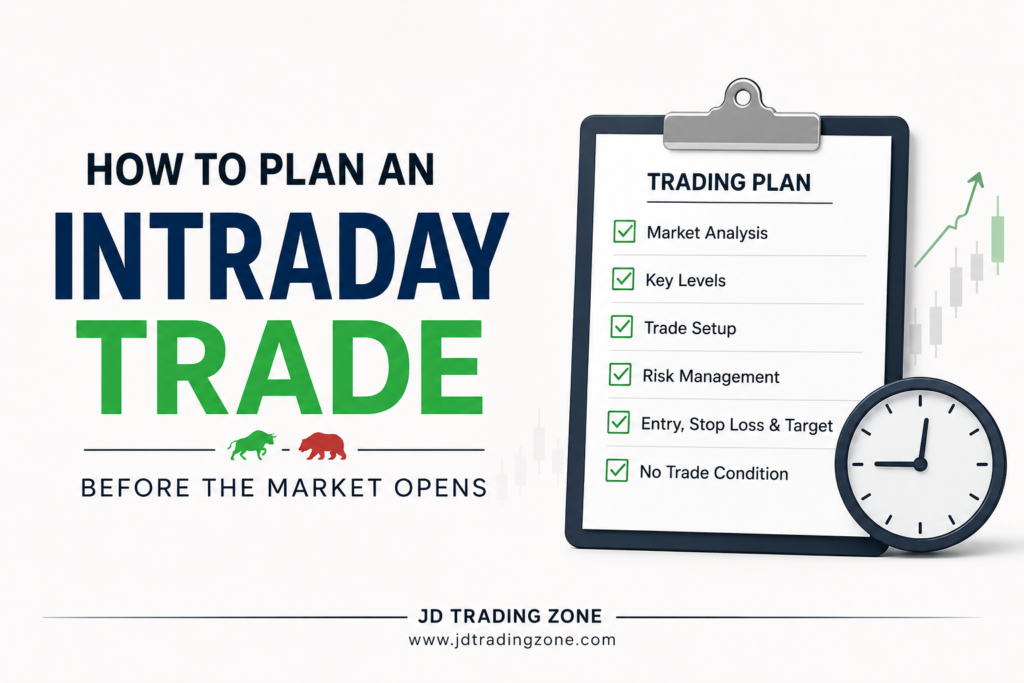
What Does It Mean to Plan an Intraday Trade?
Planning an intraday trade means deciding what you will trade, where you are interested, what must happen before you enter, where your trade idea becomes invalid, and how much you are willing to lose—before taking the position.
A proper plan should answer six basic questions:
1. What am I watching?
2. Why is it worth watching today?
3. Where are the important price levels?
4. What price action will trigger my entry?
5. Where is my stop-loss and target?
6. What would make me avoid the trade?
That last question is often ignored.
A good trading plan is not only an entry plan. It is also an avoidance plan.
1. Start With the Market, Not With a Stock
One mistake I see repeatedly in intraday preparation is opening a scanner and immediately looking for a stock that is moving.
I prefer doing the opposite.
First understand the broader market environment.
For Indian equities, traders may look at the major indices and the overall tone of the session. Depending on the instrument being traded, this could include Nifty, Bank Nifty, sector indices, or the broader market.
The objective is not to predict:
“Nifty will definitely go up today.”
Instead, ask:
“What kind of environment am I likely to be trading in?”
For example:
• Strong gap-up environment
• Strong gap-down environment
• Mild gap
• Flat opening expected
• High-volatility environment
• Possible range-bound session
• Strong sector-specific movement
This classification gives you context before you start searching for individual trades.
Why this matters
A stock can look bullish on its own chart but behave differently if the broader market is under heavy selling pressure.
Likewise, a weak-looking stock may struggle to fall when its sector and broader market are strongly positive.
Market context does not replace stock analysis.
It simply prevents you from looking at a trade in isolation.
2. Check What Happened Before You Arrived
Before the opening bell, I want to know what happened during the previous session.
You do not need to write a full market report.
Look for a few useful pieces of information:
• Previous day’s high
• Previous day’s low
• Previous close
• Major support area
• Major resistance area
• Whether the market closed near its high or low
• Whether a major sector showed unusual strength or weakness
• Whether there was an important overnight development
The objective is to create a map, not a prediction.
For example:
Previous day high: 22,450
Previous day low: 22,180
Previous close: 22,390
Instead of thinking:
“I will buy at the open.”
You can think:
“22,450 is an important area. If price reaches it and breaks with confirmation, I will look for a possible long setup. If price rejects the level, I will reassess.”
That is a much more flexible approach.
3. Mark Only the Levels That Can Actually Change Your Decision
One of the easiest ways to make a chart useless is to mark twenty different support and resistance levels.
By the time the market opens, everything looks important.
It isn’t.
I prefer keeping the pre-market chart relatively clean.
Useful levels can include:
Previous Day High
The previous session’s high can become an important reference point, particularly when price approaches it with strong momentum.
Previous Day Low
This can become important when sellers push price toward the previous session’s low.
Previous Close
It provides a simple reference for judging whether the market is trading above or below the previous day’s closing price.
Major Swing High or Low
A clearly visible recent turning point can be more useful than a level drawn simply because an indicator produced it.
Gap Area
If the stock opens significantly away from the previous close, the gap itself becomes part of the day’s structure.
VWAP During the Session
VWAP cannot be known as a completed intraday reference before the market opens, but it can become useful after trading begins. If you use VWAP in your strategy, treat it as a live confirmation tool, not a magical pre-market prediction.
The goal is to mark levels that could influence your decision—not decorate the chart.
4. Build a Watchlist Instead of Searching for a Trade
Before the market opens, I would rather have three good candidates than twenty random stocks.
Notice something important:
The watchlist does not contain an instruction to enter immediately.
It only tells you where to pay attention.
This small distinction can prevent a lot of unnecessary trades.
5. Ask Why the Stock Is on Your Watchlist
“Stock is moving” is not enough.
Before adding a stock, identify a reason.
For example:
• Strong previous-day breakout
• Unusual volume
• Sector strength
• Sector weakness
• Gap-up or gap-down
• Important support/resistance
• Fresh news or corporate event
• Strong trend on the higher timeframe
• Clean price structure
The reason does not guarantee a trade.
It simply gives you a reason to monitor the stock.
6. Create Two Scenarios Instead of One Prediction
This is one of the most useful changes you can make to your pre-market routine.
Do not write:
Today I will buy Stock A.
Write:
Bullish scenario: If price holds above the important level and confirms strength, I will consider a long trade.
Bearish scenario: If price rejects the level and breaks the opposite structure, I will consider a short trade.
Now you are prepared for both possibilities.
Example
Suppose a stock closed at ₹1,240 and the previous day’s high is ₹1,255.
Your plan might look like this:
Scenario A — Bullish
If price moves above ₹1,255, sustains above the level and gives my entry confirmation, I will consider a long.
Scenario B — Failed breakout
If price moves above ₹1,255 but quickly falls back below the level, I will not chase the breakout. A rejection setup may become relevant only if my strategy confirms it.
No-trade condition
If price remains stuck between ₹1,240 and ₹1,255 without a clean setup, I will wait.
That is a plan.
7. Decide Your Entry Trigger Before the Market Opens
A price level alone is not always an entry.
This is where many traders make mistakes.
They mark resistance at ₹500 and then decide:
“Above ₹500, I will buy.”
But what does “above ₹500” actually mean?
Does ₹500.05 count?
Does a single spike count?
What if price touches ₹500 and immediately falls?
Your entry trigger should be more specific.
Depending on your strategy, confirmation might involve:
• Breakout followed by acceptance
• Breakout and retest
• Candlestick confirmation
• Volume expansion
• VWAP confirmation
• Trend continuation
• Higher high and higher low structure
• Lower low and lower high structure
The exact trigger depends on your trading system.
The important point is:
Decide the trigger before your emotions become involved.
8. Plan the Stop-Loss Before the Entry
This is one of the most important parts of the entire plan.
Do not enter first and then ask:
“Where should I keep my stop-loss?”
That reverses the process.
Instead ask:
“At what price would my trade idea become invalid?”
For example, if you are buying after a breakout and the setup depends on price holding above a particular structure, your stop may logically belong below that structure—depending on your strategy and volatility.
The stop should not simply be placed at an arbitrary amount because:
“I can afford to lose ₹500.”
Your rupee risk and technical invalidation point are two different things.
The technical setup tells you where the trade is wrong.
Your position size should then be adjusted so that the loss at that stop remains within your predefined risk limit.
9. Calculate Position Size Before You Click Buy
This step can make your trading plan much more professional.
Suppose:
• Trading capital = ₹1,00,000
• Maximum risk per trade = 0.5%
• Maximum planned loss = ₹500
• Entry = ₹250
• Stop-loss = ₹245
Risk per share:
₹250 − ₹245 = ₹5
Maximum quantity:
₹500 ÷ ₹5 = 100 shares
So your planned position is 100 shares, assuming the instrument’s liquidity, charges, slippage, and other practical considerations are acceptable.
The important lesson is:
Position size should adapt to the stop-loss distance—not the other way around.
If the required stop is too wide for your risk limit, the correct response may be to reduce quantity or skip the trade.
Not to move the stop closer just to increase the position.
10. Plan the Target Before the Trade
A trade plan should have an exit idea before the entry.
Potential target references could include:
• Previous swing high
• Previous swing low
• Major support/resistance
• Measured move
• Risk-reward requirement
• Intraday structure
• Trailing-stop rules
Suppose your planned risk is ₹5 per share and your strategy requires a minimum 1:2 risk-reward ratio.
Your theoretical target would need to provide approximately ₹10 per share of potential reward.
But there is an important catch.
A target is not automatically realistic just because the mathematical risk-reward looks attractive.
If strong resistance sits ₹4 above your entry, writing down a ₹10 target does not make the target achievable.
Your target must make sense in the context of actual price structure.
11. Check Whether the Trade Has Enough Room
This is a simple filter that can eliminate many poor trades.
Imagine you find a bullish breakout at ₹800.
Your stop is ₹790.
You want a target near ₹820.
At first glance:
• Risk = ₹10
• Potential reward = ₹20
• Risk-reward = 1:2
Looks good.
But suppose a major resistance zone exists around ₹812.
Now the trade has only ₹12 of obvious room before that resistance.
The theoretical 1:2 setup may not be as attractive as it looked.
Before entering, ask:
“What is between my entry and my target?”
If the answer is “a major resistance level,” think again.
12. Don’t Treat the Pre-Market Gap as an Automatic Buy or Sell Signal
A gap can attract attention, but a gap by itself is not a complete strategy.
A stock opening sharply higher does not mean:
“It will continue rising.”
A stock opening sharply lower does not automatically mean:
“It will keep falling.”
The opening can lead to:
• Continuation
• Reversal
• Gap fill
• Consolidation
• False breakout
• High volatility
Your job is not to predict which one will happen before the market opens.
Your job is to prepare a scenario for each possibility that matters to your strategy.
13. Give the First Few Minutes Respect
The market can behave very differently immediately after the opening compared with later in the session.
There may be rapid movement, large candles, sudden reversals and increased emotional pressure.
That is why a pre-market plan should include a rule such as:
“I will not enter simply because the market has opened.”
Instead, allow the market to show whether your planned level and setup are actually developing.
For traders using breakout strategies, this can be particularly important.
A level breaking on the chart is not automatically a high-quality breakout.
You still need to evaluate:
• Momentum
• Volume
• Candle structure
• Follow-through
• Broader market direction
• Nearby resistance/support
14. Use a Simple Pre-Market Checklist
You don’t need a complicated spreadsheet.
A one-page checklist is enough.
My Pre-Market Intraday Checklist
Market
• [ ] What is the broader market doing?
• [ ] Is the expected environment trending, volatile or uncertain?
• [ ] Are there important overnight developments?
Previous Session
• [ ] Previous high marked
• [ ] Previous low marked
• [ ] Previous close marked
• [ ] Major swing levels marked
Watchlist
• [ ] 2–5 stocks selected
• [ ] Reason for selecting each stock identified
• [ ] Important levels marked
Trade Scenarios
• [ ] Bullish scenario written
• [ ] Bearish scenario written
• [ ] Entry trigger defined
• [ ] No-trade condition defined
Risk
• [ ] Maximum risk per trade known
• [ ] Stop-loss location defined
• [ ] Position size calculated
• [ ] Target identified
• [ ] Risk-reward checked
Execution
• [ ] No chasing
• [ ] No revenge trade
• [ ] No trade without confirmation
• [ ] Stop-loss will not be widened emotionally
15. Write the Plan in One Sentence
Here is a technique that makes the entire process easier.
After doing your analysis, write one sentence for each candidate.
For example:
“I will consider a long trade only if Stock A breaks and holds above ₹1,255 with my confirmation; my setup is invalid below ₹1,248, and I will not trade if price remains trapped inside the range.”
That sentence contains almost everything:
• Direction
• Level
• Confirmation
• Invalidation
• No-trade condition
If you cannot explain your trade that simply, your setup may not be clear enough yet.
16. Have a “No Trade” Plan
This deserves its own section because many traders believe that every market day requires a trade.
It doesn’t.
You can have a perfectly successful trading day by taking zero trades.
For example, your plan may say:
“If the market opens inside yesterday’s range and remains choppy around VWAP without a clean structure, I will stay out.”
That is not laziness.
That is risk management.
The market does not owe you a setup every morning.
17. Don’t Change the Plan Just Because the Market Opens Differently
Suppose you planned a breakout above ₹1,000.
The market opens at ₹980.
Your brain immediately starts thinking:
“Maybe I should buy now because it is cheap.”
But nothing in your original setup said ₹980 was an entry.
This is where a pre-market plan proves its value.
Your plan should act as a filter against impulsive decisions.
At the same time, a plan is not a prison. If new information invalidates your original thesis, you should be willing to cancel it.
Changing a plan because the market provided new information is different from changing it because you are afraid of missing a trade.
Learn to recognize the difference.
18. What I Would Avoid Before the Market Opens
A useful pre-market routine is also about what you deliberately do not do.
Don’t Build a Plan Around One Prediction
“I think Nifty will rise today” is not enough.
Build scenarios instead.
Don’t Fill Your Chart With Indicators
More indicators do not automatically produce better decisions.
Use only the tools that have a clear purpose in your strategy.
Don’t Pick Stocks Solely Because They Are
Trending on Social Media
A popular stock is not necessarily a good intraday setup.
SEBI specifically warns investors against relying on unsolicited “hot tips” and encourages informed decision-making.
Don’t Decide Your Stop After Entering
The market should not be allowed to decide your maximum acceptable loss emotionally.
Don’t Force a Trade
If the setup is missing, there is nothing to execute.
19. A Practical Example of a Complete Pre-Market Plan
Let’s put everything together.
Imagine Stock XYZ closed yesterday at ₹1,180.
The previous high was ₹1,195 and the previous low was ₹1,155.
You identify ₹1,195 as the important resistance.
Your pre-market plan could look like this:
Stock XYZ
Reason for watching:
Strong previous-day movement and important resistance near ₹1,195.
Bullish scenario:
If price moves above ₹1,195 and gives the required confirmation, consider a long trade.
Bearish scenario:
If price fails at ₹1,195 and produces the required rejection structure, monitor for a short setup.
Stop-loss:
Below the technical invalidation level defined by the setup.
Target:
Next meaningful resistance/support area, provided the expected reward justifies the risk.
Position size:
Calculated from the predefined maximum rupee risk and stop distance.
No-trade condition:
If price moves sideways around ₹1,180–₹1,195 without confirmation, do nothing.
Notice what is missing?
There is no statement saying:
“I will definitely buy XYZ.”
That is intentional.
The plan tells you what must happen before you act.
20. Your Pre-Market Plan Should Be Shorter Than Your Analysis
This sounds strange, but it is important.
You can spend 30 minutes studying the market and still end up with a simple plan:
Watch: 3 stocks
Key levels: 5–6
Long setup: 1 condition
Short setup: 1 condition
Risk: predefined
No-trade condition: predefined
That’s enough.
A trading plan is not supposed to become another form of analysis paralysis.
The goal is to reduce unnecessary decisions once the market opens.
21. A 20-Minute Pre-Market Routine
If you don’t have much time in the morning, you can use a simple routine.
8:45–8:50 — Market Context
Check the broader market environment and major overnight developments.
8:50–8:55 — Previous-Day Structure
Mark:
• Previous high
• Previous low
• Previous close
• Major swing levels
8:55–9:00 — Watchlist
Select a small number of stocks that have a clear reason for being watched.
9:00–9:05 — Scenarios
For each important candidate, write:
• Long condition
• Short condition
• Invalidation
• Target area
• No-trade condition
The NSE pre-open session begins at 9:00 a.m., with the regular market opening at 9:15 a.m.; the exchange describes the pre-open process as a price-discovery mechanism rather than simply “normal trading before the market.”
Because exchange timings and procedures can change, traders should verify the current schedule with NSE or their broker rather than relying permanently on an old timetable.
The Most Important Part: Plan the Trade, Not the Profit
A common mistake in intraday trading is beginning the morning with a profit target:
“Today I want to make ₹2,000.”
That number can quietly influence every decision that follows.
You may enter a weak setup because you are behind your target.
You may take another trade after a loss because you want to recover.
You may hold a bad position because you don’t want to finish the day negative.
A better starting point is:
“Today I will only take trades that meet my rules.”
The profit is an outcome.
The process is what you can control.
Final Pre-Market Framework
Before the market opens, your intraday plan should look something like this:
1. Understand the market environment.
2. Review the previous session.
3. Mark only meaningful price levels.
4. Build a small watchlist.
5. Identify why each stock deserves attention.
6. Prepare both bullish and bearish scenarios.
7. Define the exact entry trigger.
8. Decide where the trade becomes invalid.
9. Calculate position size from your risk.
10. Check whether the target has enough room.
11. Write down when you will not trade.
12. Wait for the market to confirm your setup.
The biggest benefit of this process isn’t that it makes you right more often every morning.
Its real benefit is that it changes your role.
Instead of opening the market and asking:
“What should I trade?”
you begin the session asking:
“Which of my planned scenarios is actually developing?”
That is a much healthier way to approach intraday trading.
A Simple Rule to Remember
Don’t enter the market because you have a prediction. Enter only when the market gives you the condition you planned for.
And if that condition never appears?
Do nothing.
Sometimes the best trade of the day is the one you correctly decided not to take.
Disclaimer
This article is intended for educational and informational purposes only and should not be considered investment advice or a recommendation to buy or sell any security. Intraday trading and derivatives trading involve significant risk of loss. Before trading, understand the product, charges, leverage, and risks involved. SEBI’s investor guidance also emphasizes understanding risks and dealing with regulated intermediaries.
About JD Trading Zone
JD Trading Zone focuses on practical trading education, market concepts, technical analysis, risk management, and trading psychology. The goal is to help traders develop a structured decision-making process rather than depend on tips or guaranteed-return claims.
dark web market dark market onion