Hello today we will discuss about what is Vwap in stock market, in simple words and beginners friendly. Stay tuned for more information. Are you interested in trading let’s explore what’s vwap is?
Introduction
If you are an intraday trader, you must have heard about VWAP. VWAP is one of the most powerful and widely used indicators by professional traders, institutions, and smart money.
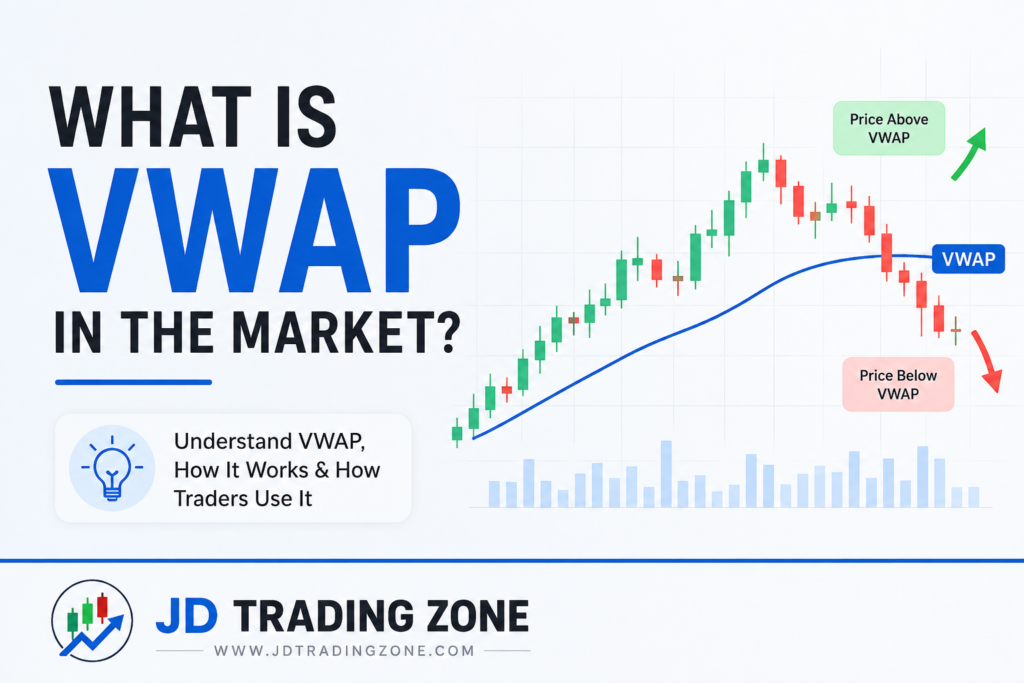
VWAP (Volume Weighted Average Price) helps traders understand:
• The true average price of a stock
• Whether price is expensive or cheap
• The trend direction
• High-probability entry and exit levels
In this article, you will learn:
• What VWAP is
• How VWAP works
• How to use VWAP in intraday trading
• Best VWAP trading strategies
• VWAP with RSI & MACD
• Advantages & limitations of VWAP
Vwap trading strategy
VWAP= Volume Weighted Average.
Good for Intraday Trading.
It is an indicator in the stock market that traders use to confirm buying or selling decision .
Vwap formula
VWAP = (Cumulative Price × Volume) ÷ Cumulative Volume
How to use VWAP in Trading ( What is Vwap in stock market)
1} Intraday Buy signal..
Using VWAP as a Bullish indicator
• If the stock price crosses above VWAP
– buyers are stronger
• VWAP acts as support in uptrend.
Entery Point
• Enter when price bounces up from VWAP.
exit point
• Stop loss – Just below VWAP or according
to your risk reward ratio.
Example : XYZ Stock opens at 100
VWAP is 98
Price goes up to 101
Then folls back near VWAP
and then bounces up from Rs.98 to
100 Rs
= Bullish signal
But at Rs.99 –100 stop – loss at Rs.97.
2} Intraday sell signal..
Using VWAP as a Selling Indicator
• If the stock price falls below VWAP – sellers
are stronger
• VWAP acts like resistance in downtrend.
Entery Point
•Enter when price falls below VWAP.
Exit point
• Stop – loss Just above VWAP or according to
Your risk reward ratio
Example: XYZ Stock at Rs. 100
VWAP is Rs. 102
Price tries to rise to Rs. 102 but fails to
break VWAP then drop to 99 Rs
=Bearing signal
Short at Rs. 99 stop – loss 101.
How I Read Price Around VWAP
Rather than asking:
“Is price above VWAP? Should I buy?”
I prefer asking:
Is price clearly holding above VWAP?
1What happens when price pulls back toward VWAP?Is volume increasing during the move?Is the market making higher highs and higher lows?Does price repeatedly reject VWAP?Is VWAP itself starting to slope in one direction?Or is price simply moving back and forth through it?
These questions provide much more information than the position of price relative to VWAP alone.
→What is RSI ?
RSI = Relative Strength Index
The RSI is a momentum indicator in
technical analysis.
It tells you whether a stock is over bought
or over sold.
How traders use RSI
1} over bought (sell signal)
If RSI > 70 → possible correction or reversed .
2} Over sold (Buy signal)
If RSI < 30 – possible bounces or reversal
upward .
3} Trend confirmation:
• RSI > 50 → bullish trend .
• RSI < 50 → bearing trend.
Example :
• stock price rises from Rs. 100 – Rs. 120.
• RSI jumps to 75
Means stock is overbought → may pull back.
• Later stock falls to Rs. 90.
• RSI drops to 25 means stock is oversold → may bounce upward.
How to use VWAP with RSI
1} Setup
• Chart : 5- min or 15- min for intraday.
• Add VWAP indicator.
• Add RSI
• Condition 2: RSI is above 50 but below
70
2} Bullish Trade Setup
• Condition 1: Price is above VWAP→
buyers are stronger.
• Entry: Buy when price pulls back near
Vwap and RSI stays above 50.
• Exit target resistance or 1 – 2 % move.
• Stop loss : Just below VWAP.
Example: Stock is Rs. 100 , VWAP = Rs. 98 , RSI=55
Price bounce from VWAP →enter at Rs. 99
Stop – loss Rs. 97 , target Rs.102.
3} Bearish Trade setup.
• Condition 1: Price is below VWAP → Seller
are stronger.
• Condition 2 : RSI is below 50 but above 30.
• Entry: sell / When price touches VWAP and
falls again, RSI stays below 50.
• Exit : Target support or 1 – 2% move.
• Stop – loss : Just above VWAP.
Example: stock is Rs. 200, VWAP= Rs. 205, RSI= 45
Price rejects VWAP at Rs. 204 – enter short
Stop – loss Rs. 206, Target Rs. 195
4} Extra confirmation.
• If RSI crosses above 70 while price > VWAP
→avoid fresh buying.
• If RSI crosses below 30 while price < VWAP
→avoid fresh selling.
In short
• Price > VWAP + RSI > 50 = Buy.
• Price < VWAP + RSI < 50 = sell.
How to use VWAP with MACD ( What is Vwap in stock market)
1} Setup
• Chart: 5 – mint or 15 for Intraday
• Add VWAP indicator.
• Add MACD
2} Bullish trade setup
• Condition 1: Price is above VWAP
→ bullish signal.
• Condition 2: MACD line crosses above Signal
line (Bullish crossover)
• Entry: When crossover happenes and price
is holding above VWAP
• Exit: Target previous resistance or 1 – 2 %
move.
• Stop – loss : Below VWAP.
Example: Stock at Rs. 500, VWAP = Rs. 495, MACD
Crossover at Rs. 501
→ Buy near Rs. 501 – 503, stop – loss Rs. 494, target Rs. 515.
3} Bearish Trade setup
• condition 1: Price is below VWAP
→ bearish signal
• condition 2: MACD line crosses below signal
line ( bearing crosses )
• Entry: When crosses happened and price is
staying below VWAP.
• Exit Target support zone or 1–2 % move.
Stop – loss : above VWAP.
Example: Stock at Rs. 300 , VWAP= Rs. 305, MACD Crossover at Rs. 299.
→short at Rs. 299 – 300,
Stop – loss Rs. 306 Target 290
4} Avoid false signal
• If MACD crosses happened but price is
hugging VWAP ( sideway) → ignore trade.
• Best traders happen when VWAP and MACD
both agree on direction.
In short
• Buy: price > VWAP+MACD Bullish crossover.
• sell: price < VWAP+MACD Bearish crossover.
Is VWAP really good for Intraday.
Advantages of VWAP for IntradayHow to trade banknifty options using vwap
1} True Average price
• VWAP shows where most traders actually
bought / sold
• Better than just a moving average.
2} Dynamic support/ resistance
• price often reacts around VWAP→ good for
entry/ exit
3} Institutional benchmark
• Big funds are VWAP to avoid moving
market.
• If price is for above VWAP, institutions wait
to buy lower
4} Trend signal
• price above VWAP →bullish signal
• price below VWAP → bearish signal
Limitation of VWAP ( what is Vwap in stock market)
1} Intraday only
• VWAP resets every day.
• Not useful for multi day or swing position.
2} Lagging Indicator
• VWAP is average → reacts slowly in first
move .
• You may miss part of the move if you wait
for confirmation.
3} sideways market problem
• If stock is range – bound, price keeps
crossing VWAP → gives false signals .
When VWAP works best
• Trading stocks.
• High → volume stocks / indexes
• combined with other indicators
When VWAP fails
• Low volume or illiquid stocks.
• Choppy sideway market.
In reality
Yes, VWAP is very good for Intraday, but only if .
• you combined it with another indicator
• you avoid sideways markets
• you use proper Stop–loss.
Important things to notice ( What is Vwap in stock market)
1} VWAP resets daily.
It’s not very useful for multi day analysis but is very powerful for Intraday Trading.
Pro tips.
Combined VWAP with RSI < 50 for stronger signals.
Important tips for real market
• Don’t trade every time price tovcher VWAP
→ Wait for clear bounce or rejection.
• Avoid during sideways market .
• Practice in paper trading first before using real money .
🏁 Conclusion
VWAP is one of the most powerful intraday trading indicators that helps you:
• Identify trend
• Find high-probability entries
• Avoid bad trades
• Trade like professional traders
For best results, always use VWAP with confirmation indicators like RSI, MACD, Pivot Points or Price Action and follow strict risk management.
❓ FAQ
1.Is VWAP good for intraday?
✅ Yes, VWAP is specially designed for intraday trading.
2. Can beginners use VWAP?
✅ Yes, it is very simple and beginner-friendly.
3. Which timeframe is best for VWAP?
✅ 5-minute and 15-minute charts are best.
Vwap trading strategy
- How to Plan an Intraday Trade Before the Market OpensMost intraday trades are not decided when you click Buy or Sell. The decision is usually shaped much earlier—while the market is still closed. A trader who spends the first few minutes of the session randomly searching for stocks is already reacting to the market. A trader who comes prepared with important levels, possible scenarios, a defined risk, and a condition for staying out has a very different starting point. That does not mean a pre-market plan… Read more: How to Plan an Intraday Trade Before the Market Opens
- How to Plan a Trade Before Clicking BuyThe most important part of a trade often happens before you enter it. A common trading mistake looks simple: a trader sees a stock moving quickly, feels that the move is about to continue, and clicks Buy. Only after entering does the real thinking begin: • Where should I keep my stop-loss? • Where should I book profit? • How much quantity should I hold? • What if the price immediately reverses? • Should I exit if… Read more: How to Plan a Trade Before Clicking Buy
- How to Use Volume Before Taking an Intraday TradeMost beginners look at volume only after entering a trade. They see a breakout, click Buy, and then notice that the volume suddenly looks weak. A few candles later, the breakout fails. I made the opposite mistake when learning intraday trading. I started treating every large volume bar as a signal. A big green volume bar meant “buyers are coming,” while a big red bar meant “sellers are attacking.” It looked simple on the chart, but it… Read more: How to Use Volume Before Taking an Intraday Trade
- Which Timeframe Is Better for Intraday Trading?Also check:- (Best Time to Trade in the Indian Stock Market) (Why Good Trading Setups Fail: 9 Reasons Behind Losing Trades) (One Complete Intraday Trading Setup) (Opening Range Breakout Strategy: A Practical Guide for Intraday Traders in India) (How to Choose Stocks for Intraday Trading in India) Which Timeframe Is Better for Intraday Trading? There is no single timeframe that is automatically the best for every intraday trader. A trader using a 1-minute chart is looking at… Read more: Which Timeframe Is Better for Intraday Trading?
- Best Time to Trade in the Indian Stock MarketIf you ask ten intraday traders, “What is the best time to trade in the Indian stock market?”, you may get ten different answers. Some will say 9:15 AM because the market opens with strong movement. Others prefer the last hour because volume can increase again. Some traders avoid the first 15–30 minutes completely because they find the price action too unpredictable. The interesting part is that all of them can be right. There is no single… Read more: Best Time to Trade in the Indian Stock Market
Can you help me for training best strategy
Pingback: Top 5 scalping strategies for beginners - jdtradingzone.com
Ok I will make this post soon
Pingback: How to trade banknifty options using vwap - jdtradingzone.com
See my latest post What is Vwap in Stock market?
Pingback: Macd+ Vwap combo strategy for better accuracy. - jdtradingzone.com
Pingback: How to control emotions while trading. - jdtradingzone.com
Pingback: Types of trading in the stock market - jdtradingzone.com
Pingback: Macd Indicator - how to use it in Intraday Trading. - jdtradingzone.com
Pingback: What is Fibonacci retracement? - jdtradingzone.com
Pingback: What is the volume in trading? - jdtradingzone.com
Pingback: Best intraday trading strategy for stocks - jdtradingzone.com
Pingback: VWAP Trading Strategy Step by Step - jdtradingzone.com