Today we will discuss about simple risk management rules for traders that can protect your capital and help you grow consistently.
Trading can be profitable, but without proper risk management, even the best strategy can fail. Many beginners focus only on profits and ignore risk—this is one of the biggest reasons traders lose money.
Also check:- ( How to Choose Stocks for Intraday Trading in India) ( Best price action trading strategy for beginners) ( Best time frame for intraday trading) ( Real Reasons Traders Lose Money mistakes to avoid) ( Best intraday trading strategy for stocks)
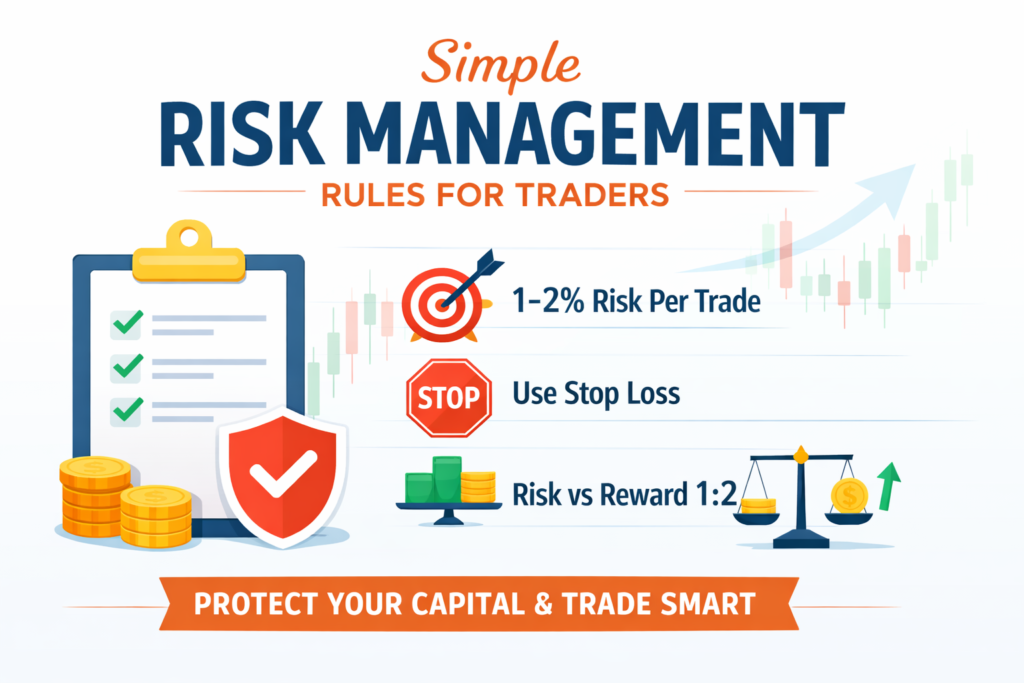
Why risk management is important ?
Why Risk Management is Important
Risk management is not just a concept—it’s your survival tool in trading.
Without it:
• One bad trade can wipe out your account
• Emotions take control (fear & greed)
• Consistency becomes impossible
With proper risk management:
• Losses stay small
• Profits grow steadily
• You stay in the game longer
1. Never Risk More Than 1–2% Per Trade
This is the golden rule of trading.
If your capital is ₹10,000:
• Risk only ₹100–₹200 per trade
This ensures:
• Even after 10 losing trades, you still have capital left
• You avoid emotional decisions
👉 Pro Tip: Professional traders focus on protecting capital, not chasing profits.
2. Always Use a Stop Loss
A stop loss is your safety net.
• It automatically exits your trade at a predefined loss
• Prevents big losses during sudden market moves
Example:
• Buy stock at ₹100
• Stop loss at ₹98
• Risk = ₹2 per share
👉 Never trade without a stop loss—it’s like driving without brakes.
3. Maintain Risk-Reward Ratio (Minimum 1:2)
Before entering a trade, calculate:
• Risk (possible loss)
• Reward (expected profit)
Ideal Ratio:
• Risk ₹100 to make ₹200
Even if you win only 50% of trades, you’ll still be profitable.
4. Avoid Overtrading
More trades ≠ more profit.
Overtrading leads to:
• Poor decisions
• Increased brokerage costs
• Emotional stress
👉 Focus on quality trades, not quantity.
5. Don’t Trade With Full Capital
Never put all your money into one trade.
Instead:
• Divide capital into smaller parts
• Take multiple controlled trades
This reduces risk and improves flexibility.
6. Control Leverage (Very Important for Intraday)
Leverage can increase profits—but also losses.
• High leverage = high risk
• Beginners should use low or no leverage
👉 Use leverage only when you fully understand the risk.
7. Set Daily Loss Limit
Decide a maximum loss per day.
Example:
• Capital: ₹20,000
• Daily loss limit: ₹500
If you hit this limit: 👉 Stop trading for the day
This prevents revenge trading and protects your account.
8. Avoid Emotional Trading
Emotions destroy discipline.
Common mistakes:
• Revenge trading after loss
• Greed after profit
• Fear causing early exit
👉 Follow your plan, not your emotions.
9. Keep a Trading Journal
Track every trade:
• Entry & exit
• Reason for trade
• Profit or loss
This helps you:
• Identify mistakes
• Improve strategy
• Build consistency
10. Focus on Capital Protection First
Your first goal is NOT profit—it’s survival.
Think like this:
• “How can I protect my money?”
• Not “How can I double my money quickly?”
👉 If you protect capital, profits will follow automatically.
Common Mistakes to Avoid
• Trading without stop loss
• Risking too much in one trade
• Overconfidence after profits
• Ignoring risk-reward ratio
• Following tips blindly
Final takeaway
Risk management is what separates successful traders from beginners.
You don’t need a complex system—just follow simple rules:
• Small risk per trade
• Strict stop loss
• Proper discipline
Consistency in these habits can turn an average trader into a profitable one.
Pingback: Support and Resistance for Beginners The Ultimate Guide - jdtradingzone.com
Pingback: Trading Psychology for Beginners: Master Your Emotions - jdtradingzone.com
Pingback: The secret to consistency in trading| JD Trading Zone - jdtradingzone.com
Pingback: Daily routine of successful traders|JD Trading Zone - jdtradingzone.com