Hello guys if you read my blog continuously then here is new information about stock market today, you’ll learn:What time frames are in trading, best time frame for intraday trading, How to combine multiple time frames,Common mistakes beginners should avoid
Intraday trading is all about timing—both in terms of market entry and the time frame you choose for analysis. Many beginners focus only on indicators or strategies but ignore one crucial factor: the right time frame.
Choosing the wrong time frame can lead to confusion, false signals, and unnecessary losses. On the other hand, selecting the right one can significantly improve your accuracy and confidence.
Also check:- ( Real Reasons Traders Lose Money mistakes to avoid) ( Best intraday trading strategy for stocks) (How to start stock market investing in India) (How to make your own strategy in trading) (Rules of options trading for beginners)
What is a time frame in trading?
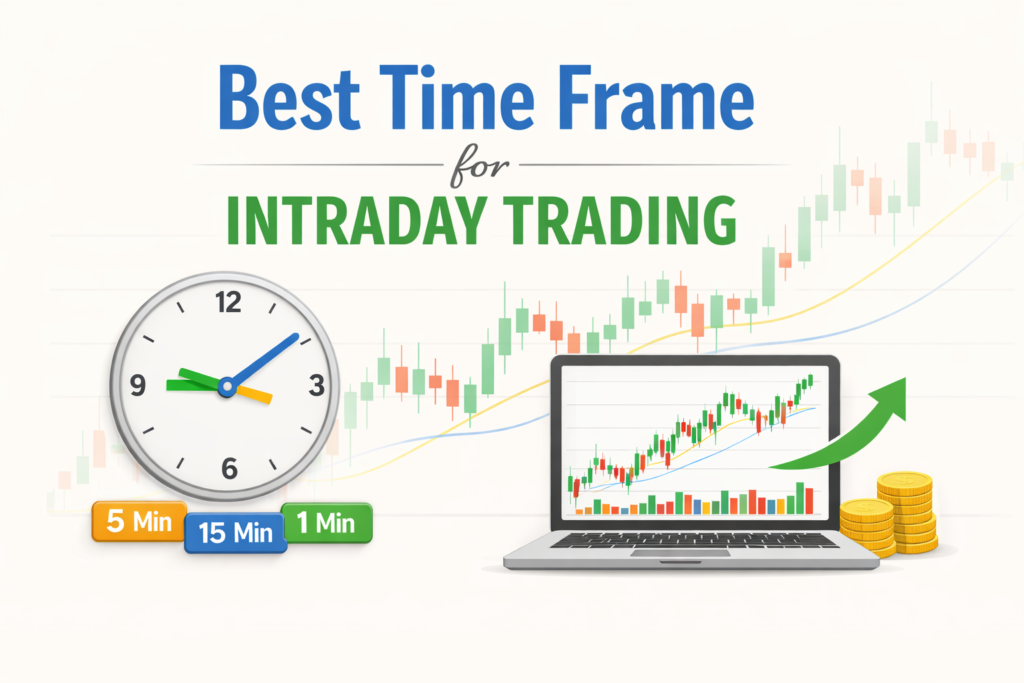
What is a Time Frame in Trading?
A time frame refers to the duration each candle or bar represents on a chart.
For example:
• 1-minute chart → each candle = 1 minute
• 5-minute chart → each candle = 5 minutes
• 15-minute chart → each candle = 15 minutes
Time frames help traders understand market structure at different levels.
Why time frame selection matters
Why Time Frame Selection Matters
Choosing the right time frame:
• Reduces noise and false signals
• Helps identify strong trends
• Improves entry and exit timing
• Matches your trading style and psychology
Beginners often make the mistake of jumping into lower time frames without understanding the bigger picture.
Best Time Frames for Intraday Trading
1. 5-Minute Time Frame (Best for Entries)
The 5-minute chart is one of the most popular among intraday traders.
Why it works:
• Provides clear price action
•Filters out unnecessary noise compared to 1-minute
• Offers enough trading opportunities
Best for:
• Entry and exit decisions
• Scalping and quick trades
2. 15-Minute Time Frame (Best for Confirmation)
The 15-minute chart is slightly slower but more reliable.
Why it works:
• Stronger trend confirmation
• Less false signals
• Better for beginners
Best for:
• Confirming trend direction
• Identifying support and resistance
3. 1-Minute Time Frame (Advanced Use Only)
This is a fast-paced chart used by experienced traders.
Why it’s risky:
• High market noise
• Frequent fake signals
• Requires quick decision-making
Best for:
• Scalping
• Very short-term trades
👉 Beginners should avoid relying only on this time frame.
4. Higher Time Frames (30-Min / 1-Hour)
These are not used for entry but for understanding the bigger trend.
Why they matter:
• Show overall market direction
• Help avoid trading against the trend
Best for:
• Trend analysis
• Planning trades
Best Time Frame Combination (Pro Tip)
Professional traders don’t rely on just one time frame. They use multi-time frame analysis.
Ideal Combination:
• 15-minute → Identify trend
• 5-minute → Find entry
• 1-minute (optional) → Fine-tune entry
This approach increases accuracy and reduces risk.
Best Trading Time During the Day
Time frame is important, but market timing is equally critical.
1. Market Open (9:15 AM – 10:30 AM)
• High volatility
• Best for experienced traders
• Quick moves and opportunities
2. Mid Session (11:00 AM – 1:30 PM)
• Slow movement
• Low volatility
• Avoid trading unless clear setup
3. Closing Session (2:00 PM – 3:30 PM)
• Good momentum returns
• Trend continuation trades work well
Common Mistakes to Avoid
1. Using Only 1-Minute Chart
Leads to overtrading and losses.
2. Ignoring Higher Time Frame
You may trade against the main trend.
3. Switching Time Frames Too Often
Creates confusion and inconsistency.
4. Overloading Indicators
Time frame matters more than too many indicators.
Best Time Frame Strategy for Beginners
If you’re just starting:
👉 Follow this simple setup:
• Use 15-minute for trend
• Use 5-minute for entry
• Trade only during high-volume hours
• Focus on 1–2 quality trades per day
This approach builds discipline and reduces emotional trading.
Final takeaway
There is no “perfect” time frame that works for everyone. The best time frame depends on your:
• Experience level
• Risk tolerance
• Trading style
However, for most beginners, the combination of 15-minute + 5-minute charts is the safest and most effective starting point.
Remember, intraday trading is not about taking more trades—it’s about taking better trades with clarity and discipline.
Pingback: Best price action trading strategy for beginners - jdtradingzone.com
Pingback: How to Choose Stocks for Intraday Trading in India - jdtradingzone.com
Hey guys, just giving a shoutout to 8777sx. Had a pretty good experience there. Things seemed fair and above board, which is always a plus. Give them a whirl! 8777sx
We’re a group of volunteers and starting a new scheme in our community. Your website provided us with valuable info to work on. You have done an impressive job and our whole community will be grateful to you.
Pingback: Simple Risk Management Rules for Traders - jdtradingzone